Where Do Rats Go When a Ship Sinks? (4 Photos)
When a ship goes down, rats are always the first to abandon deck. Or so the story goes. The rodents supposedly sense danger long before humans and swim to safety. 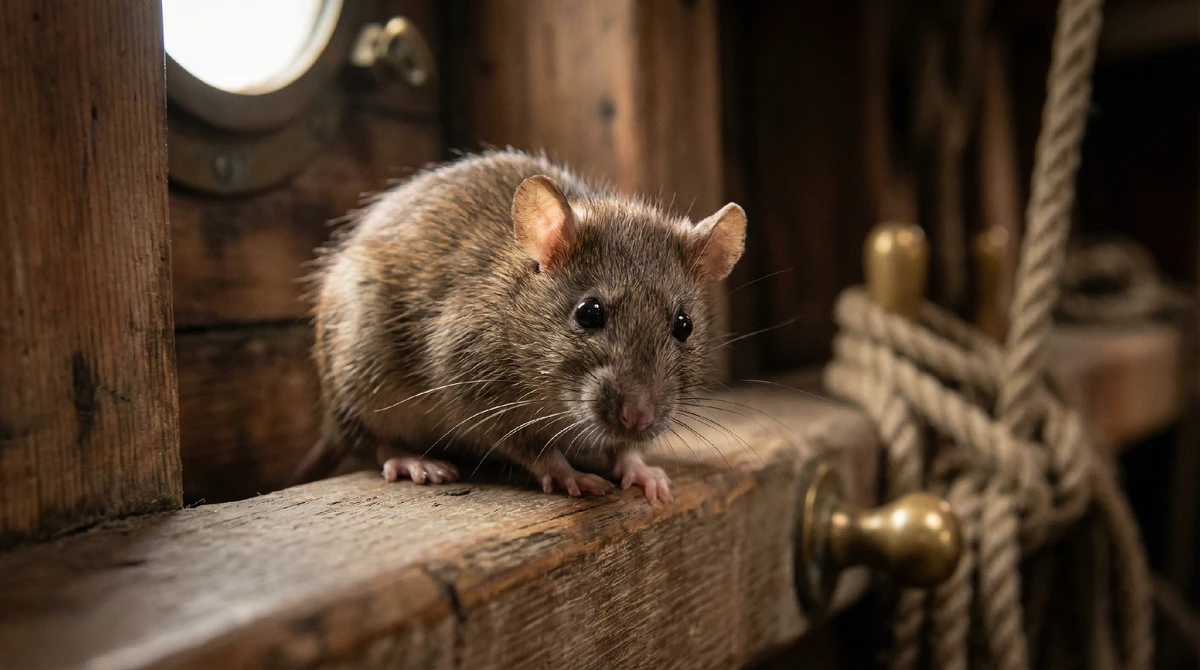
First, let's look at how rats manage to anticipate impending disaster in the first place.
Geometry, Not Clairvoyance
First and foremost, rats rely on their heightened sensitivity. Their senses of smell and hearing act as high-precision sensors.
A rat's instincts are finely tuned for survival. Their olfactory system boasts 1,500 receptor genes—four times as many as humans. These rodents can register an odor in just 100 milliseconds, faster than the blink of an eye.
Rodents can pick up ultrasound up to 76,000 hertz, whereas humans top out at around 20,000. They smell moisture and hear the trickle of seeping water long before the crew ever notices.
On a purely practical—and spatial—level, they are simply the first to know. 
Ship rats live in the hold, the lowest compartment of the vessel. When a ship springs a leak, the hold fills with water first. The rodents are already wading in rising water while the captain is still studying charts on the upper deck.
Rats aren't fortune tellers—they're just the first ones to get wet.
Their behavior before a disaster comes down to a simple reality: they are closer to the source of trouble. They don't predict catastrophes through some mystical sixth sense—they just find out about them before anyone else.
Where Exactly Do Rats Flee During a Shipwreck?
A logical question arises: where do rats escape to if a ship sinks in the open sea?
Nowhere—if the ship is truly sinking in open waters.
They can only save themselves if there is land within reasonable distance.
A striking example is the Mary Rose, an English warship that sank in 1545. 
When archaeologists raised the wreck in the 20th century, they found only three rat skeletons. A vessel that size should have harbored hundreds. Most of the rodents had swum to shore while the ship was slowly sinking.
When ships sank slowly near coastlines, the rodents made a break for it. Rats can swim continuously for up to three days and cover distances of up to 30 kilometers.
During a shipwreck, rats head for the nearest shore, nearby vessels, floating debris, or port settlements if the ship is tied to a dock.
Not Just Ships
In much the same way, rats can "predict" natural disasters—such as earthquakes.
Vibrational sensitivity is another key adaptation. Their paws detect seismic waves. Relatives of rats, such as blind mole-rats, use "seismic echolocation" by generating low-frequency waves at 250–300 hertz, and ordinary rats are not far behind.
Rodents sense a threat, but only once it has already begun. Before an earthquake, they pick up primary (P) waves—faint initial tremors—well before humans notice the destructive secondary (S) waves.
Before a storm, a barometric sensor in their inner ear registers the drop in atmospheric pressure. 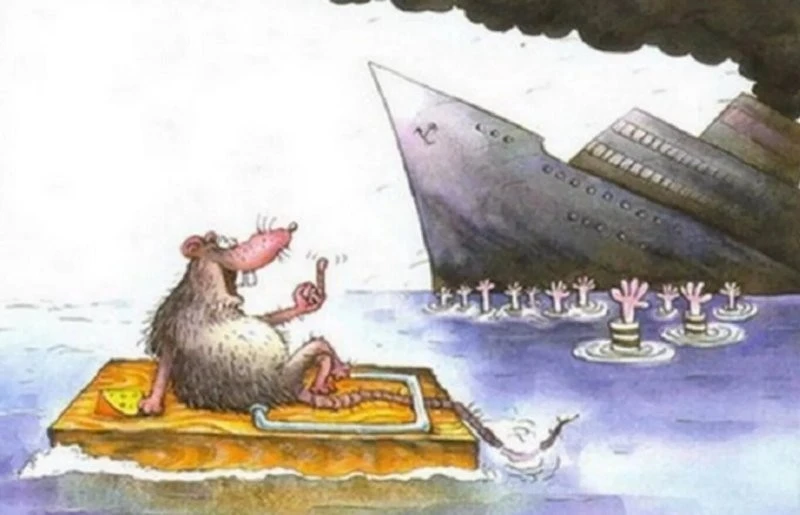
Rat migrations can serve as an indicator of environmental or man-made hazards—not due to anything supernatural, but simply because they react to danger and seek safety.
When a sudden influx of rats moves toward a specific part of a city, it signals a problem: improper waste storage, damaged sewage lines, or structural defects in buildings. Rats simply go wherever food, water, and shelter are available.