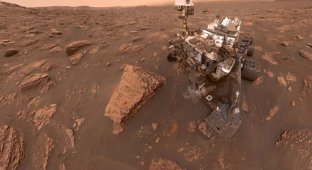
What Are Mars’ Layered Rocks Hiding? (2 Photos)
In the images transmitted daily by NASA's active rover duo, it is hard not to notice the bizarre layered boulders and rock formations. Far from being random products of erosion, these are sedimentary rocks—a geological archive built over millions of years. 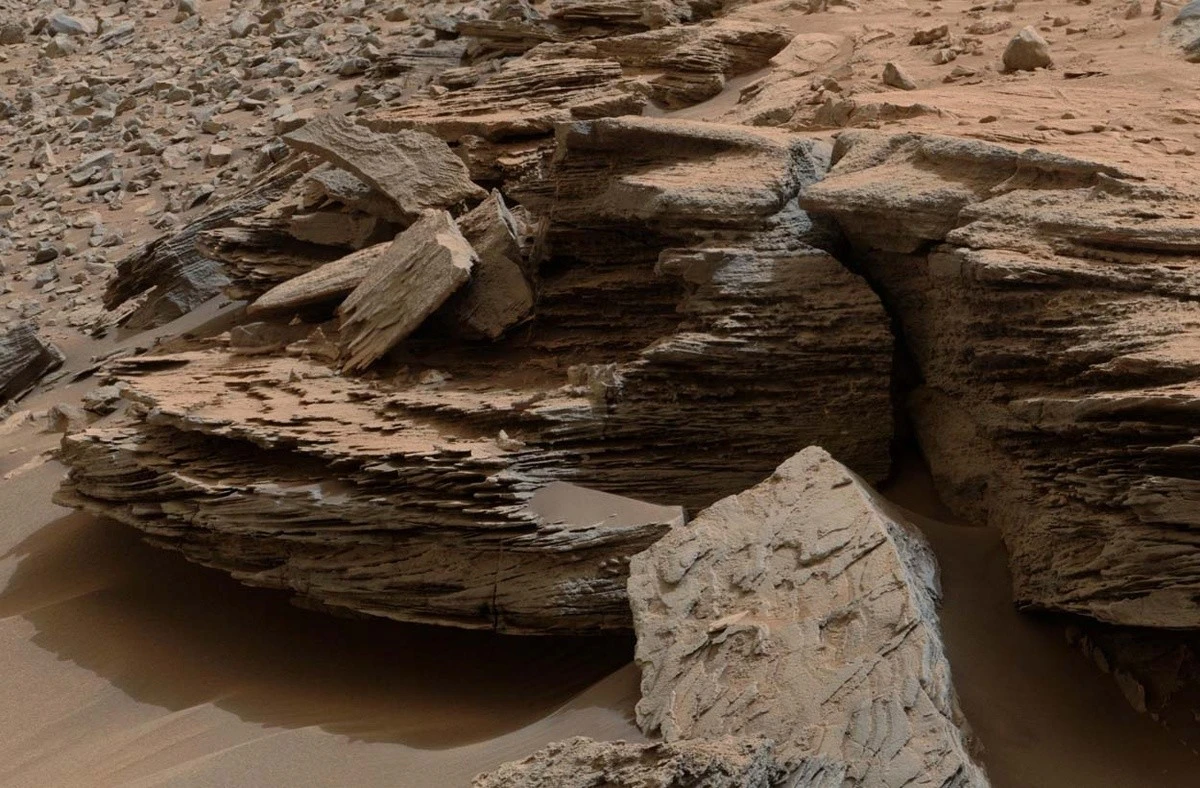
An image taken by NASA's Curiosity rover on November 2, 2014, shows layered rock formations at the base of Mount Sharp.
Modern science traces the origins of these rocks to ancient Martian bodies of water. Current data indicates that billions of years ago, the Red Planet was a vastly different place: rushing rivers coursed across its surface, and deep lakes filled low-lying depressions, such as Gale and Jezero craters, currently being explored by the Curiosity and Perseverance rovers, respectively.
The key to this story lies in cyclical patterns. These bodies of water were not permanent throughout their existence; they filled periodically, carrying suspended rock particles, before evaporating due to climate shifts and leaving behind a thin layer of sediment. Each subsequent flooding event brought a fresh batch of material, depositing a new layer on top of the last.
Repeating over millions of years, this process created the distinctive banded structure visible in images today. Every layer is a page in an ancient Martian chronicle, capturing a specific chapter in the planet's climate history. If we could analyze this material in a laboratory setting, we could reconstruct with incredible precision the timeline of water level fluctuations and chemical changes in the rock—and gain deeper insight into whether conditions were ever suitable for the origin of simple life forms.
Yet one thing is certain today: at some point, Mars suffered a global climatic catastrophe. Stripped by solar winds, the planet rapidly lost its dense atmosphere, rendering the surface inhospitable to liquid water. The lion's share escaped into space, a portion froze into polar ice caps, and the rest seeped underground, locked away as permafrost. 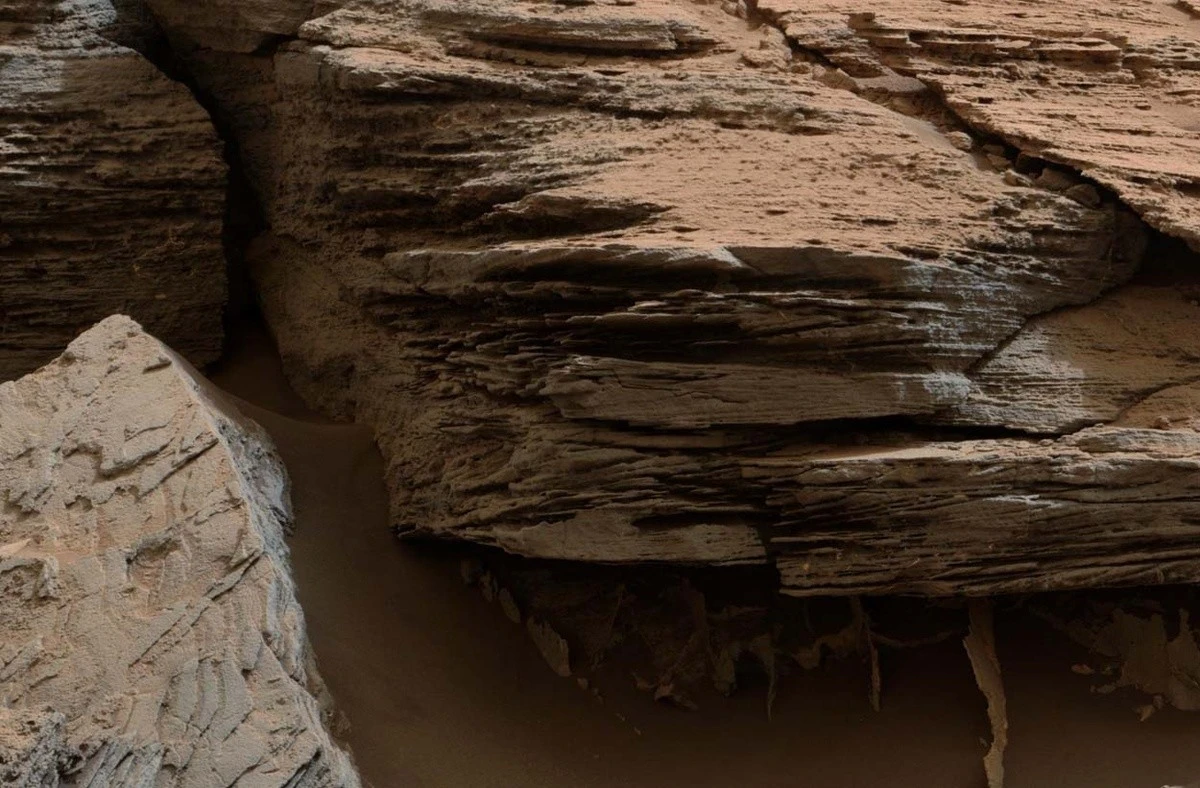
An image taken by NASA's Curiosity rover on November 2, 2014, shows layered rock formations at the base of Mount Sharp.
Two factors were to blame: the planet's low mass (Mars is roughly 89% lighter than Earth) and the absence of a global magnetic field. Early in its history, Mars likely possessed a magnetosphere, but as its core cooled rapidly, this protective shield failed.
An alternative scenario suggests the Red Planet never had a global magnetic field to begin with. In that case, its early dense atmosphere was merely a primordial envelope left over from the planet's formation. Eventually, solar winds swept it away, triggering a radical climate shift.
Returning to the layered rocks: they rest pristine in the frozen Martian desert, virtually untouched by erosion thanks to the planet's ultra-thin atmosphere. On Earth, similar formations would have long since been destroyed by tectonic activity and weathering. They represent an invaluable archive of information—yet humanity lacks the funding to fully study them.
Yet there is hope. China is emerging as a global leader in space exploration, treating fundamental science not as a commercial pie to be torn apart by private corporations, but as a strategic priority. Thanks to a systematic, state-backed approach and rigorous planning, there is every reason to believe that the first Martian soil samples will be successfully brought back to Earth within the decade.