Most people know that dogs can cry, but it was long assumed to be driven solely by negative emotions. Now, researchers at Azabu University have discovered that dogs can also shed tears when they are happy. Our four-legged friends can well up with joy after a long separation from their owner—or even just upon seeing someone who has been kind to them. 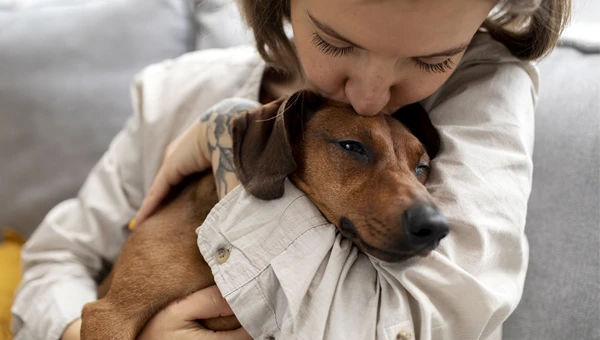
The findings, published in the journal Current Biology, were conducted by a team of Japanese zoologists. The researchers used the Schirmer test to measure tear fluid volume in dogs' eyes by placing specialized paper strips under their eyelids. While originally developed to diagnose dry eye syndrome, the test proved unexpectedly useful in a whole new context. 
The researchers established a baseline for tear production during routine daily interactions between dogs and their owners. They then compared this baseline to tear levels measured 5 to 7 hours after separation. The results showed a significant surge in tear production during the first few minutes of being reunited with their human.
The idea for this unusual experiment came to biologist Takefumi Kikusui after he noticed his poodle tearing up while nursing her puppies. This led the scientist to hypothesize that oxytocin, often called the "love hormone," might be driving tear production.
“We had never heard of animals shedding tears in positive situations, such as reuniting with their owners or interacting with their offspring.” 
Interestingly, tear volume was noticeably higher when dogs were reunited with their primary owner compared to other family members. The biologists also discovered that a dog's tears have a powerful effect on humans. When owners were shown photos of their pets, those featuring teary eyes elicited a much stronger emotional response. Researchers suspect this is no coincidence—tears may help dogs foster deeper emotional bonds with their owners.
Dogs are companions that require a thoughtful approach. Here are 10 tips to help you better understand and connect with your pet.
Add your comment
You might be interested in:












We just discovered that fur seals are actually... sea

Dogs That Just Can't Even… (35 Photos)

The Happiness of Old Dogs Adopted from the Street (22

Looking straight into your soul: mustachioed beggars you

Children and dogs are best friends (26 photos)

A simply huge Caucasian puppy arrived at the shelter (4

The kitten was so hungry that he ate dirt (12 photos)

A LEGO Camera Test (2 Photos + 2 Videos)

25 Photos That Will Give Visual Learners an Aesthetic

How to start a 102-liter engine

Protective film Removing it with a power screwdriver

When a child plays hide-and-seek at a professional level

Man sets up bedroom camera and discovers the reason for his

Super dads who swoop in to save the day

Precision carpentry

Looks like it's time to buy WinRAR

How to hang wallpaper neatly

How metal buckets are made in Pakistan
