Outlandish Anti-Tank Defense Tactics: Traps, Axes, Crowbars, and Blankets (10 Photos)
During World War I, none of the warring nations had enough time to truly grasp what tanks were capable of or how to use them effectively. Over the next two decades, military theorists developed numerous concepts and tactics, yet doubts about the tank's role on the battlefield persisted. It was Germany that settled the debate in 1939 in Poland and in 1940 in France, demonstrating the devastating power of the Blitzkrieg’s armored spearhead.
The rise of the tank naturally sparked intense interest in anti-tank weaponry—from traditional guns, rifles, and grenades to far more unconventional devices. 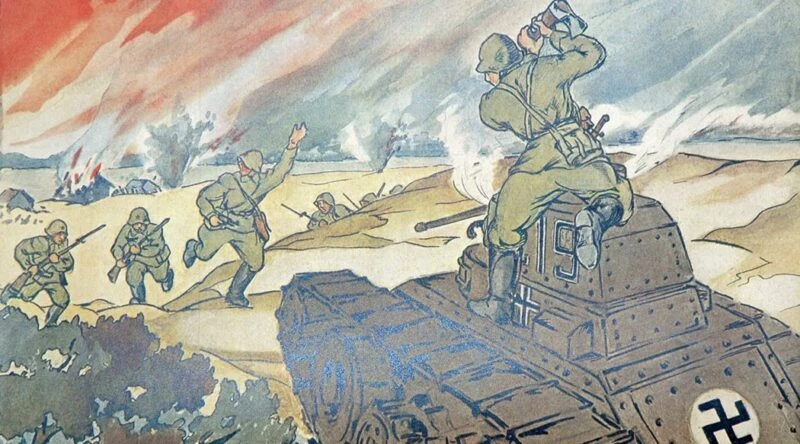
Trapping the Steel Beast
Soviet military inventor Bogdanenko proposed "catching" tanks using massive traps strikingly similar to standard hunting traps. His idea was to lay these devices out in a staggered grid along expected enemy tank routes. When a tread ran over the trap, it would snap shut. As the tank kept moving, Bogdanenko believed the mechanism would jam, throw, or snap the track. 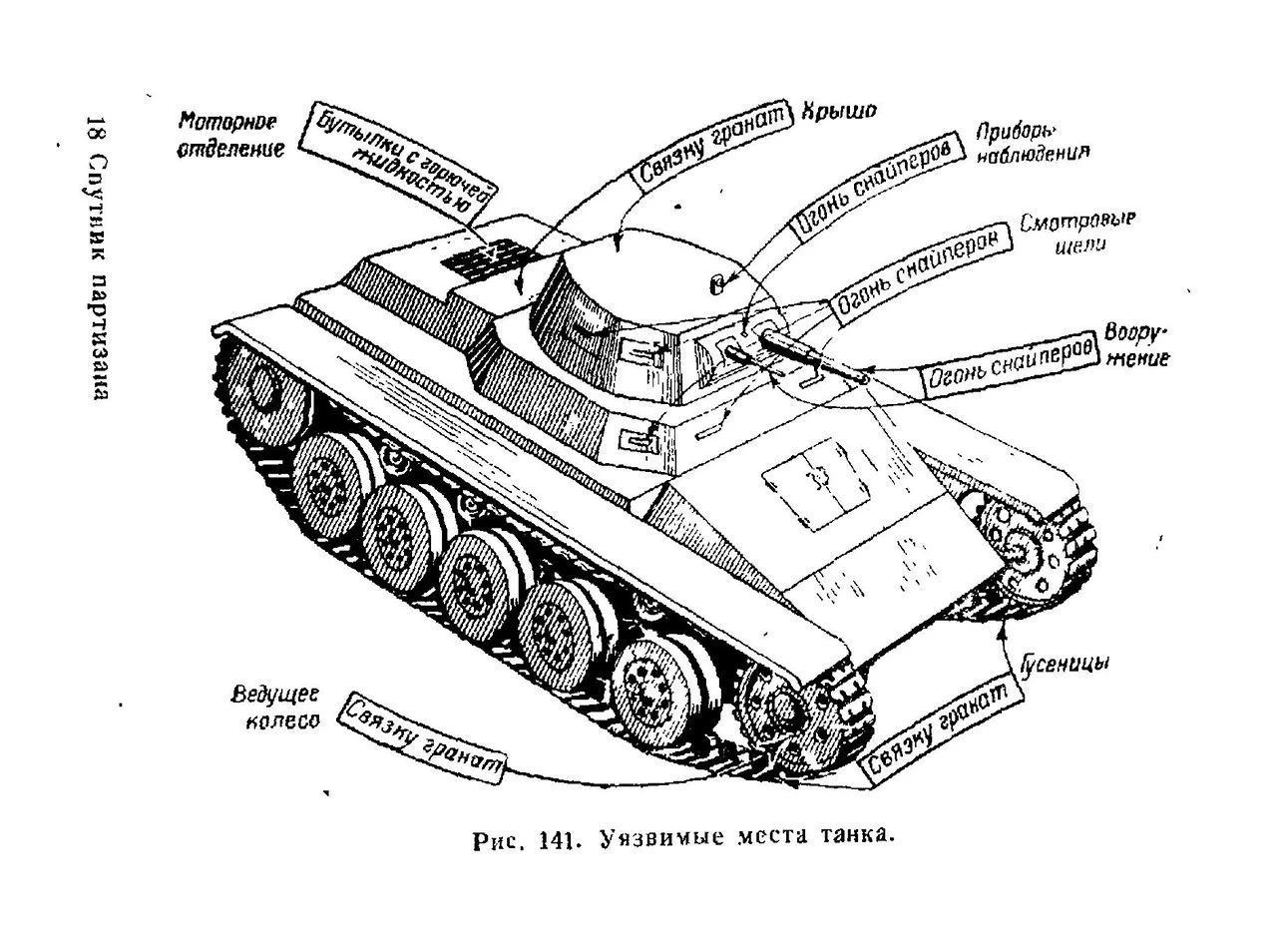
The Soviet handbook "Partisan’s Companion," 1942.
Military commanders thought the concept was worth exploring. In early 1941, the Red Army's Main Armored Directorate (GABTU) fabricated two prototype anti-tank traps—one single-hinged and one double-hinged—based on Bogdanenko’s blueprints at their proving grounds. The imposing look of the finished prototypes likely raised eyebrows among testers, who decided to play it safe and start trials on light tanks: the T-40, T-26, and BT-7. 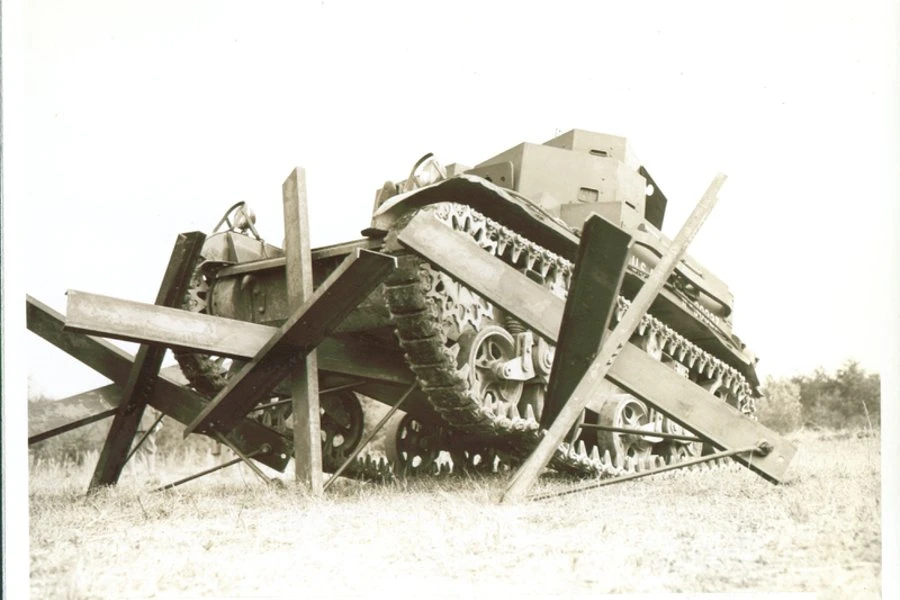
An American tank testing a Czech hedgehog, 1940.
The single-hinged trap turned out to be so small that testers had to place it directly in front of the tread just to hit it. The first victim was the lightest of the trio: the 5.5-ton T-40. The trap snapped onto the track and traveled up to the first road wheel, which casually flattened its arms. The remaining road wheels rolled over it without issue. The rear armor plate delivered the final blow—the trap, still clinging to the track, clipped the hull and shattered into pieces.
Its double-hinged counterpart proved equally useless, inflicting zero damage on the tank's running gear. 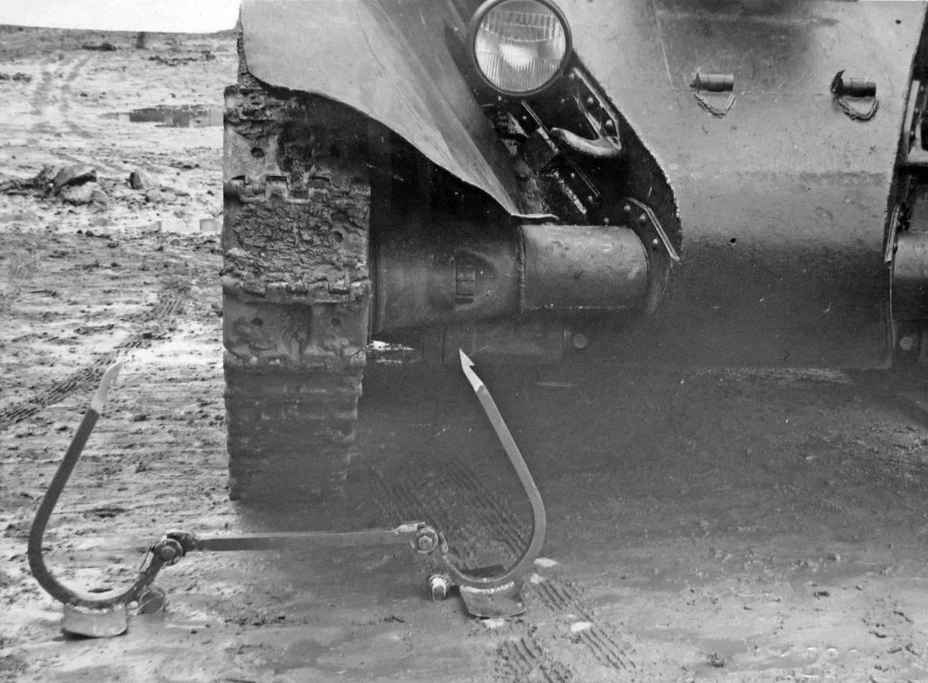
A BT-7 tank approaches the double-hinged anti-tank trap.
Next onto the cobblestone test road was the eight-ton T-26. It simply knocked the single-hinged trap over before it could trigger. Following the run, testers dutifully logged the usual result: "Caused no damage to the tank's running gear." The 13-ton BT-7 yielded the exact same outcome.
The wider double-hinged trap was deliberately positioned to resist tipping over. Even so, the tank’s lower glacis plate tilted the trap before it could snap shut. After two more failed attempts, the testers manually clamped the trap onto the bottom section of the tread. Yet this desperate move produced the same result: the road wheels rolled over the trap, bending its closed arms flat. Still, zero damage.
Considering that each trap devoured 33 to 35 pounds of high-grade steel and hiding a massive piece of iron was vastly harder than concealing a standard flat mine, the fate of this dubious invention was sealed.
Logs, Rails, and Blankets
While the USSR at least attempted to mechanize the track-jamming process, other countries tasked infantrymen with becoming human traps armed with "anti-tank crowbars." Finnish veteran Toivo Ahtimo, who fought in the Winter War, later recalled: "The anti-tank tactics we learned in peacetime proved virtually useless. The manuals claimed you could stop a tank simply by jamming a crowbar or a log into its suspension!" 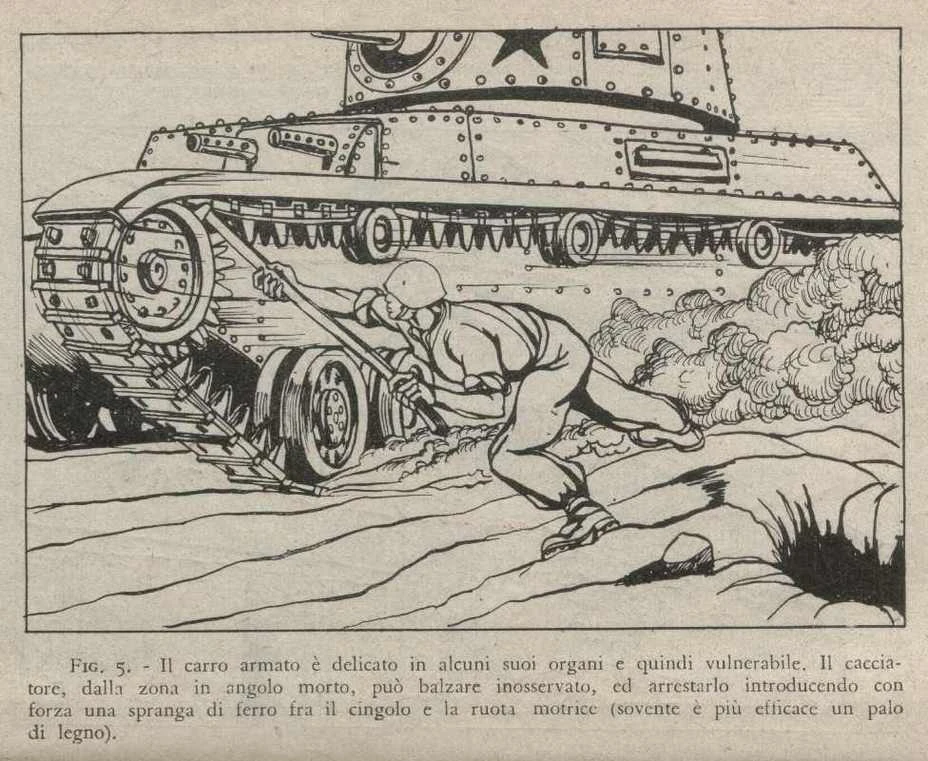
Improvised anti-tank weapons: the Italian approach.
Ahtimo witnessed these theoretical tactics put to the test firsthand. A soldier named Loimu attempted to stop an advancing Soviet tank with a crowbar. With a horrific screech, the iron bar wrapped around the track and slipped out completely unscathed. Undeterred, Loimu grabbed a thick log and shoved it into the treads. The result? "The log instantly splintered into enough toothpicks to feed a whole company, and the tank kept rolling until someone knocked it out with a satchel charge."
Finland wasn't alone—Italian field manuals prescribed similar methods. But it was the pioneers of tank warfare themselves—the British—who produced the most detailed and methodical guidelines on the subject. 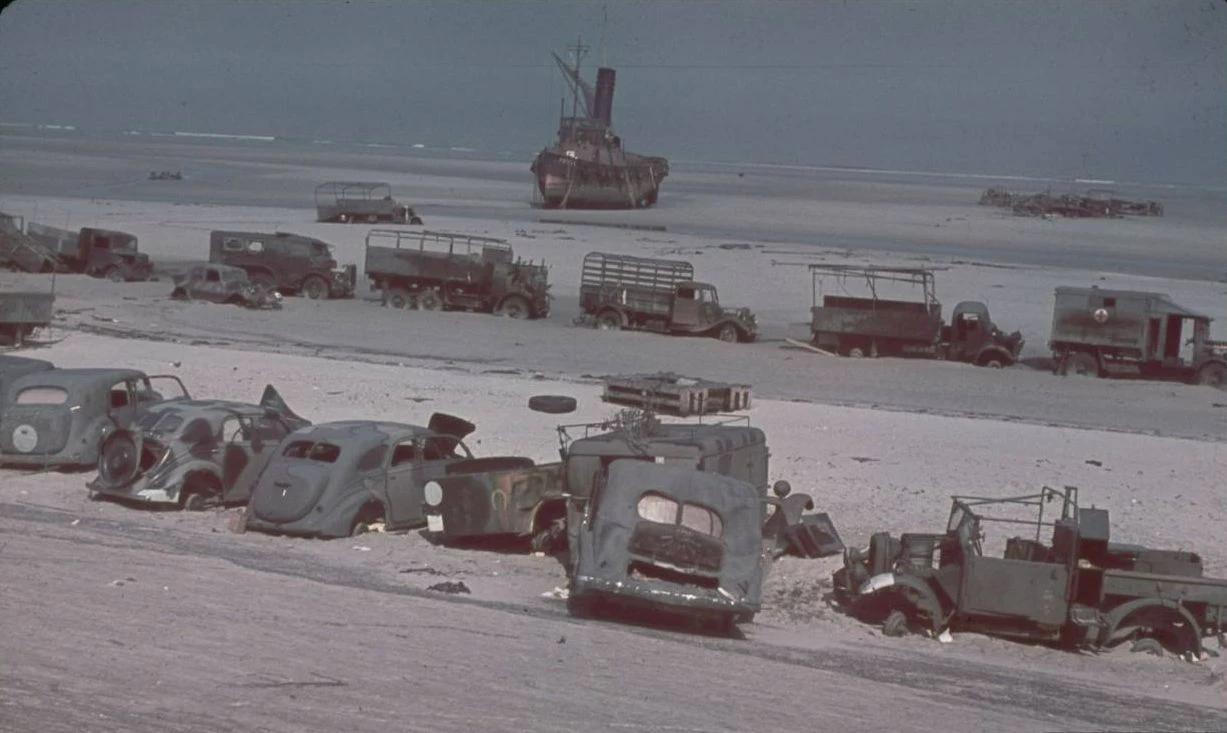
Allied military vehicles abandoned on the beaches of Dunkirk.
In 1940, the British Army was forced into a chaotic evacuation at Dunkirk, leaving vast amounts of heavy equipment behind. On the fields and coastal dunes of France, Britain lost 840 anti-tank guns. Only 147 remained on the Home Front, with ammunition so scarce that live-fire training was strictly forbidden. Meanwhile, the Battle of Britain raged in the skies, and a German amphibious invasion carrying the very armor that had just shattered Allied forces seemed imminent. While regular troops received whatever weapons could be scraped together, the Home Guard was left with almost nothing.
It was against this desperate backdrop in August 1940 that the War Office issued Training Manual No. 42:
The Tank: How to Hunt and Destroy It
. Among other unconventional advice, it detailed how to form specialized tank-hunting squads. 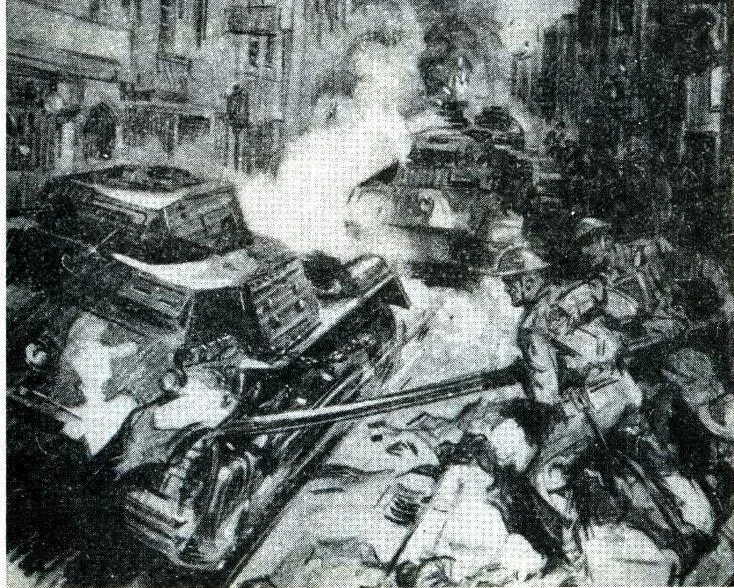
How British Home Guard volunteers were expected to tackle enemy armor.
The manual prescribed four-man teams equipped with a steel rail (leaving where to find one entirely to the imagination), a blanket, a bucket of gasoline, and a box of matches. The team was to lay an ambush along a street where tanks were expected to pass. As enemy armor rolled by, two men were to charge forward carrying the rail—one end wrapped in the blanket—and ram it into the suspension to jam the drive sprocket and track. The third man would douse the blanket in gasoline, leaving the fourth to drop a lit match onto it.
If a steel rail wasn't readily available, the manual offered an alternative plan: "A soldier takes up position on the second floor of a building holding a hammer in one hand and a grenade in the other. When an enemy tank passes below, he jumps onto the roof and begins pounding furiously on the turret hatch. When the tank commander pops his head out to see who is knocking, the soldier strikes him on the head with the hammer, drops the grenade into the open hatch, and slams it shut."
One can only be thankful that the gentlemen of the British Home Guard never had to test these suicidal directives in battle. In 1940, Britain's most reliable anti-tank defense proved to be the sheer courage of its pilots and sailors.
Taking an Ax to a Tank
"A Soviet soldier took on a German tank armed with nothing but an ax—and won." To most, this sounds like pure tall-tale propaganda. Yet this extraordinary incident actually happened, and it is fully documented in official military records. 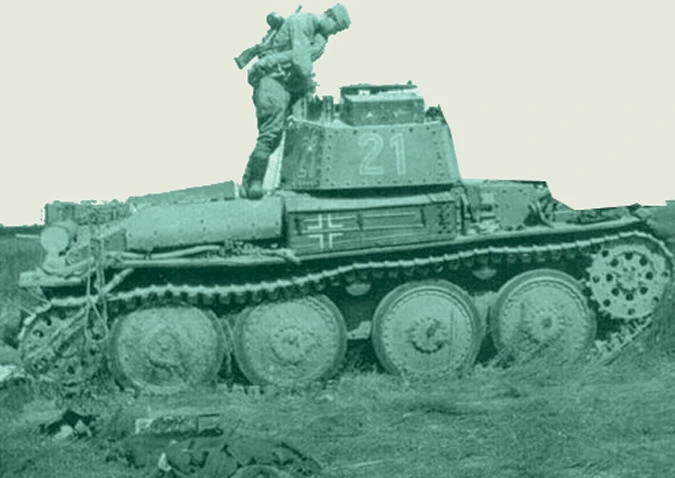
On June 30, 1941, Corporal Ivan Pavlovich Sereda, armed with only an ax, subdued a German tank and forced its crew to surrender.
Ivan Sereda served as a cook for the Red Army's 91st Tank Regiment. One day in August 1941, Sereda was preparing lunch at his field kitchen when he spotted a German tank rolling to a stop nearby.
Armed with his rifle and an ax, Sereda hid and waited for the crew to step out. Spotting a Soviet soldier charging at them with an ax, the German crew ducked back inside and locked the hatches. As the machine gun started opening fire, Sereda leapt onto the hull and used his ax to bend the machine gun barrel out of shape. He then covered the vision slits with a tarpaulin and began pounding violently on the armor, shouting orders to imaginary comrades to pass him grenades. Terrified into believing they were surrounded by an entire Red Army unit, all four crew members surrendered.
Word of Sereda's exploit quickly reached top commanders. The story was picked up by military newspapers and repeated so heavily in wartime propaganda that "Cook Sereda" took on a legendary status, reminiscent of Russian folklore heroes. 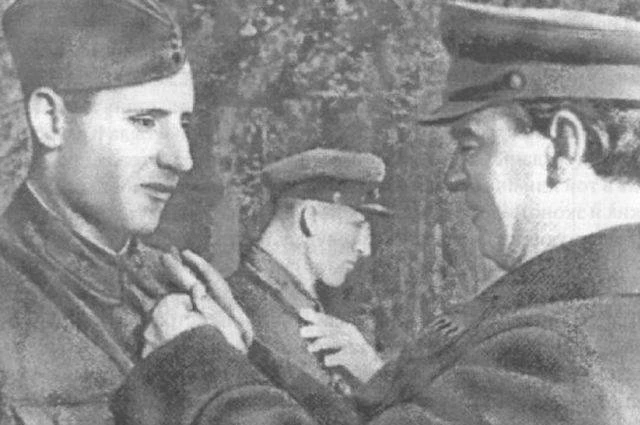
Ivan Sereda fought throughout the war and racked up several more heroic feats. During a later battle, he destroyed a German tank with a bundle of grenades, then took over a machine gun after its gunner was killed, taking down ten enemy soldiers.
By decree of the Presidium of the Supreme Soviet of the USSR on August 31, 1941, Red Army soldier Ivan Pavlovich Sereda was awarded the title Hero of the Soviet Union, along with the Order of Lenin and the Gold Star medal, for courage and heroism in combat. 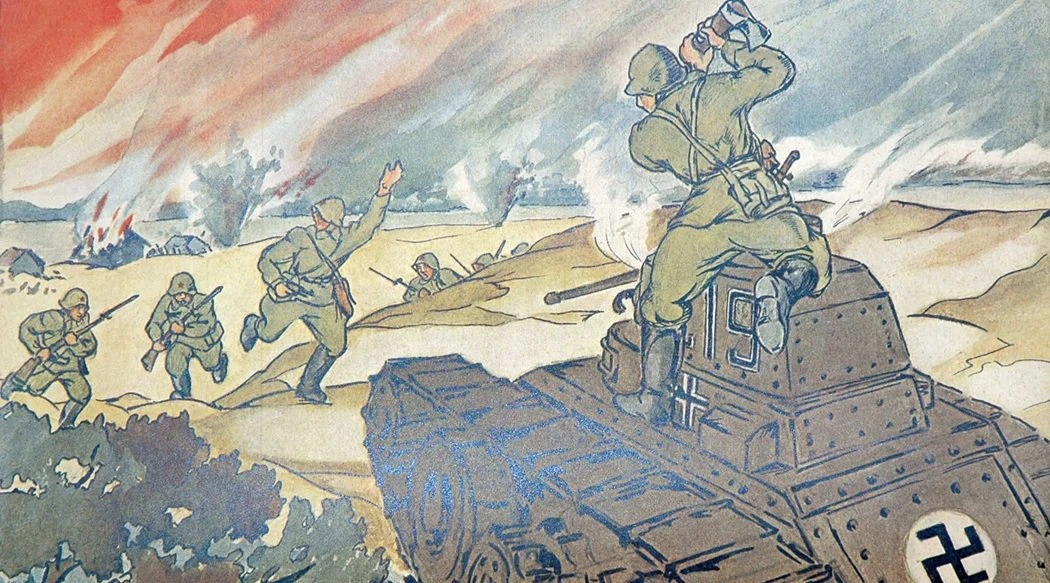
Ivan Sereda’s heroic deed was widely publicized during the war and featured prominently on Soviet propaganda posters.