How Deep Can You Dig a Well by Hand? The Answer: 392 Meters (8 Photos)
In 1858, the guardians of the Brighton parish decided to stop paying the local water company. They figured it would be far cheaper to dig their own well using cheap labor from the local workhouse. 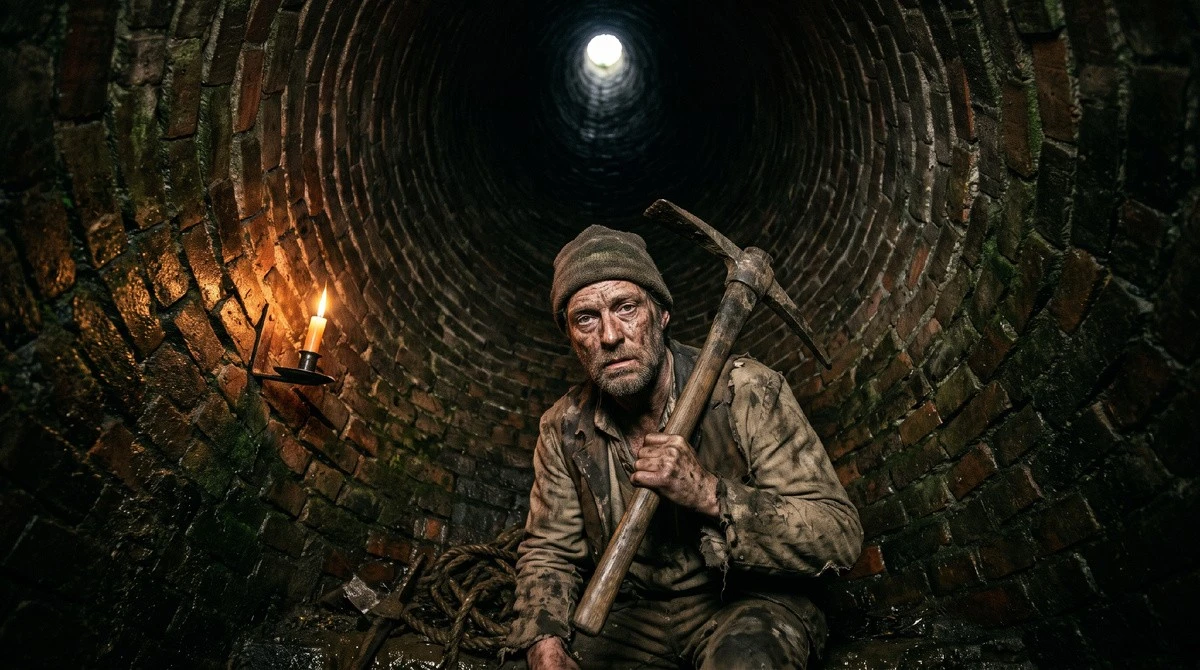
They expected to hit water at 120 meters, but didn't reach it until 392 meters down. What was supposed to be a cost-saving measure turned into four years of round-the-clock digging and a world record that Guinness still recognizes to this day.
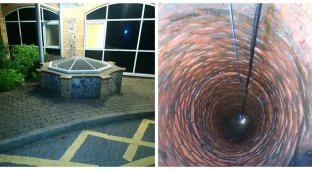
Outside the Nuffield Health Brighton Hospital stands a low stone wellhead topped with a protective cap and a modest plaque. At first glance, it looks like any ordinary historical marker.
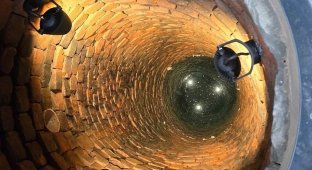
Beneath it lies a shaft 391.6 meters deep.
If you were to drop the Empire State Building in upside down (minus its antenna), the roof would still fall about 11 meters short of the bottom. 
Two-thirds of the shaft sits below sea level. And the entire depth was excavated by hand: a solitary worker down in the dark, chipping away at the rock face with a pickaxe by candlelight.
Why on earth did Victorian England spend four years digging almost half a kilometer straight down into the earth?
Why They Needed Such a Deep Well
In the 1850s, Brighton was constructing two new facilities for the poor: a new workhouse near Race Hill and an industrial school for impoverished children at Warren Farm, about three kilometers away. Both needed water, so the Poor Law Guardians—the board managing local taxpayer money—asked the private water company for a quote. 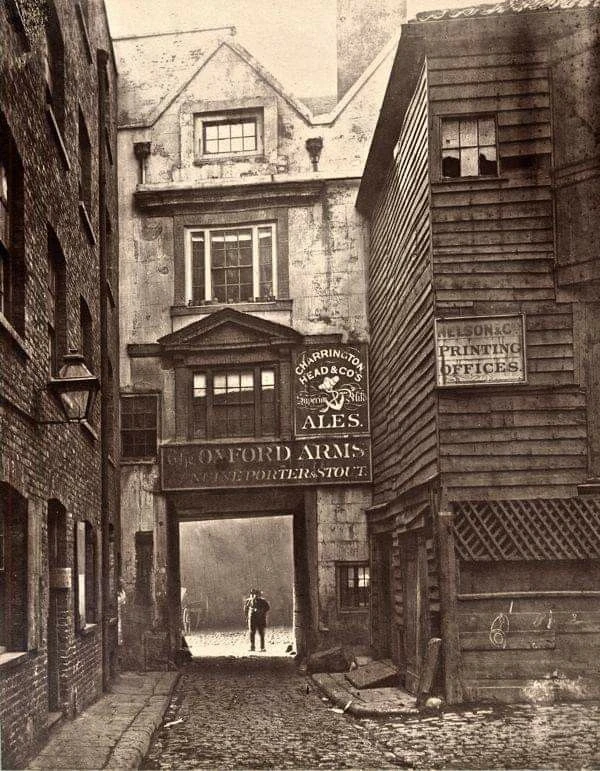
They didn't like the price. Instead, they decided to sink their own well at Warren Farm to serve both institutions. The grueling manual labor fell to inmates from the existing workhouse, who were required to work on the site as a condition of receiving relief. Professionals were involved too—contractor Mr. North managed the initial phase, and later Isaac Huggett took over the excavation with a crew of navvies, bricklayers, and winch operators. But what made the budget so appealing was the practically free labor.
Free labor, however, didn't make the project cheap. It simply allowed the guardians to ignore just how badly off-track things were getting for much longer.
A Fatal Miscalculation in the Geology 
The original plan seemed straightforward: a 1.8-meter-wide shaft lined with brickwork, reaching water at roughly sea level, around 120 meters down.
Two years later, they hit the 120-meter mark. Completely dry.
Assuming they had missed the aquifer horizontally, they dug a lateral adit. Nothing. They drove a second tunnel in the opposite direction—with the same result. So, at the end of one of the tunnels, they started a new, narrower vertical shaft—just 1.2 meters wide—and kept digging down. 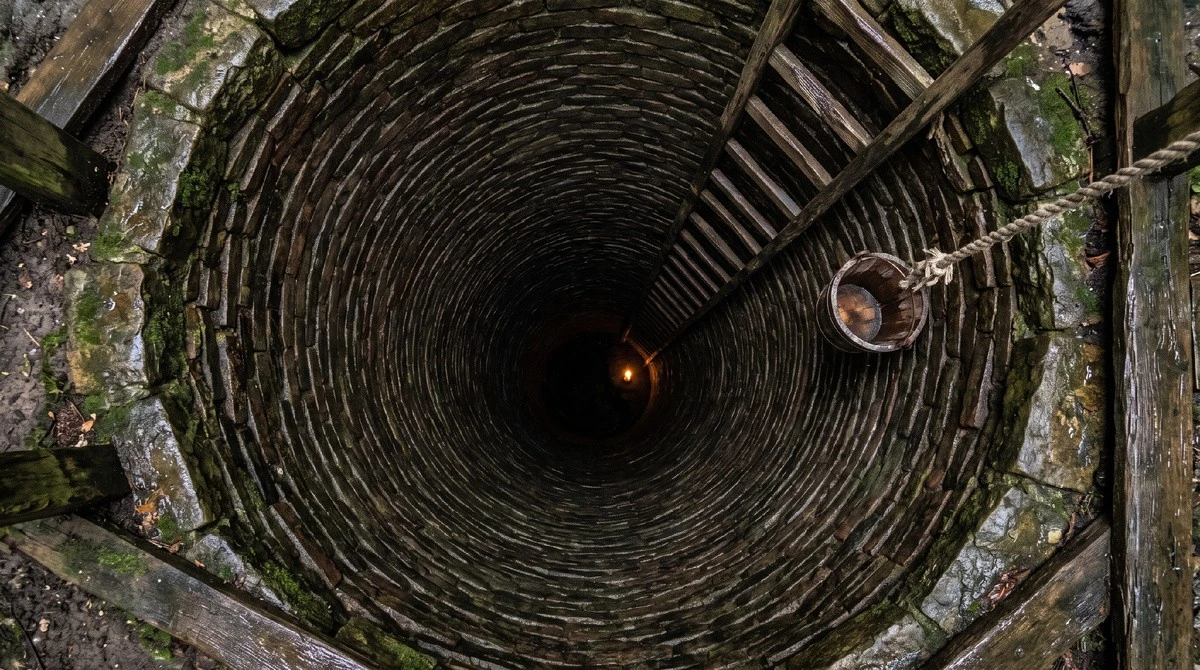
It wasn't the diggers' fault; the geological maps themselves were dead wrong. For the first hundred meters, the shaft passed through chalk and flint—just as predicted. But then came vast strata no one had anticipated: thick layers of grey and blue marl, followed by nearly a hundred meters of extremely dense Gault clay.
The subterranean strata beneath the hill were far thicker and dipped much more steeply than expected, placing the water-bearing greensand deep underground.
By 1861, with the shaft passing 300 meters, surveyor George Maynard frankly admitted in his report that he was neither a professor of geology nor a hydraulic engineer. He traveled to London to consult Sir Roderick Murchison, one of the premier geologists of the Victorian era.
The verdict: there is water in the lower greensand—keep digging.
Every dry meter excavated conveyed two messages at once: "we were wrong," and "now we know better—water is just a bit further down." That's the trap of runaway projects: there is always a compelling reason to push on just a little longer.
A Vertical Factory
Work at the face continued around the clock with a crew of about 45 men. At the bottom, inside the cramped 1.2-meter shaft, two men hacked at the rock with pickaxes and loaded spoil into buckets. A bucket couldn't be hauled straight to the surface in one go; it was relayed up through a chain of seven winch platforms carved into the shaft walls. On the way down came bricks to line the walls as the hole deepened. 
Fresh air was pumped down by a steam-driven blower through pipes, while candles provided illumination. Sweltering heat at the bottom forced the men to work completely naked at times. Climbing out via the staging ladders took about 45 minutes—a vertical ascent equivalent to over a hundred stories.
Meanwhile, the local Brighton Herald newspaper branded the well a monster that swallowed a hundred pounds of taxpayer money every week while yielding nothing in return.
The Night of March 16
On March 16, 1862, at a depth of 1,285 feet, the bottom of the pit suddenly began to buckle. A thin floor of rock gave way as water forced its way up from beneath. A deafening roar echoed up the shaft. 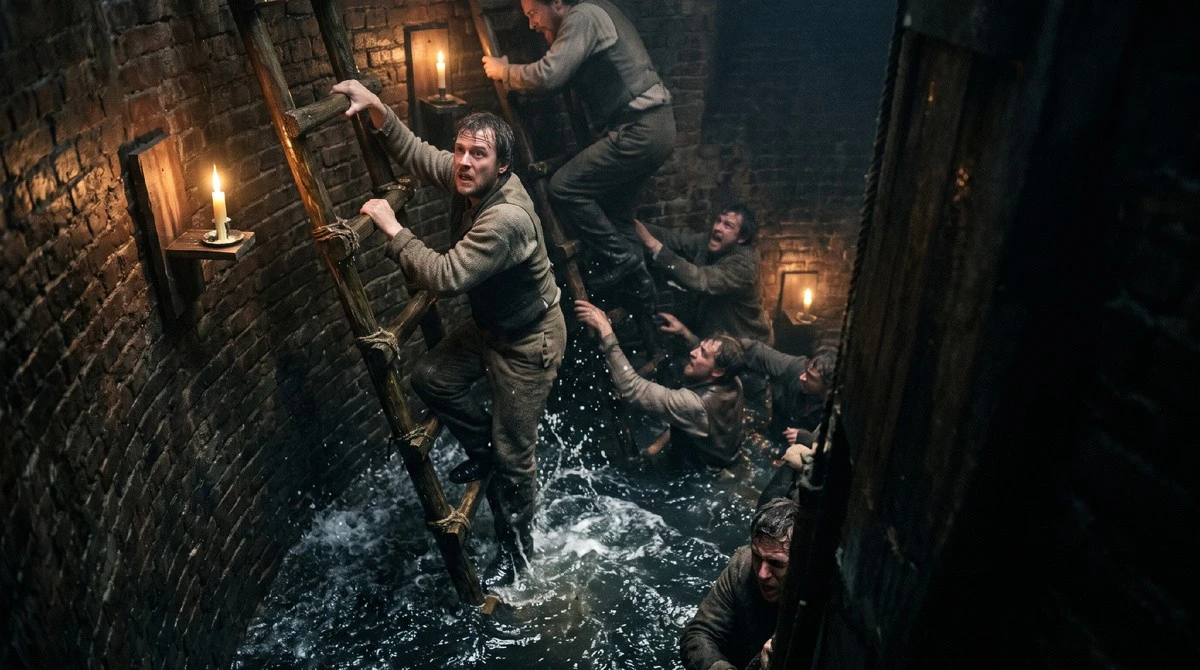
Illustration
The men on the lower levels scrambled for their lives as rising water threatened to drown them.
Everyone made it out safely. Within the first hour and a half, water surged up nearly 120 meters of the shaft, and within a few days, over 900,000 liters poured in.
How a Fiasco Became a Triumph
The next day, church bells chimed across Brighton as crowds gathered to watch the first bucket of water hauled up. Overnight, a city that had spent years mocking the money pit hailed it as a monumental engineering feat. 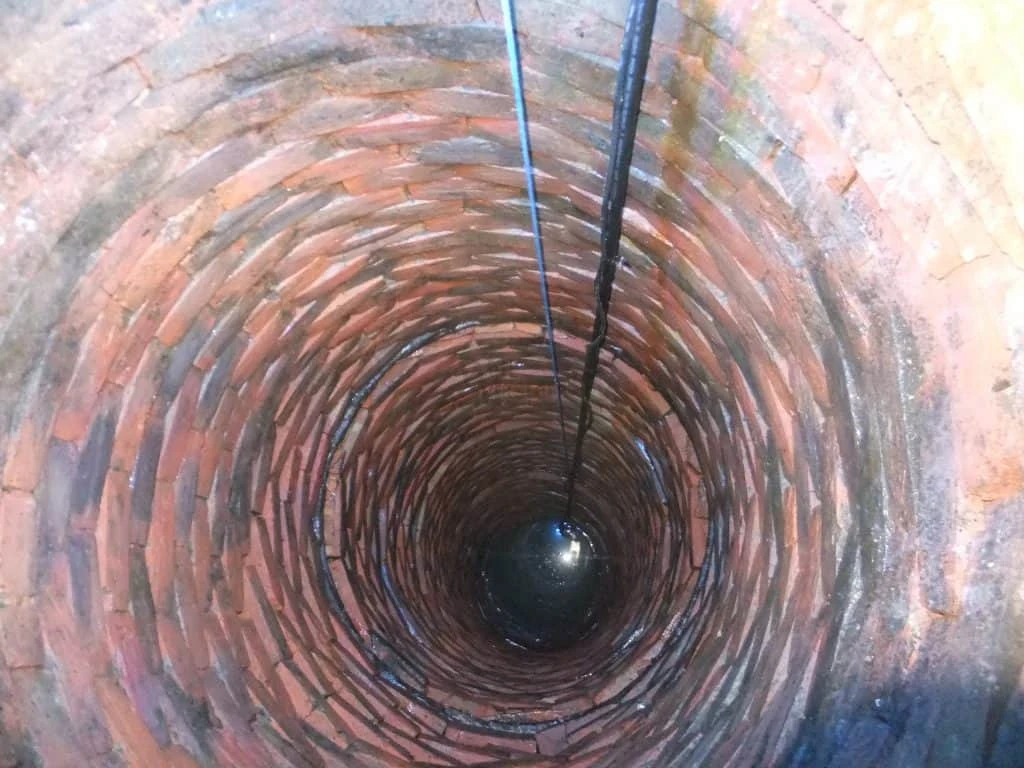
What followed was a celebratory banquet, silver medals for the crew, and a gold medal for Huggett. The first water drawn was sealed in souvenir vials, and the last scoops of greensand from the bottom were preserved like holy relics—some of these vials are still housed in Brighton Museum today.
On August 14, 1862, a parade of 77 boys and 65 girls marched into the Warren Farm school, which had been waiting to open until a water supply was secured.
The well supplied water until 1878—about sixteen years in total. The outcome was inevitable: modern mains water eventually rendered the hand-dug shaft obsolete.
But the record endures. Guinness World Records still lists the Woodingdean well as the deepest hand-dug well in the world. And it's unlikely ever to be beaten: modern drilling rigs can reach that depth in a fraction of the time with no human risking their life at the bottom, making a repeat performance totally pointless.