The most expensive metal on Earth (3 photos)
Upon reading the headline, many might think of gold, platinum, or palladium. However, the most expensive metal on Earth is not the kind used for rings and earrings, but a radioactive element costing around $27 million per gram. That metal is called californium. 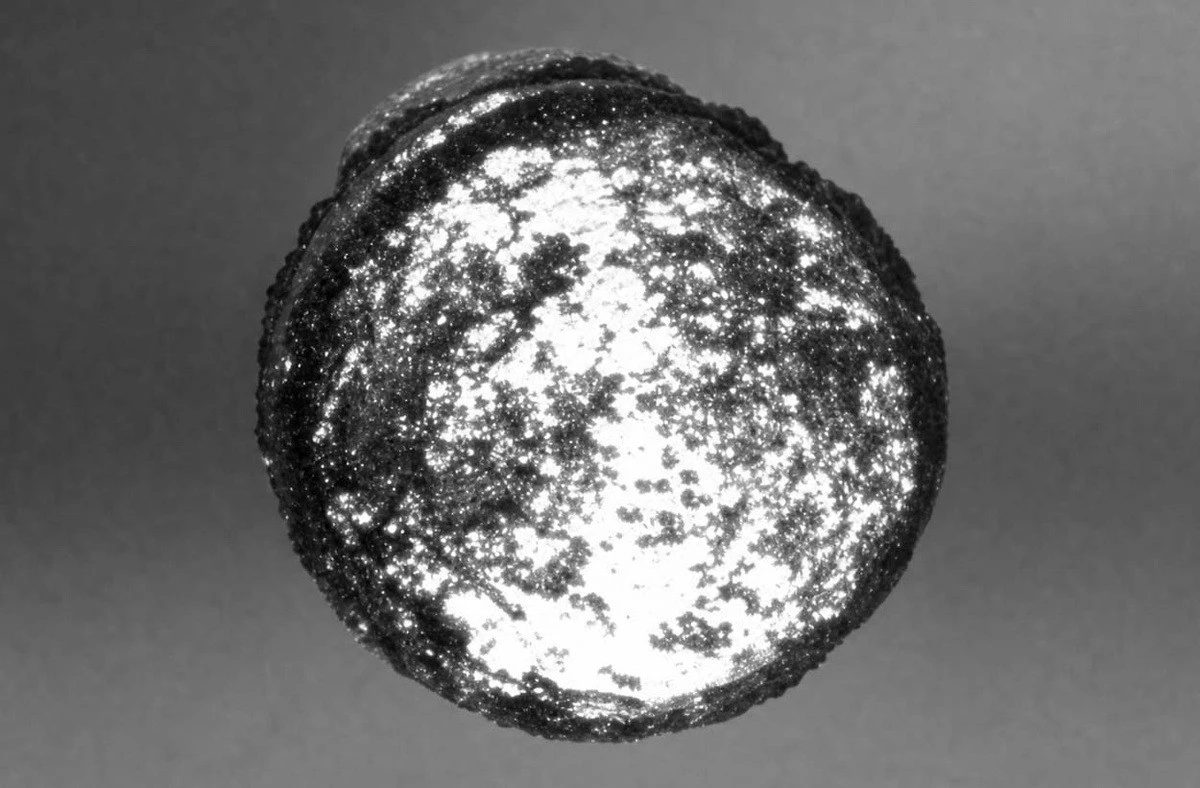
A sample of californium-249 weighing approximately 10 micrograms. The image was obtained by the U.S. Department of Energy in the 1970s.
It was first synthesized in February 1950 at the University of California, Berkeley. American scientists Stanley Thompson and Albert Ghiorso bombarded curium (Cm) atoms with alpha particles, ultimately producing a new element named californium (Cf)—after the state of California, its "birthplace." It occupies atomic number 98 on the periodic table.
Californium is a synthetic element that has never been found in nature, although theoretically, it could form in minute quantities during nuclear reactions within uranium ores.
Californium Production
As far as is known, there are only two places in the world where californium (specifically the californium-252 isotope) is synthesized: the Research Institute of Atomic Reactors (NIIAR) in Dimitrovgrad, Russia, and the Oak Ridge National Laboratory in Tennessee, USA.
*It is possible that China is engaged in unofficial production to avoid dependence on others.
The production process is extremely complex and time-consuming. Plutonium-239 undergoes prolonged neutron irradiation in a nuclear reactor. Californium is formed through a series of neutron captures and beta decays. The entire cycle takes 8 to 18 months. Afterward, tiny amounts of californium are extracted from the mixture of irradiated elements using chemical methods. 
The 60-inch cyclotron at the University of California, Berkeley Radiation Laboratory, 1939. Californium was first synthesized in 1950 using accelerators of this type.
Collectively, the USA and other countries produce only 30–60 milligrams of californium annually. For comparison, the weight of an average dry kidney bean is about one gram.
Properties of Californium
Californium is a silvery-white actinide metal that is so malleable and soft that it can easily be cut with a knife. Its melting point is approximately 900°C, and its boiling point (calculated) is 1,470°C.
However, its most notable characteristic is its high radioactivity. Californium-252, the most common isotope, is an extremely powerful artificial source of neutron and gamma radiation. Due to its capacity for spontaneous fission, a mere one gram of this isotope emits approximately 2.3 trillion neutrons per second. For comparison, one gram of uranium-235 emits about 0.0003 neutrons per second.
Applications
Despite its minuscule production volume, californium is used in a wide variety of fields:
Medicine
Californium is used in brachytherapy, a form of radiation therapy in which a radiation source is placed directly inside or next to a tumor. 
Neutron radiation from californium effectively destroys cancer cells, particularly those resistant to conventional X-ray therapy. This localized approach significantly minimizes exposure to healthy tissue, thereby reducing the severity of side effects.
Geology and Resource Extraction
Californium is used in neutron logging—a geophysical method for analyzing rock formations in boreholes. Neutrons emitted by the californium penetrate deep into the rock; the way they scatter makes it possible to determine the rock's composition and moisture content, as well as the presence of oil or gas. This method is far more precise than X-ray imaging, enabling savings of tens of millions of dollars during large-scale deposit development.
Precious Metal Exploration
Californium is used in neutron activation analysis to detect gold, silver, other metals, and rare-earth elements. Irradiating rock samples with neutrons makes it possible to detect even trace amounts of the target elements.
Industrial Quality Control
Neutron radiography is used to inspect components for aircraft, turbines, and nuclear reactors. The method detects micro-cracks, voids, and corrosion—defects that are invisible on X-rays. In doing so, californium minimizes risks, thereby saving thousands of lives.
Scientific Research
Californium is used in fundamental physics to study the structure of atomic nuclei, synthesize new superheavy elements, and investigate the properties of matter and its behavior under extreme conditions.
Thus, californium is not merely the most expensive metal. It is a unique tool that helps treat cancer, prospect for oil, ensure the quality of complex structures, and study matter at the atomic level—all thanks to minute quantities of a substance that humanity learned to synthesize only 76 years ago.