Two massive, continent-sized anomalies are hidden underground. How science explains them (10 photos)
From school geography, we know the Earth's modern structure consists of layers: the crust, the mantle, and the core.
However, at the very base of the mantle—right next to the scorching core—lie two massive structures the size of continents. They behave unusually and may be the culprits behind the planet's most devastating mass extinctions. 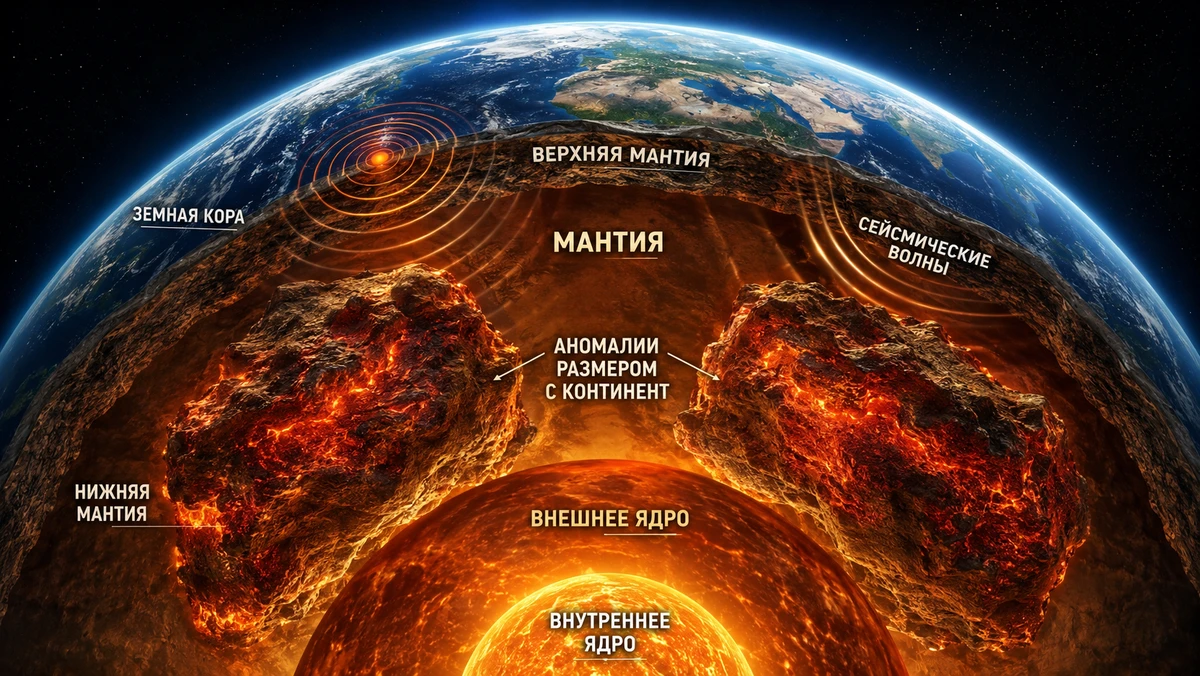
They are inaccessible, and we still do not know exactly what they are. Ancient Earth debris? A graveyard of sunken tectonic plates? Or the remnants of another planet that once collided with us and gave rise to the Moon?
How they were discovered
In the 1970s, seismologists began to notice something strange: seismic waves from powerful earthquakes behaved differently as they traveled through the planet.
Beneath Africa and the Pacific Ocean, the waves slowed down abruptly—as if passing through a region of hotter material with a different chemical composition.
In 1984, American geophysicists Adam Dziewoński and Bradford Hager created one of the first 3D maps of the Earth's mantle.
The principle was similar to medical tomography: instead of X-rays, they used waves from thousands of earthquakes recorded by stations around the world. Two anomalous patches clearly emerged on these maps—zones where waves traveled unusually slowly. On tomographic maps, such regions are typically colored red. 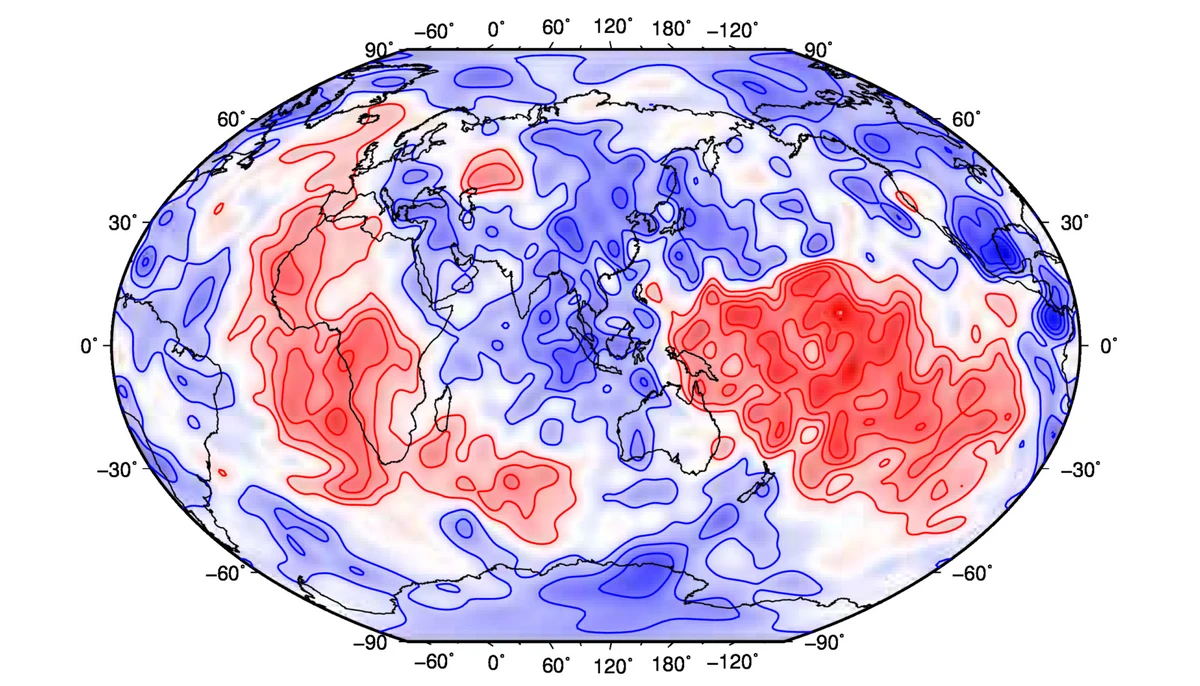
Scientists have given them an official name—LLSVPs (Large Low-Shear-Velocity Provinces)—and unofficial ones: Tuzo (beneath Africa) and Jason (beneath the Pacific Ocean). These names honor geologists John Tuzo Wilson and Jason Morgan, the founders of plate tectonics theory.
The scale of these structures is hard to fathom. Each rises nearly a thousand kilometers above the core—these are not merely mountains, but entire continents in the planet's depths. Together, they account for up to 9% of the mantle's volume.
Models suggest they are hundreds of degrees hotter than the surrounding mantle. Yet, they are likely denser—possibly due to a higher iron content. 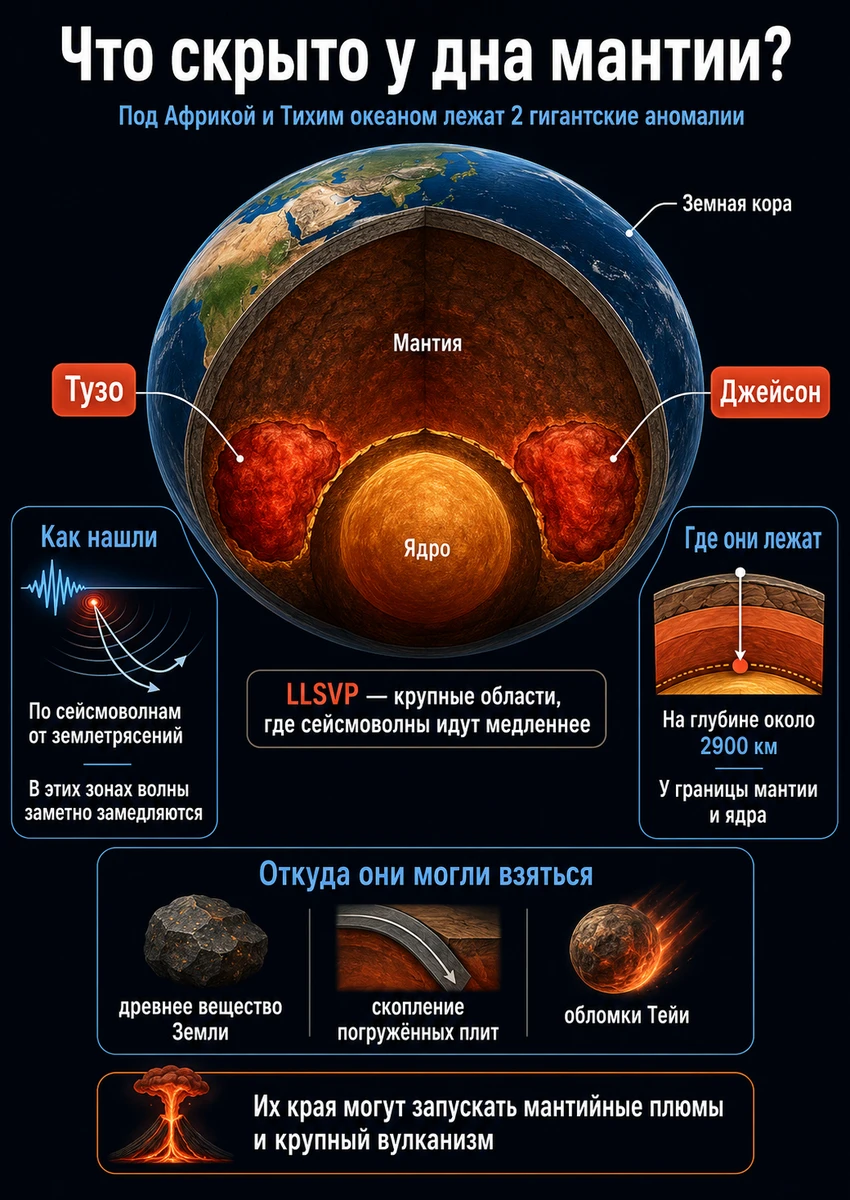
That is precisely why they do not rise like a typical hot plume but instead remain at the base of the mantle. They also appear remarkably long-lasting: over timescales of hundreds of millions of years, their edges seemingly serve as stable zones from which mantle plumes originate.
As for exactly what they are—science has yet to provide a definitive answer.
Hot, yet in no rush to rise
Hot material is lighter, and lighter material ought to rise. Does this mean we are looking at two giant bubbles straining to ascend?
It doesn't add up. 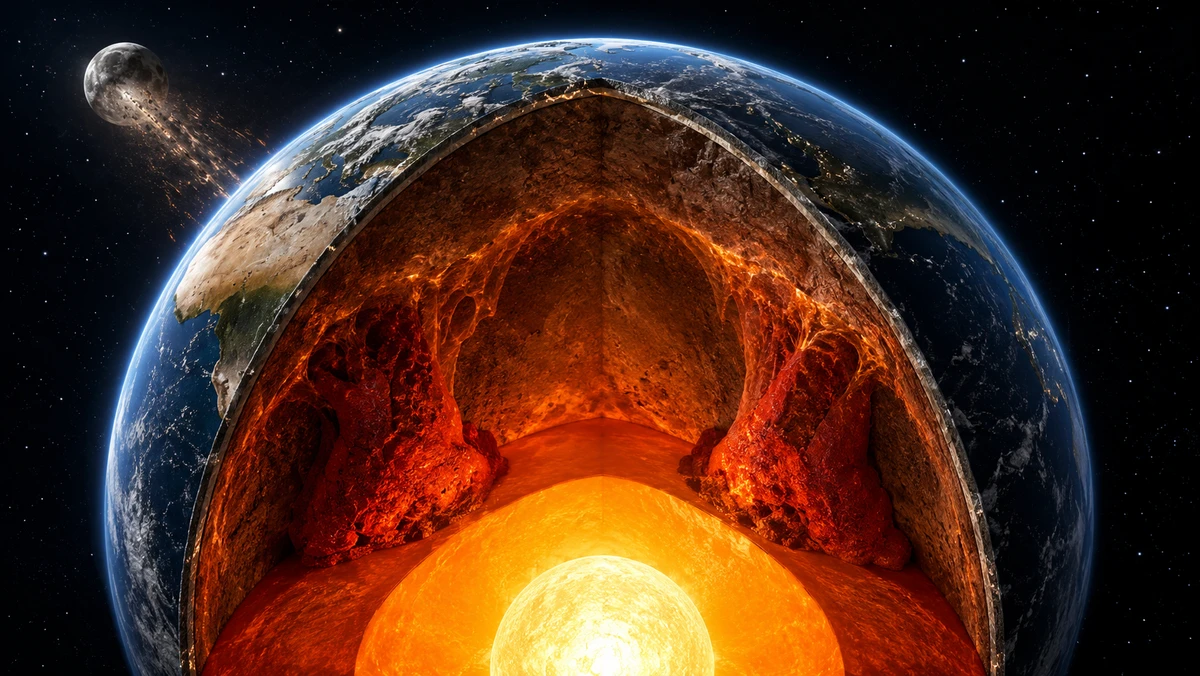
These massive blobs have unexpectedly sharp boundaries. If temperature were the only factor, the edges would blur gradually, like tea steeping in a glass. Instead, they are clearly defined—as if the material inside is simply different, possessing a distinct chemical composition. Add one more detail: based on how Earth responds to the Moon's gravitational pull (a method used to weigh the planet's interior), the lower parts of these structures are slightly denser than the surrounding mantle.
But if they have persisted for billions of years, where did they come from? Science frankly has no answer; only hypotheses remain.
Science has three suspects
When Earth was young. The first theory is a "homegrown" one. This is ancient primordial matter—a fragment of the young Earth from before everything had fully mixed. Over billions of years, the mantle has slowly churned and homogenized, much like dough in a massive kneading trough, yet pockets of original material could have survived near the very bottom, untouched by this great mixing process.
A graveyard of plates. For millions of years, the ocean floor has been descending into the mantle at subduction zones; old, cold crust sinks because it is denser. Over the planet's history, so much of this sunken material has accumulated that it could have clumped together into two massive piles near the core-mantle boundary. Many geologists favor this theory—it may be incredibly mundane, but it fits the data regarding both chemistry and physics.
A visitor from space. And then there is the third theory—the one that brought discussion of these anomalies out of scientific journals and into the public eye. It is the boldest of them all.
Stripped of the finer details, the debate boils down to a simple question: is this debris from Earth itself, or a visitor from elsewhere?
Since this hypothesis is currently the most popular and offers the best explanation for the phenomenon, I will examine it in greater detail in a separate chapter.
The Planet Theia
Let’s rewind four and a half billion years. Earth is young and hasn't yet fully cooled. A Mars-sized protoplanet—dubbed Theia—slams into it at full speed. The impact is cataclysmic: the ejected material scatters into orbit and coalesces to form the Moon. This is currently the leading hypothesis regarding our satellite's origin.
Yet, there are no other obvious traces of the collision between Earth and Theia. But what if Theia didn't disappear—what if it simply sank deeper inside?
In 2023, a paper by geophysicist Qian Yuan and his colleagues was published in the journal *Nature*; the authors proposed precisely this scenario and demonstrated that it aligns with data regarding the Moon's size and the properties of deep-seated anomalies. 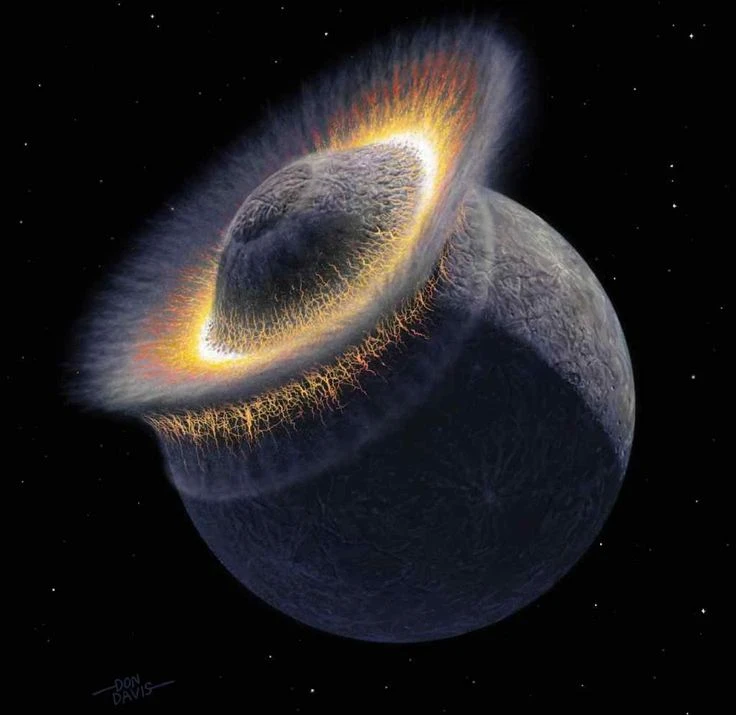
Yuan was attending a seminar on planet formation when the speaker mentioned two things: the Moon is unexpectedly rich in iron, yet no traces of Theia have been found anywhere. It clicked for Yuan. If Theia’s mantle was heavy and iron-rich, the impact could have driven it into the depths of the young Earth, causing it to sink all the way to the core—and settle there permanently.
His team’s models showed that the scenario works. Their calculations indicated that material amounting to about two percent of Earth's total mass sank to the very bottom, and that this material was two to three-and-a-half percent denser than the surrounding rock—precisely because of its iron content. These figures bear a striking resemblance to what we observe in the anomalies identified by Tuzo and Jason.
It is tempting to draw a definitive conclusion: here, right beneath our feet, lie the remnants of a lost world. Yet, an honest scientist would not stop there. 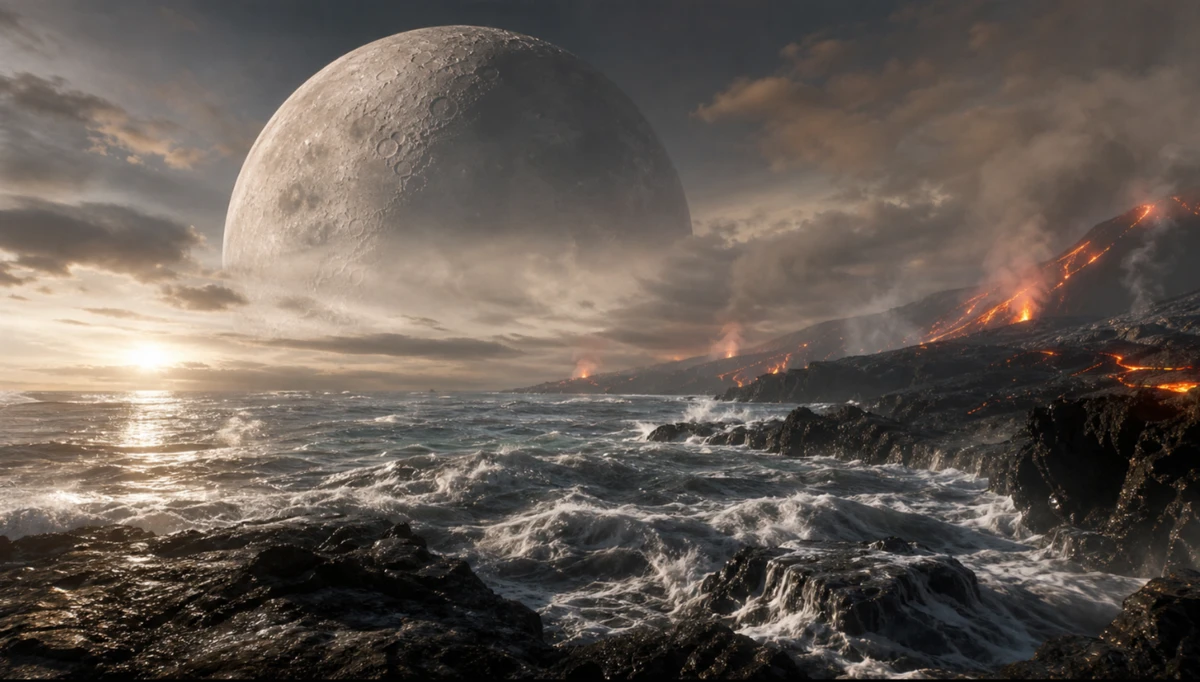
The Theia hypothesis is the most compelling of the three, though it is far from being the proven winner. Nevertheless, one piece of evidence warrants special attention. It comes from the most unexpected of places: the throat of a volcano.
A Clue in Hawaiian Lava
Geochemists have discovered an anomaly in the lava found in Hawaii, Iceland, and Samoa: unusually high levels of helium-3 relative to helium-4.
Why does this matter? Helium-3 is a primordial isotope—one captured by Earth from the gas and dust cloud that formed the Solar System. Virtually none remains on the surface, as the lightweight gas long ago escaped into space. If it nevertheless erupts alongside lava, the conclusion is clear: the lava has risen from a deep, ancient reservoir that has remained largely undisturbed for billions of years. 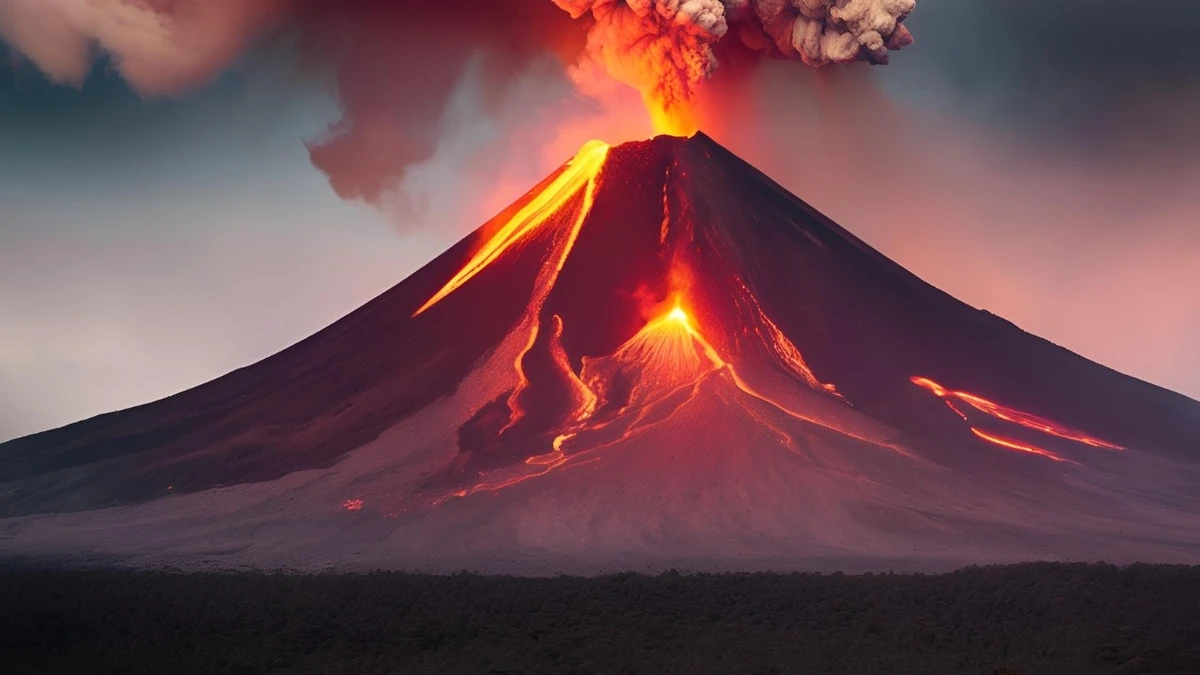
This implies that "time capsules"—untouched pockets of ancient material—truly exist deep underground. Furthermore, the lava carrying this helium often originates from plumes linked to the edges of LLSVPs.
And these massive structures have a way of reaching the surface—though the process is far from gentle.
Hottest at the Edges
If "Tuzo" and "Jason" are the "continents" of the lower mantle, the most intense activity occurs not at their centers, but along their edges. According to many models, this is where plumes are most likely to form—hot jets of material that slowly rise over tens of millions of years, eventually erupting as volcanoes. These margins have even been given a name: plume generation zones. 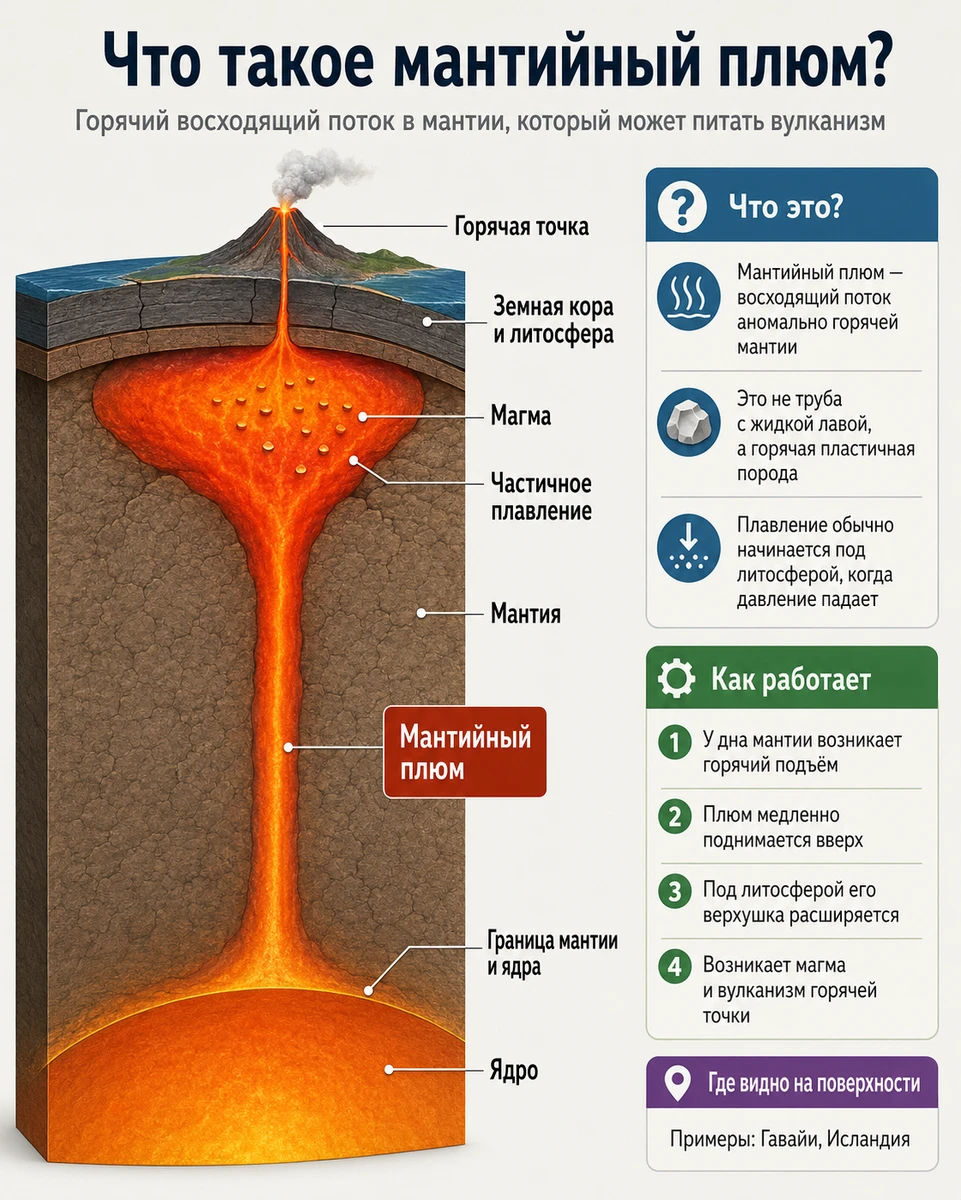
And the connection is not merely theoretical. Take the largest volcanic provinces of the past, hotspots, and kimberlite pipes, and mentally place them back where they erupted millions of years ago—more than ninety percent would align precisely with the edges of these two massive blocks. This pattern holds true for hundreds of millions of years into the past. Such a correlation cannot simply be dismissed as coincidence.
Furthermore, our planet’s history includes a devastating catastrophe that may be linked to these features.
Two hundred and fifty-two million years ago, the Permian-Triassic extinction event occurred—the most catastrophic event in the history of life. 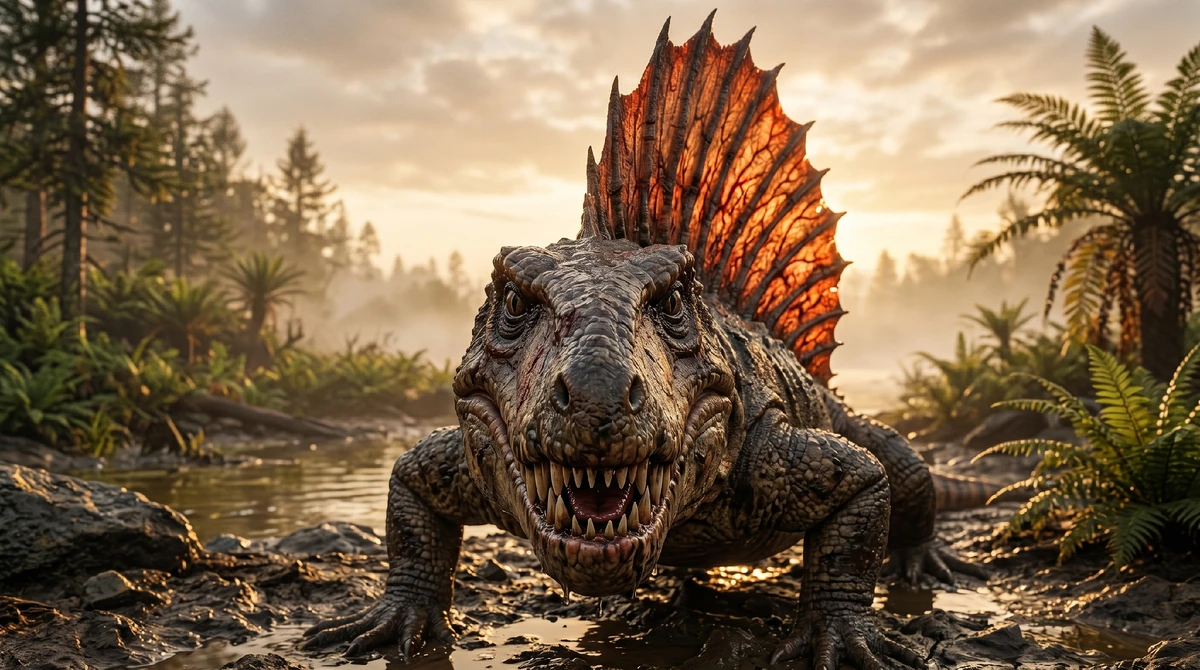
The oceans were nearly emptied: estimates suggest that between eighty and ninety percent of marine species vanished. The vast majority of land-based species perished as well. Life teetered on the very brink of total annihilation.
The trigger appears to have been a period of massive volcanism. At that time, present-day Siberia was situated over one of these "hot edges," resulting in the eruption of the Siberian Traps—an igneous province with a volume of millions of cubic kilometers. Carbon dioxide and methane were spewed into the atmosphere, the oceans suffocated, and the climate was thrown into chaos. 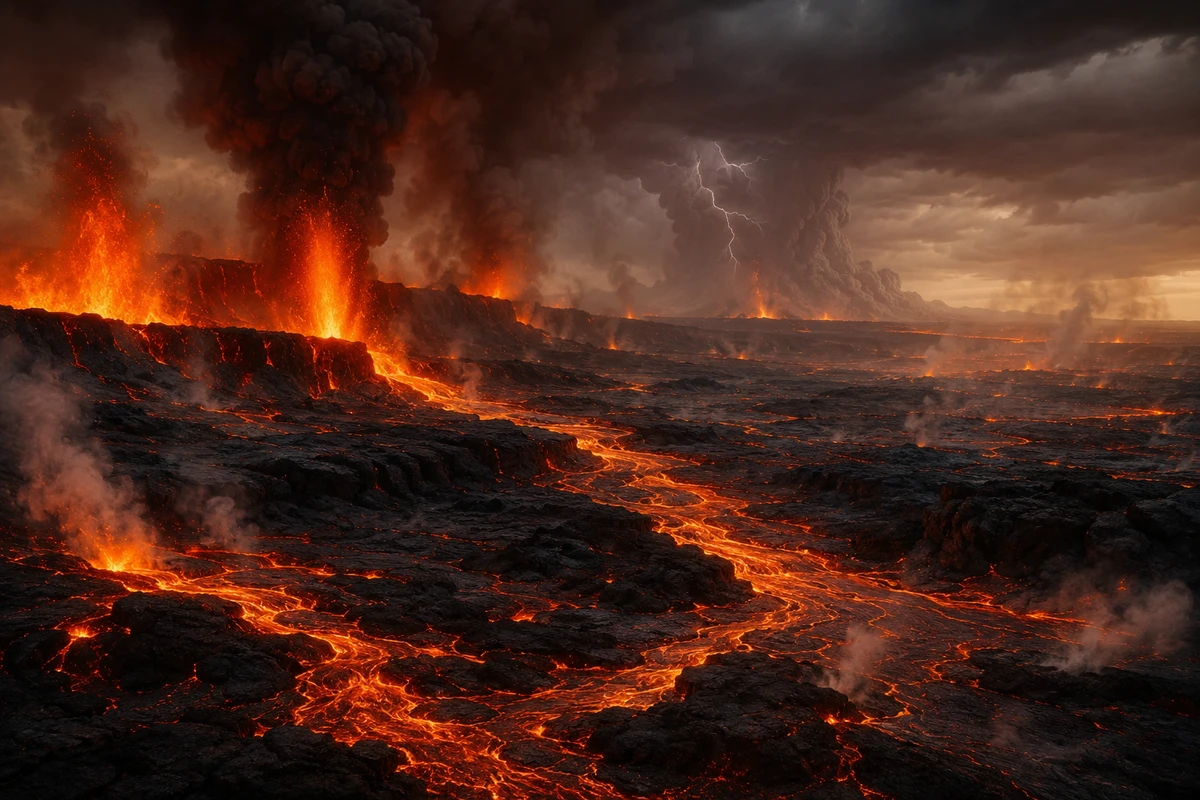
A massive block near the core spewed a plume—and wiped out almost all life. In reconstructions by Torsvik, Burke, and their colleagues, many ancient eruptions align with the edges of LLSVPs.
This is a living, open chapter right beneath our feet—and few generations get the chance to be the first to look into it.
We are accustomed to thinking of Earth as our home: solid, comprehensible, and thoroughly studied. Yet beneath this home, at its very scorching foundation, lie two continent-sized mysteries.
Perhaps this is an ancient memory of Earth itself. Perhaps it is the trace of another planet. Or perhaps it is a reminder that the world beneath our feet is just as cosmic as the sky above our heads.