Sex in Savonarola's Florence: From Bacchanalia to Bonfires of the Vanities in One Decade (11 photos)
A state that simultaneously ran brothels and persecuted sodomy. The monk Savonarola, who burned luxury goods in the very square where he would later be burned. The artist Botticelli, who threw his own paintings into the fire. 15th-century Florence was a city of absurd contradictions—and all of it is documented. The archives of the "Night Watch" contain 17,000 names. Leonardo da Vinci is on one list. We explain how this world was structured from the inside. 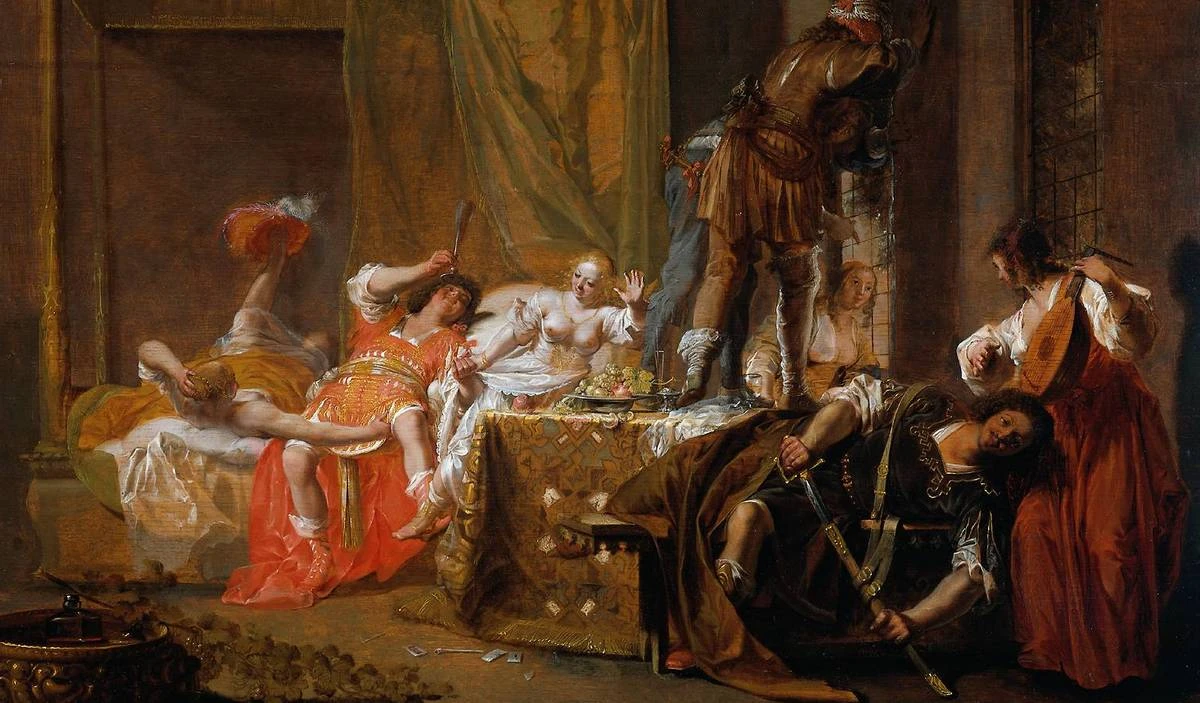
Florence before Savonarola: Reputation and Reality
By the mid-15th century, Florence had established a reputation that made even its more seasoned neighbors blush. In German lands, the verb florenzen, literally "to sodomize," had taken hold. A resident with such inclinations was called ein Florenzer—a "Florentine." The preacher Bernardino of Siena publicly called all of Italy "the birthplace of sodomy," but singled out Florence in particular. 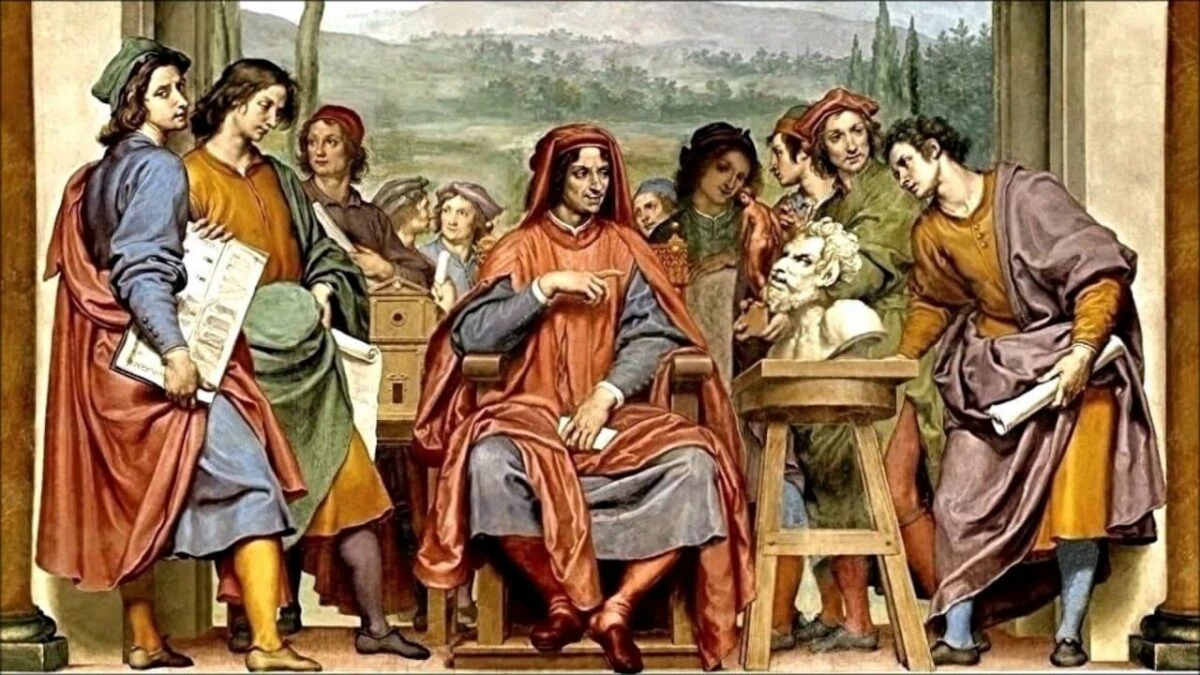
Lorenzo de' Medici the Magnificent – patron of the arts, poet, and organizer of lavish carnivals. Portrait by Giorgio Vasari
This reputation was based on reality. Florence was a wealthy trading city with a late average age of marriage – around 30–31 for men. This meant a huge number of young, unmarried citizens with money and no family obligations. Plus, there was a strong Neoplatonic tradition that celebrated male friendship and physical beauty in the spirit of ancient ideals.
Lorenzo de' Medici, nicknamed the Magnificent, himself composed love poems and organized lavish masquerades. The humanist poetry of his court celebrated earthly joys without reservation. The era seemed like an endless celebration. Ancient ideals and Christian faith intertwined in a whimsical pattern, and moral boundaries became transparent—like the finest lace on the dresses of Florentine ladies.
The Bureaucracy of Sin: The "Bureau of Decency" and the State Brothel
The Florentine authorities approached moral issues with merchant pragmatism. If sin could not be eradicated, it could be regulated and taxed. On April 30, 1403, the republic's authorities established the Ufficiali dell'Onestà—the "Bureau of Decency," or the Moral Service. Officially, the agency was created "to avoid vice and emulate virtue," but in practice, it was created to encourage prostitution as the "lesser evil." 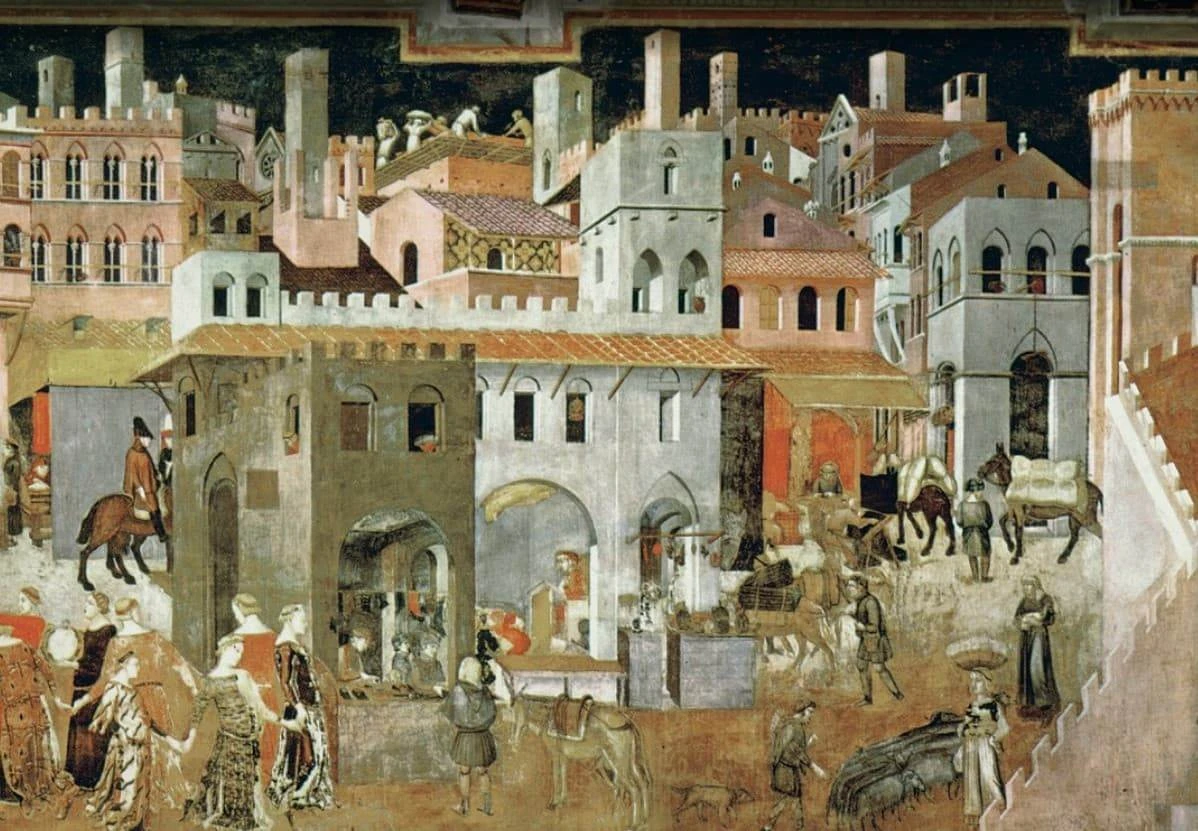
"Allegory of Good Government." Ambrogio Lorenzetti, 14th century. The Florentines loved order—even in the regulation of sin.
The state built a municipal brothel in the city center and levied a tax on the workers' earnings. The idea was clear: accessible women were supposed to distract men from sodomy and encourage them to marry—which would help repopulate the population after the devastating plague. Pope Pius II (1458–1464) sarcastically remarked that Florence was not so much a city of merchants (mercatrice) as a city of prostitutes (meretrice).
For the workers themselves, the state established a strict dress code: gloves, high-heeled shoes, and a small bell on their headdress. The ringing served as a warning: "respectable people" were expected to hear and avoid the sinner in good time. 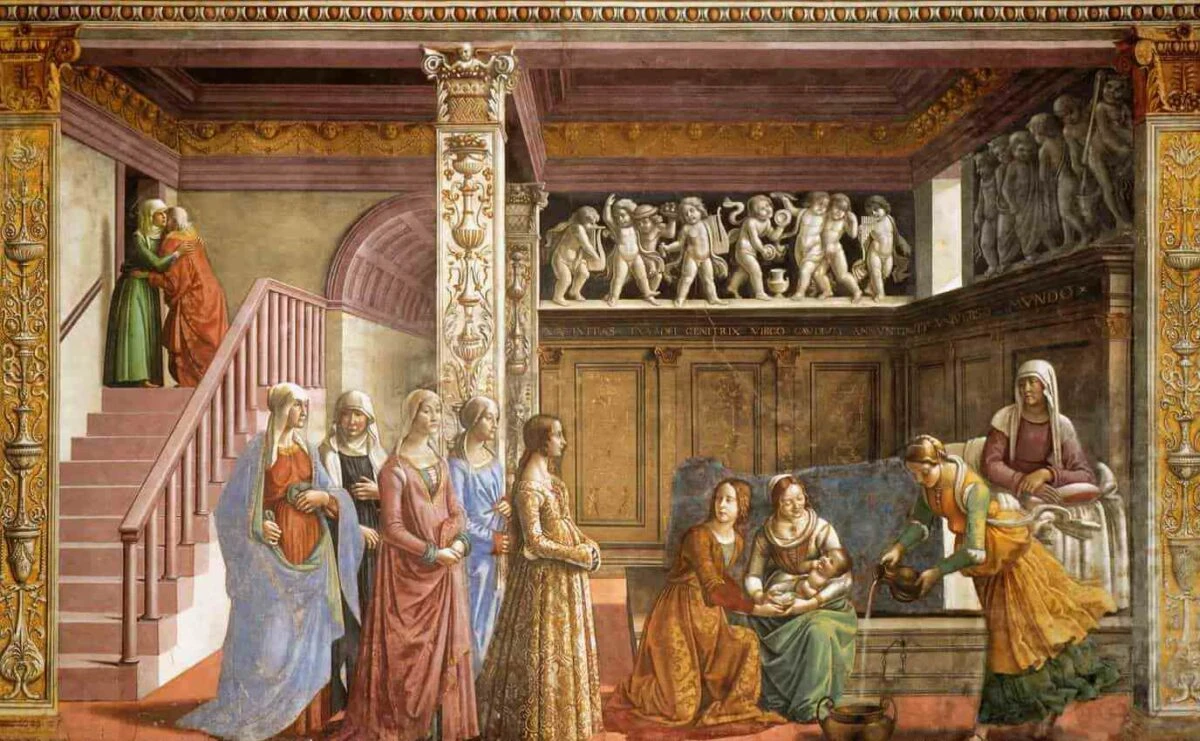
15th-century Florence: dress and morals were equally strictly regulated by the state. Fresco by Domenico Ghirlandaio
Workers at the official brothel enjoyed unexpected rights: they could file complaints with the Court of Morality—and they did so, disputing the claims of clients and each other. In a city where ordinary women were legally powerless without male representation, prostitutes were one of the few groups with real access to justice.
"Night Watch": Nine Citizens Against Half the City
In 1432, a second body appeared alongside the "Bureau of Decency"—the Ufficiali di Notte, or "Night Watch." The name was ambiguous: "notte" in Florentine slang was synonymous with "sodomite." Nine respectable citizens over 45—all married—were exclusively tasked with persecuting those covered by the second meaning of the word. 
Leonardo da Vinci was investigated by the Night Watch in 1476. The charges were dropped—the denunciation was anonymous.
Citizens dropped their denunciations into special boxes—tamburi—at each church. Anonymity was guaranteed. Over the 70 years of its operation, the agency opened cases on approximately 17,000 people—out of a city population of approximately 40,000. Historian Michael Rocque calculated in his book Forbidden Friendship (1996) that by the age of thirty, almost every second Florentine man had been under investigation at least once.
The fine for a first offense was 1,000 lire. The fines increased with each repeat offense. A fifth offense was punishable by burning at the stake. Over seven decades, the agency issued approximately 3,000 guilty verdicts. Actual executions were rare—only six documented cases occurred, usually involving children.
In 1476, 24-year-old Leonardo da Vinci was named among the accused. A denunciation was lodged in the tamburo near the Palazzo della Signoria on April 9 of that year. The accusation concerned a connection with a certain Jacopo Saltarelli, a goldsmith's apprentice. The case was dismissed: the denunciation was anonymous, and the law required a signature. Perhaps the intercession of the Tornabuoni family, associated with the Medici—one of the co-defendants bore that name—also helped.
The Arrival of Savonarola: A Prophecy from the Square
In 1490, the humanist Pico della Mirandola convinced Lorenzo the Magnificent to bring the Dominican monk Girolamo Savonarola back to Florence. The monk's first attempt to conquer the city in the early 1480s had failed—the Florentines found his manner too crude. Now everything had changed. 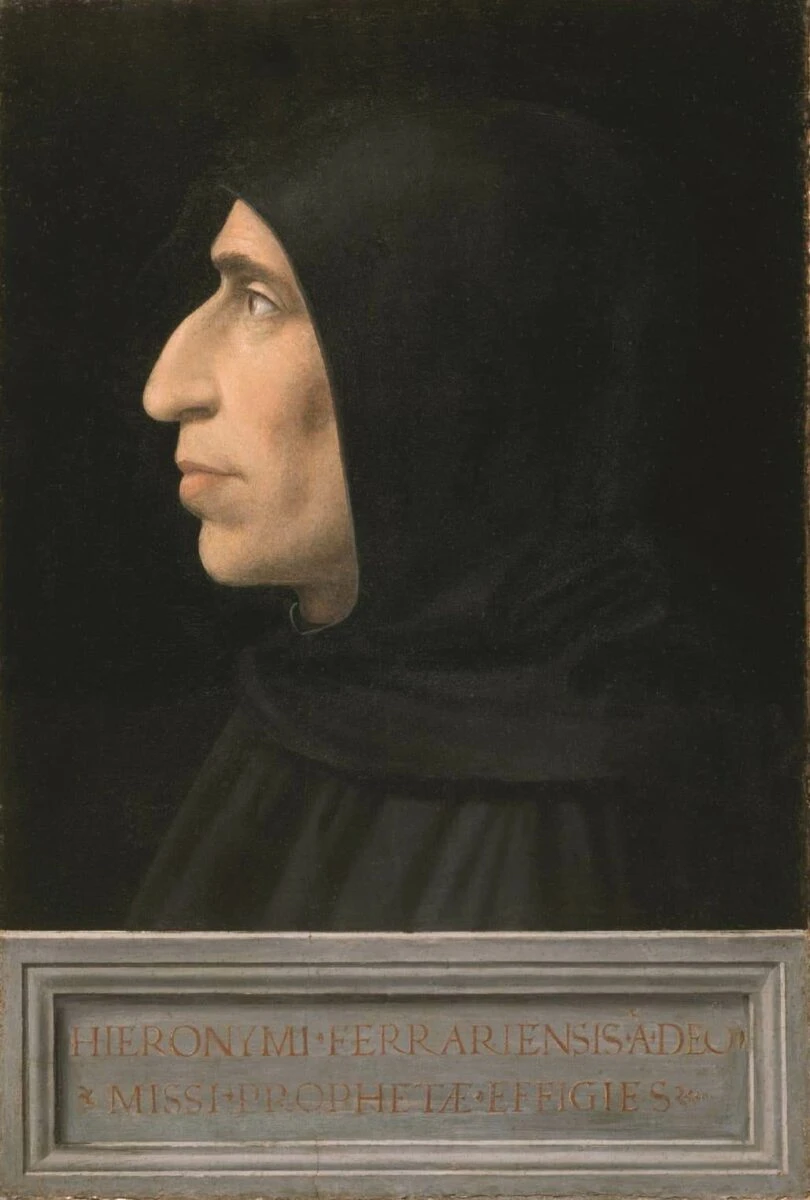
Girolamo Savonarola. Portrait of Fra Bartolomeo, circa 1498 — painted the year the preacher was executed.
On August 1, 1490, Savonarola delivered a speech in San Marco that became the point of no return. If Florence did not repent, God would unleash the sword of His wrath upon all of Italy. The monk spoke without rhetorical flourishes: directly, harshly, with images from the Apocalypse. This was precisely what worked.
The churches were no longer able to accommodate those who wanted to attend. The monk took to the squares. Butchers complained of losses: citizens were fasting en masse and abstaining from meat. 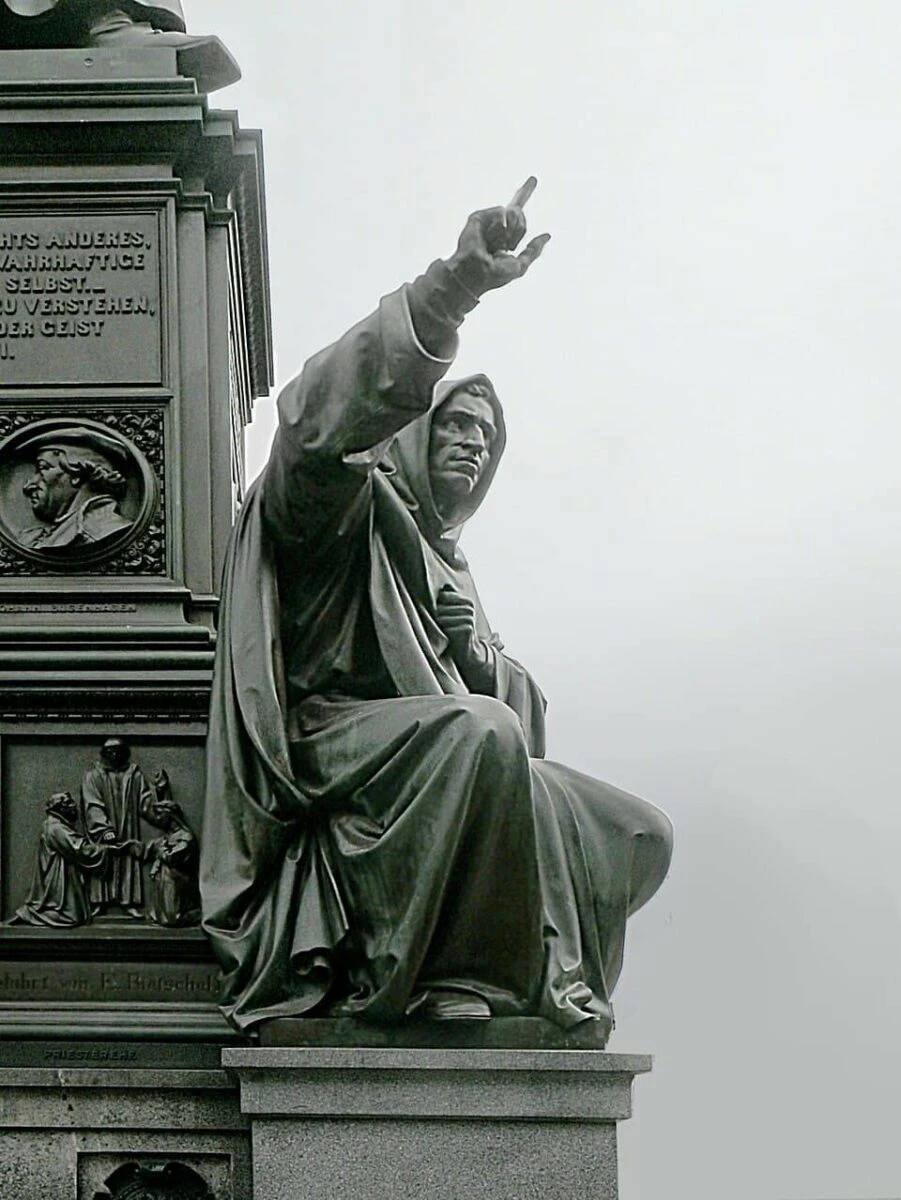
Savonarola Preaching. Detail of the Luther monument in Worms: the Protestant reformer revered his predecessor
Florence was plunged into a state of religious ecstasy. The friar's political party, the Frateschi, quickly gained influence in the city council. Savonarola prophesied the coming of a new Cyrus who would purify the sin-ridden church. When the French King Charles VIII marched his army on Italy in 1494, the preacher declared: here it is—God's sword.
Power without office: A New Jerusalem on the banks of the Arno
Lorenzo de' Medici died in 1492. In 1494, his son Piero fled the city. Savonarola personally met Charles VIII at the gates and convinced him to spare Florence. After this, the friar's authority became absolute. He never held an official position—and that was his strength: no position for which he could be held accountable. 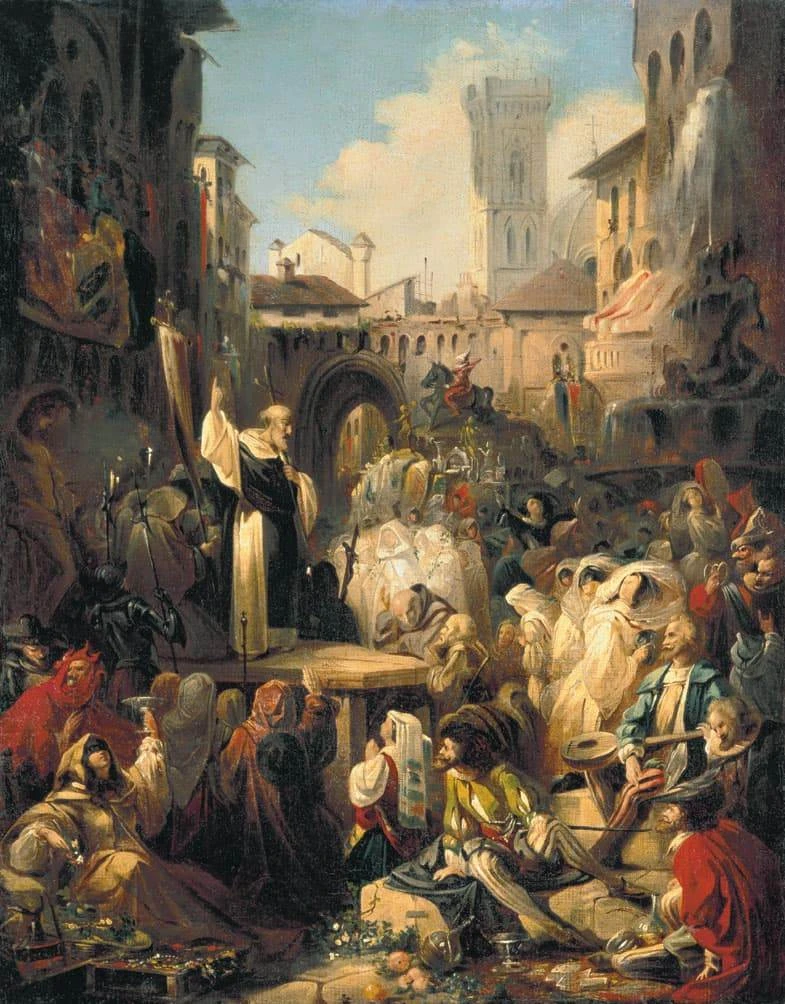
"Savonarola's Sermon in Florence." Nikolai Lomtev, 1850. A scene that entered the cultural memory of Europe.
Savonarola declared Christ the King of Florence and set about building a "New Jerusalem." Laws were passed against gambling, usury, luxury, and sodomy. Sodomites faced death under the new regulations.
The main instrument of control became the pianoni ("mourners")—bands of teenagers dressed in white. They went door-to-door demanding "objects of vanity": cards, dice, mirrors, wigs, perfumes, musical instruments, "immodest" paintings, and secular books. Fear of God's wrath proved stronger than their attachment to the items—the sacks filled quickly.
Bonfires of the Vanities: The Pyramid in the Piazza della Signoria
On February 7, 1497, Fat Tuesday—the eve of Lent—the first "Bonfire of the Vanities" (falò delle vanità) erupted in the Piazza della Signoria. A pyramid of confiscated items was erected, some 18 meters high and almost 73 meters in circumference. A figure of Satan graced the very top. 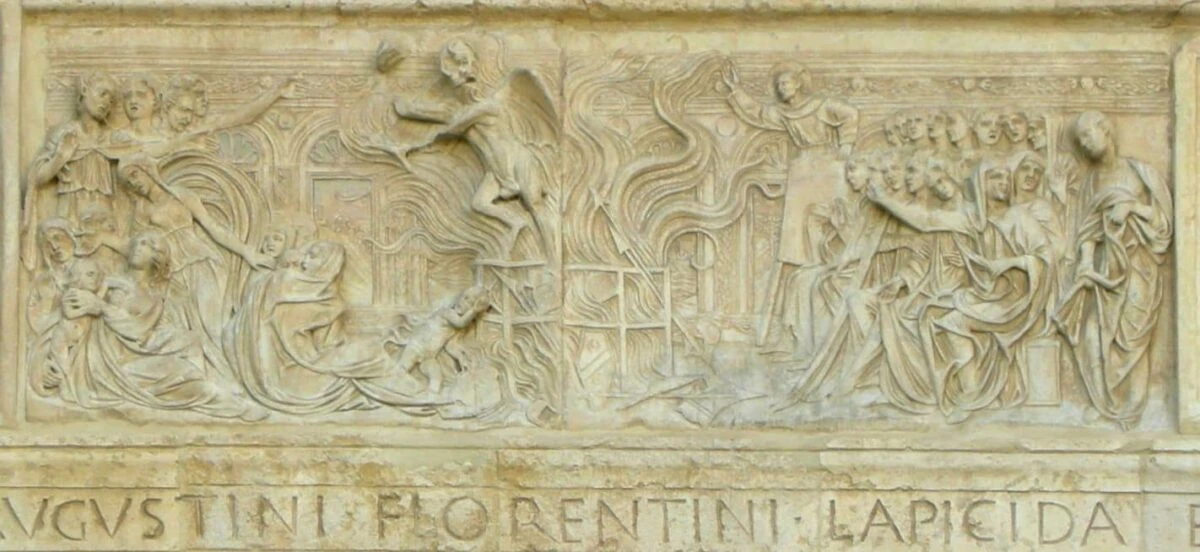
Bonfire of the Vanities, February 7, 1497. A 16th-century bas-relief is one of the few depictions of the event made during Savonarola's lifetime.
An eyewitness listed the items burned: "obscene paintings, ladies' hats, mirrors, wigs, dolls, perfumes, playing cards, dice, chess pieces, lutes and other instruments, books by various poets." Works by Boccaccio, poems by Ovid and Petrarch, manuscripts of secular songs, and paintings were thrown into the flames. The Venetian ambassador offered to buy everything for a huge sum. Savonarola refused. At the sound of silver trumpets and the ringing of bells, the guards brought torches.
A later tradition claims that Sandro Botticelli himself threw several of his paintings into the bonfire. Vasari's biographer didn't mention this; the episode appears in later sources. However, it is reliably known that after 1497, Botticelli completely abandoned mythological and secular subjects. The turning point in his work is obvious even without the legend.
The bonfire was repeated in February 1498, again as a counterpoint to the carnival. By then, the townspeople had begun to tire of the asceticism. The second bonfire ended in riots: the crowd threw stones at the participants.
The Irony of Fire: A Stake for the Reformer Himself
In May 1497, Pope Alexander VI Borgia—whom Savonarola had publicly denounced for corruption and debauchery—excommunicated the monk. Savonarola responded by calling for a council to depose the pope. This was too much. 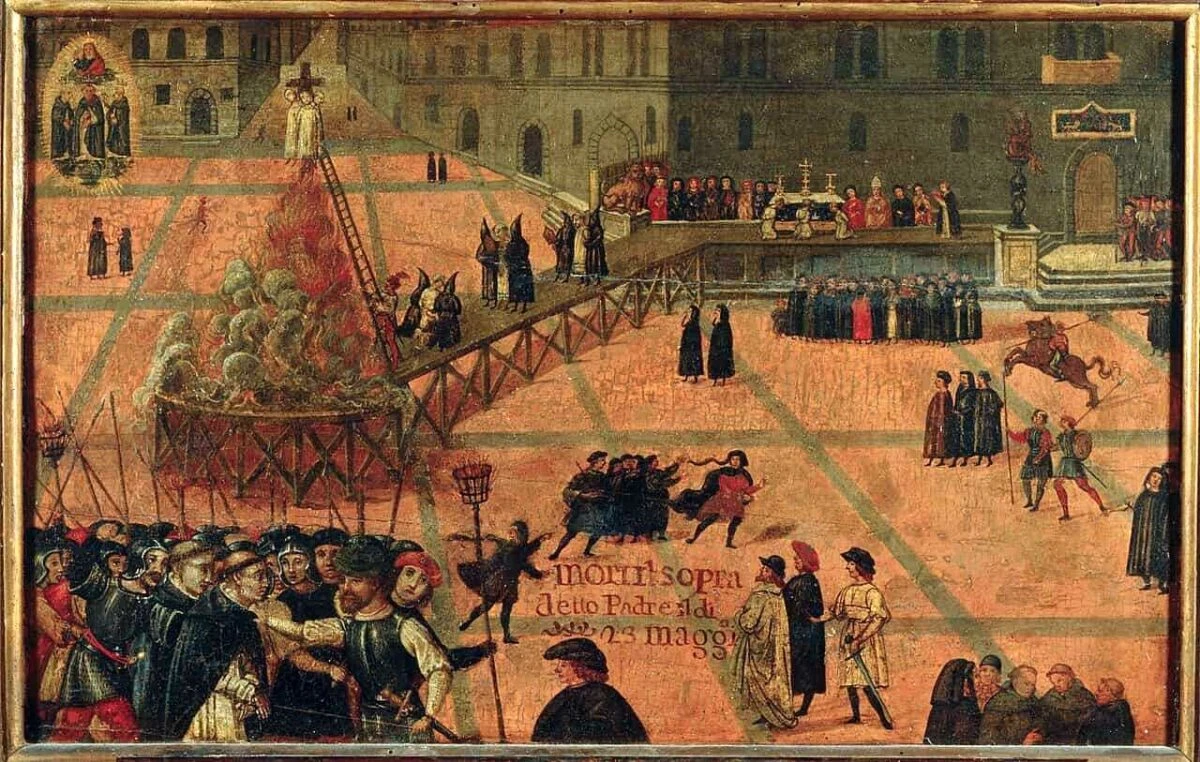
The execution of Savonarola in the Piazza della Signoria, May 23, 1498. Contemporary painting by Filippo Dolciati
The Florentine Signoria, not wishing to antagonize Rome, arrested the monk. After extensive torture, Savonarola confessed to "false prophecies and heresy"—though he later recanted. The court sentenced him to death.
On May 23, 1498, in the same Piazza della Signoria—where the Bonfire of the Vanities had blazed a year earlier—a new bonfire was erected. Savonarola was first hanged along with two fellow monks, then burned. The ashes were thrown into the Arno: his followers were not to collect the relics. 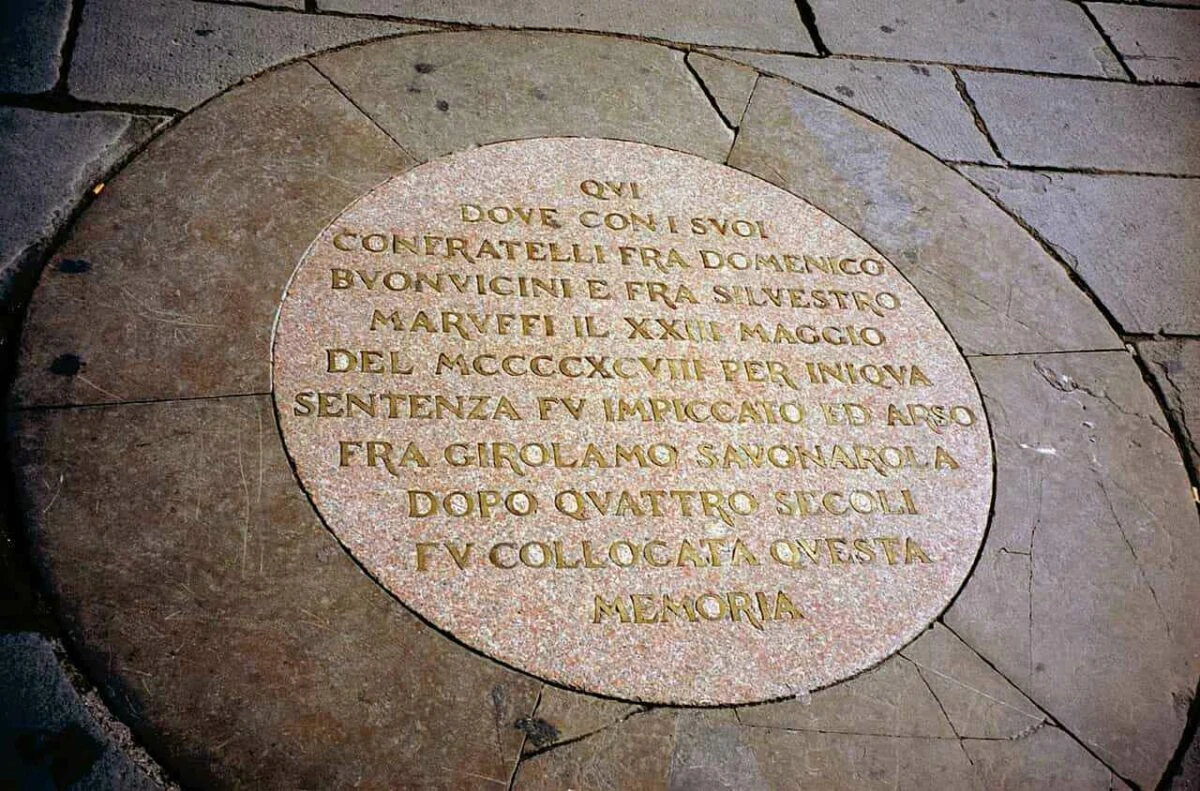
A bronze plaque in the Piazza della Signoria today. Tourists pass her by without noticing.
The traditional punishment for sodomy—burning—befell the man who persecuted it most fiercely. In 1502, the Night Watch was disbanded. Florence slowly returned to itself.
The era of Savonarola has gone down in history as a decade of collective repentance—and a warning about the consequences of power seized in the name of purity.
What do you think: was Savonarola a sincere reformer broken by the system—or a charismatic manipulator who, without realizing it, became the very thing he fought against?