Europe's Richest Heiress Who Died Debt-Rich in a Strange City: Rise and Fall Marie de Medici (14 photos)
Europe's richest heiress of the 16th century died in debt in a strange city—without an entourage, without diamonds, without power. Marie de Medici rose from a Florentine princess to the Queen of France, and then lost everything: first her husband, then her son, then herself. A story about how ambition and a blind eye to people can destroy even the strongest positions. 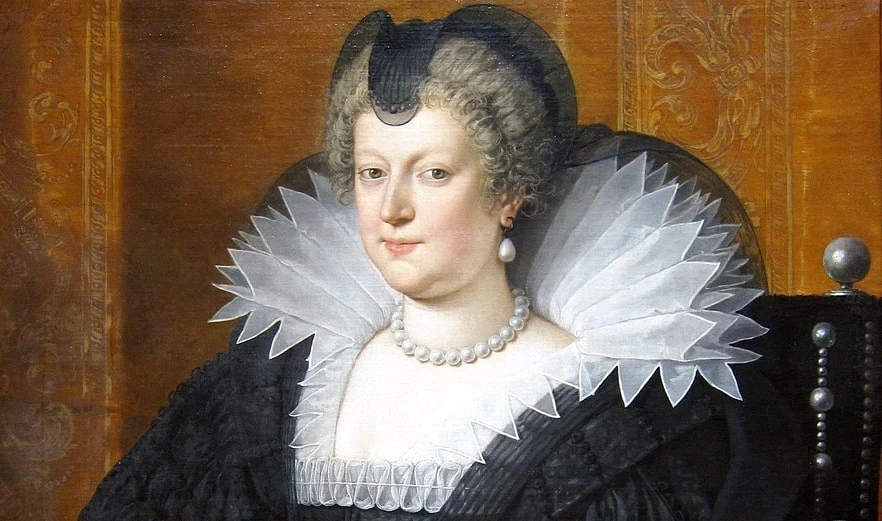
An Orphan with a Half-Million-Dowry
Maria de Medici was born on April 26, 1575, in Florence. She was the sixth daughter of Francesco I, Grand Duke of Tuscany, and his wife, Joanna of Austria. Of their seven children, only two survived to adulthood: Maria and her sister Eleanor. By this time, the Medici family had risen from Florentine bankers to rulers of Tuscany and patrons of the Renaissance. It was under them that Florence became what we know it as: the city of Botticelli, Leonardo, and Michelangelo. 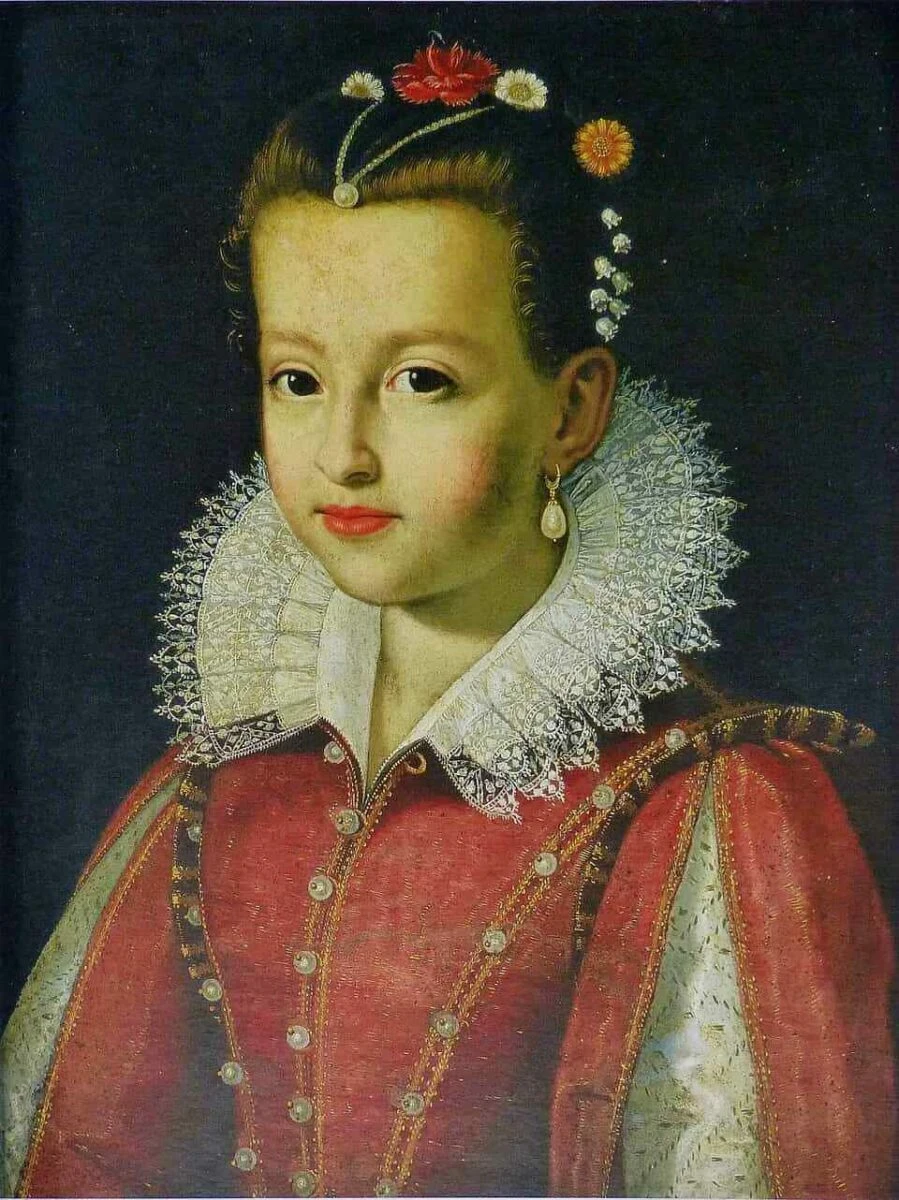
Childhood portrait of Maria de' Medici. Circa 1590. Author unknown
When Maria was two years old, her mother died in childbirth. Her father quickly married his mistress, Bianca Capello. In 1587, within a single day, both died: first Francesco I, then Bianca. Twelve-year-old Maria was left an orphan. And simultaneously, the richest bride in Europe.
The suitors were quick to appear. Maria rejected one after another. The reason, which she did not hide, was that a clairvoyant nun from Siena had predicted her a royal, not a ducal, crown. The Florentine princess waited for a worthy suitor—and waited patiently. 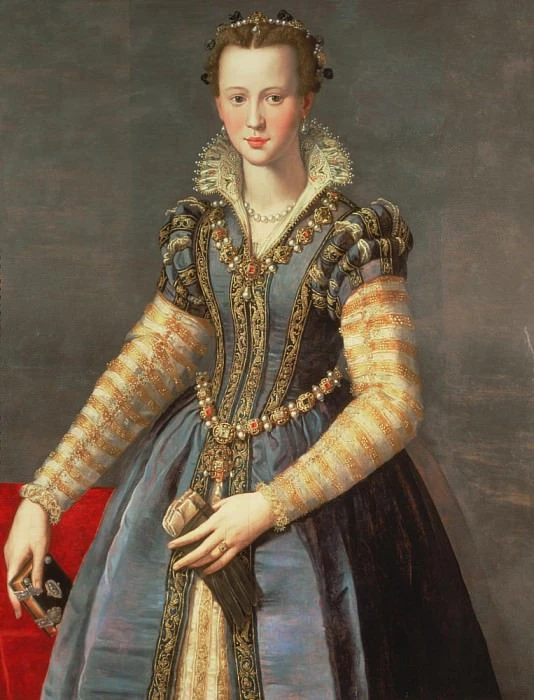
Maria de' Medici. Alessandro Allori. 1600 – written shortly before his wedding to Henry IV
The "Fat Banker's Wife" on the French Throne
In 1599, a suitable candidate was found. King Henry IV of France, founder of the Bourbon dynasty, had just lost his beloved mistress, Gabrielle d'Estrées, who died suddenly. The treasury was empty by then: years of religious wars had devastated it, and the Medici banking house had become the French crown's main creditor. 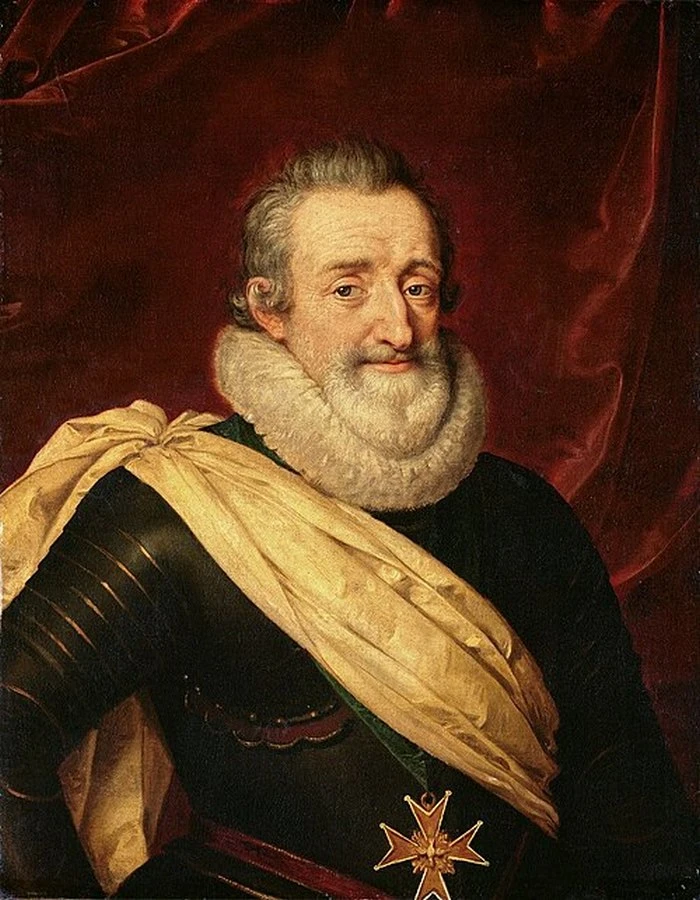
Henry IV of Bourbon. Frances Pourbus. The King needed money – and found it in the dowry of Marie de' Medici.
Negotiations concluded in March 1600. Maria's uncle, Grand Duke Ferdinand I, gave his niece 600,000 gold écus—the largest dowry ever given to a French queen. A significant portion of the sum was simply written off as debts to the crown. In October of that year, the wedding took place at the Pitti Palace in Florence—without the groom, but by proxy: the bride's uncle played the role of Henry IV.
There was no romance here. Henry's mistress, Catherine de Balzac d'Entragues, openly called the new queen "the fat banker," alluding to Maria's merchant origins and large frame. She was not respected at the French court. Henry continued to live with his mistresses, even housing one of them in chambers adjacent to his wife's. Maria created scenes. The scenes didn't help. 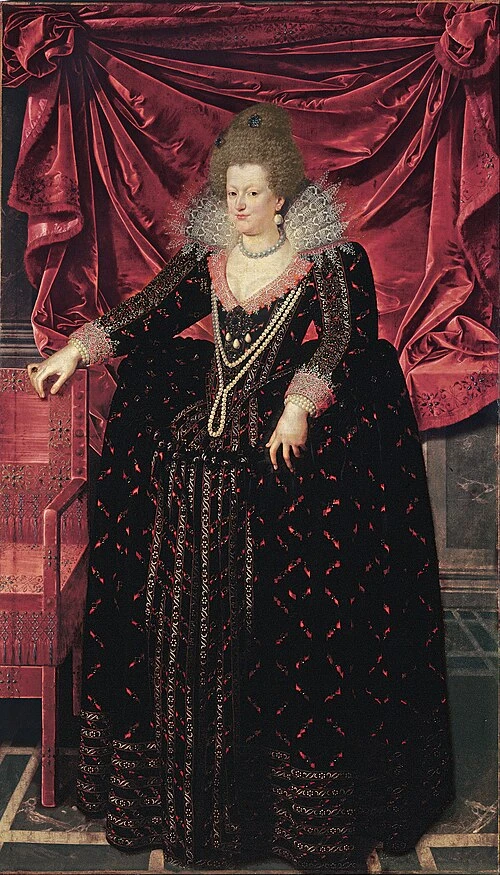
Marie de Medici. Frans Pourbus. 1606 – the queen had already given birth to four of her six children.
During their ten years of marriage, Marie bore Henry six children. Her husband delayed her coronation under various pretexts for almost ten years. Finally, on May 13, 1610, she was crowned in the Basilica of Saint-Denis. The following day, May 14, the fanatic François Ravaillac stabbed the king to death in his carriage on a Parisian street. 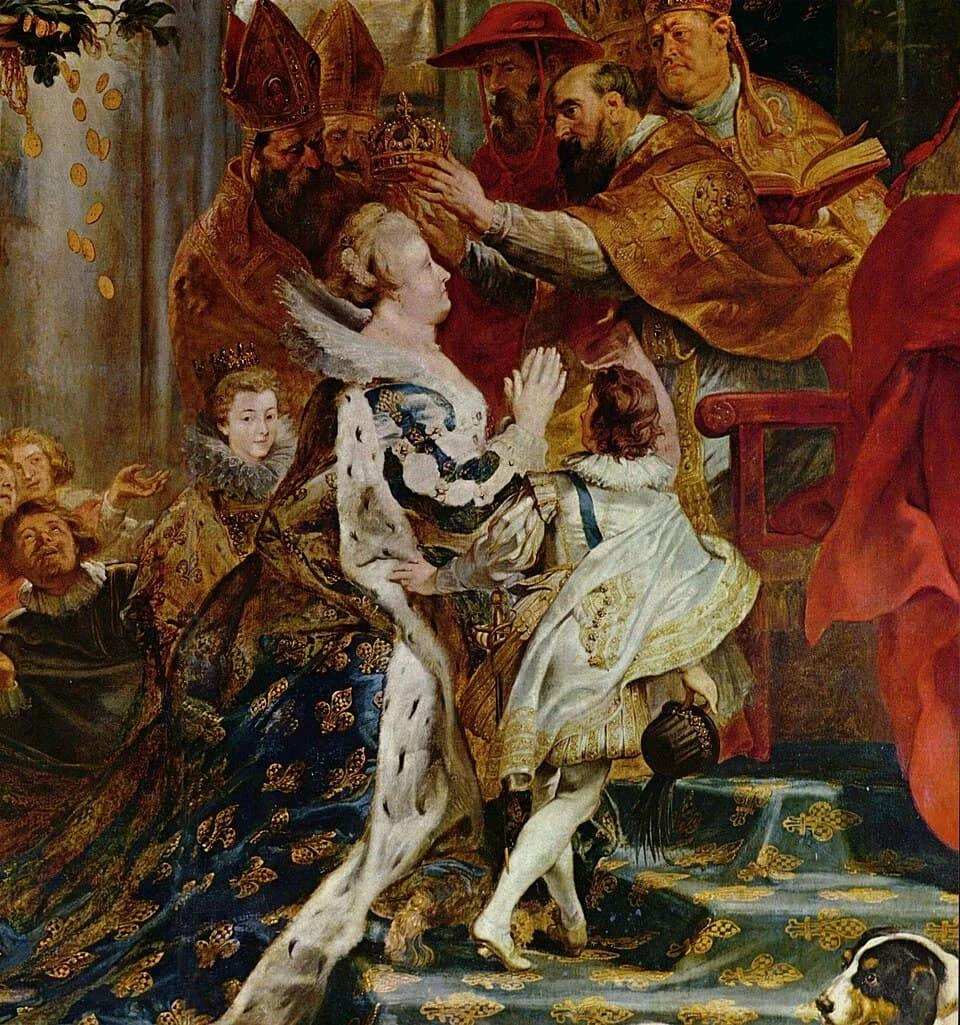
"Cardinal de Joyeuse crowns Marie de Medici." Detail. Rubens, 1622–1625. Louvre
The Regent: Power through Favorites
Eight-year-old Louis XIII became king, and Marie became regent. She held power firmly—and she did so through her followers. Her main supporters were the Concinis: Concino Concini and his wife Leonora Galigai, a childhood friend of Marie's. Concini began as an equerry, and by 1614, the queen had granted him the title of Marquis d'Ancre and the rank of Marshal of France. In fact, the country was ruled by Italian adventurers, not the French crown. 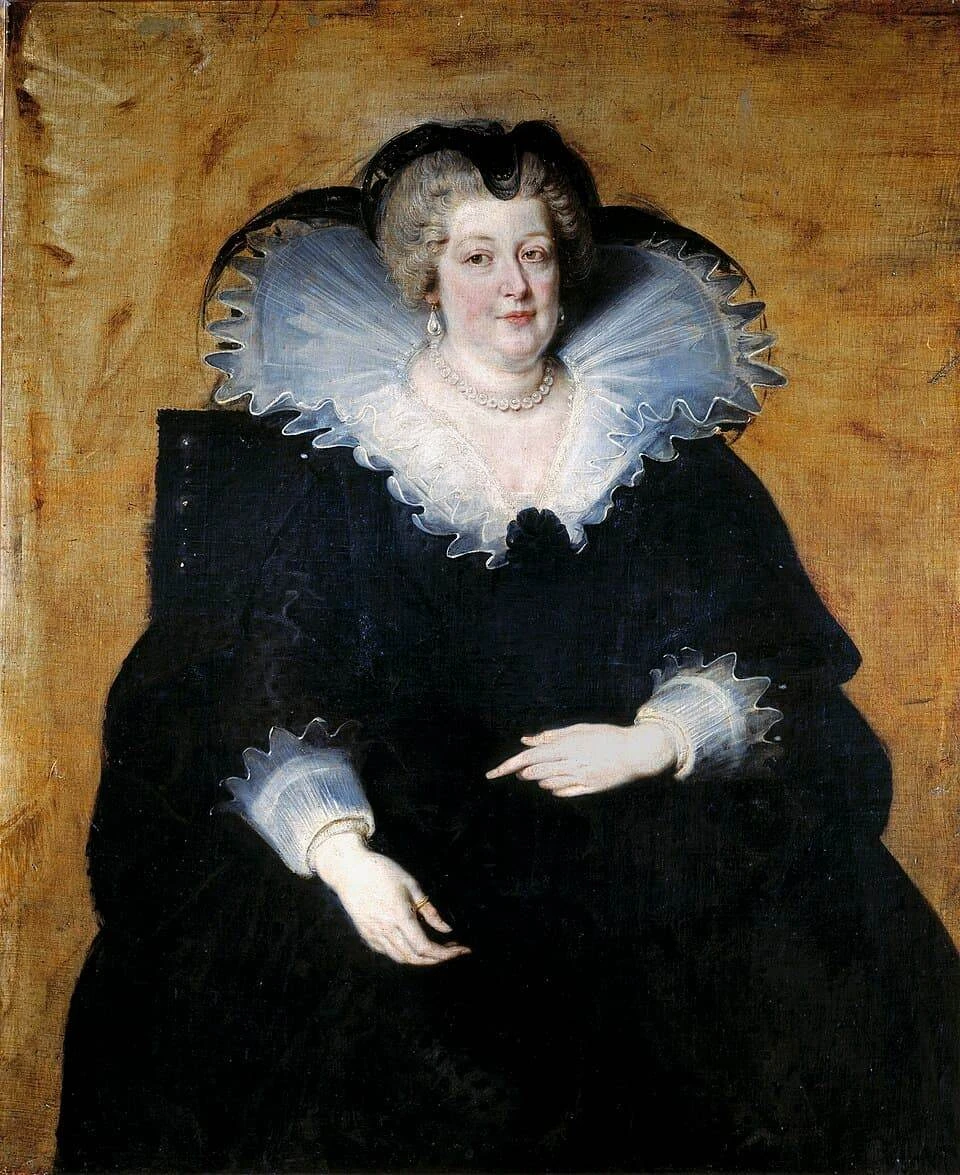
Marie de Medici. Rubens. 1622 – painted during the period when she still held influence at court.
Louis XIII grew up under the complete control of his mother. When he was declared of age in 1614, Marie did not relinquish power – she became head of the Royal Council and continued to govern in his name. Her son's patience ran out in April 1617: on his orders, Concini was murdered right in the Louvre. Leonora Galigay was executed – accused of witchcraft – in order to legally confiscate her fortune. The king exiled her mother to Blois. 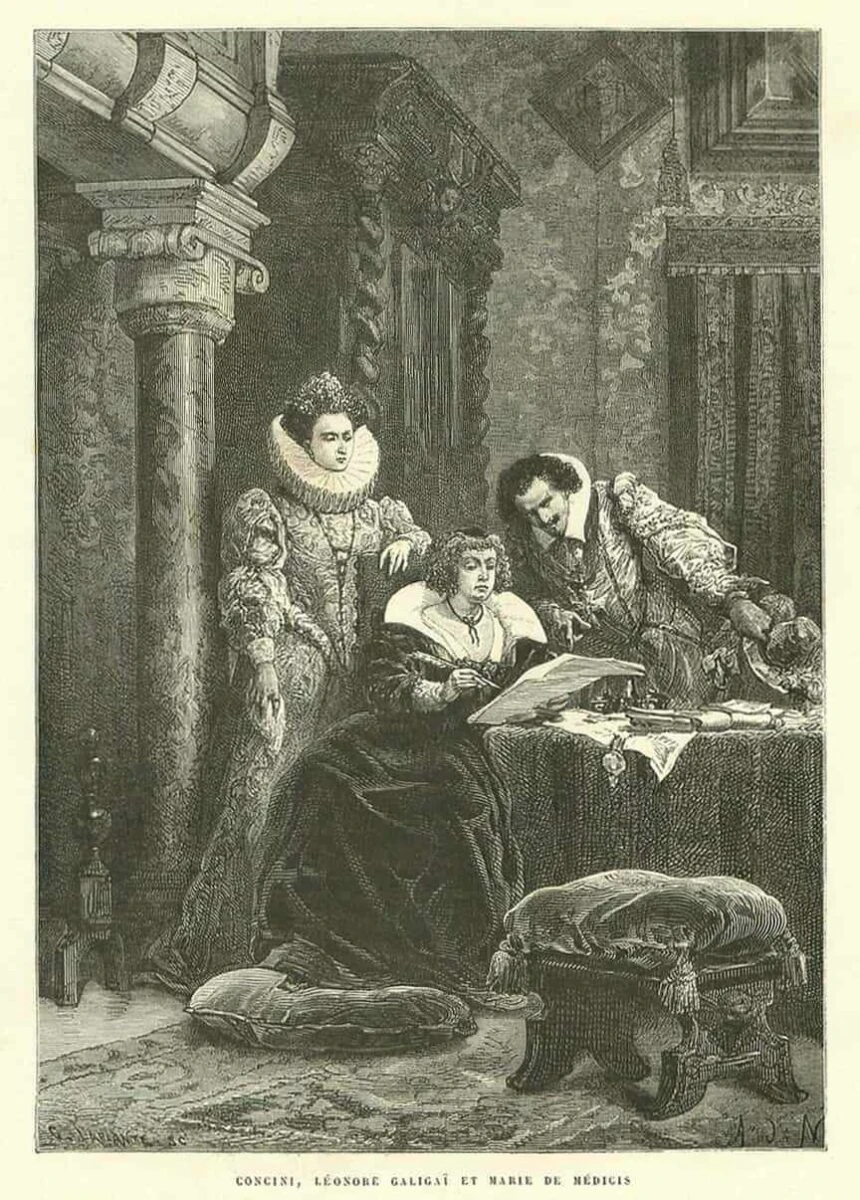
Marie de Medici and the Concinis. Through her favorites, the queen held the reins of power in France.
In February 1619, Marie fled from Blois to Angoulême. War broke out—literally: the son's army against the mother's army. It ended with a truce. After the death of Luynes, Louis's favorite, in 1621, Marie returned to Paris and once again took charge of the Royal Council.
Richelieu: An Uncorrectable Mistake
Having regained her position, Marie made a move that seemed flawless to her. Her advisor, Armand Jean du Plessis—a clever, obedient man, who owed her everything—was only looking for a promotion. She helped him become a cardinal, and then the first minister of France. Soon the whole world knew his name: Richelieu. 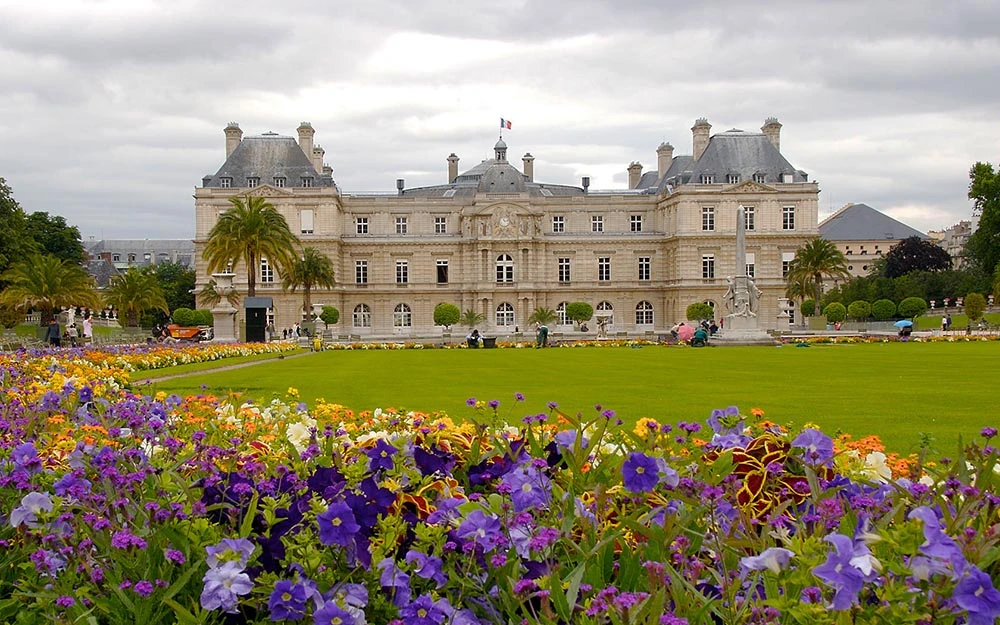
The Luxembourg Palace in Paris – the residence Marie built for herself and ultimately lost
Mary had hoped to gain an obedient puppet. But instead, she gained a man who understood politics better than she did. Richelieu quickly realized that Marie de Medici's intrigues were harming France. He placed his bets on the king – and gradually pushed his patroness away from all levers of power. 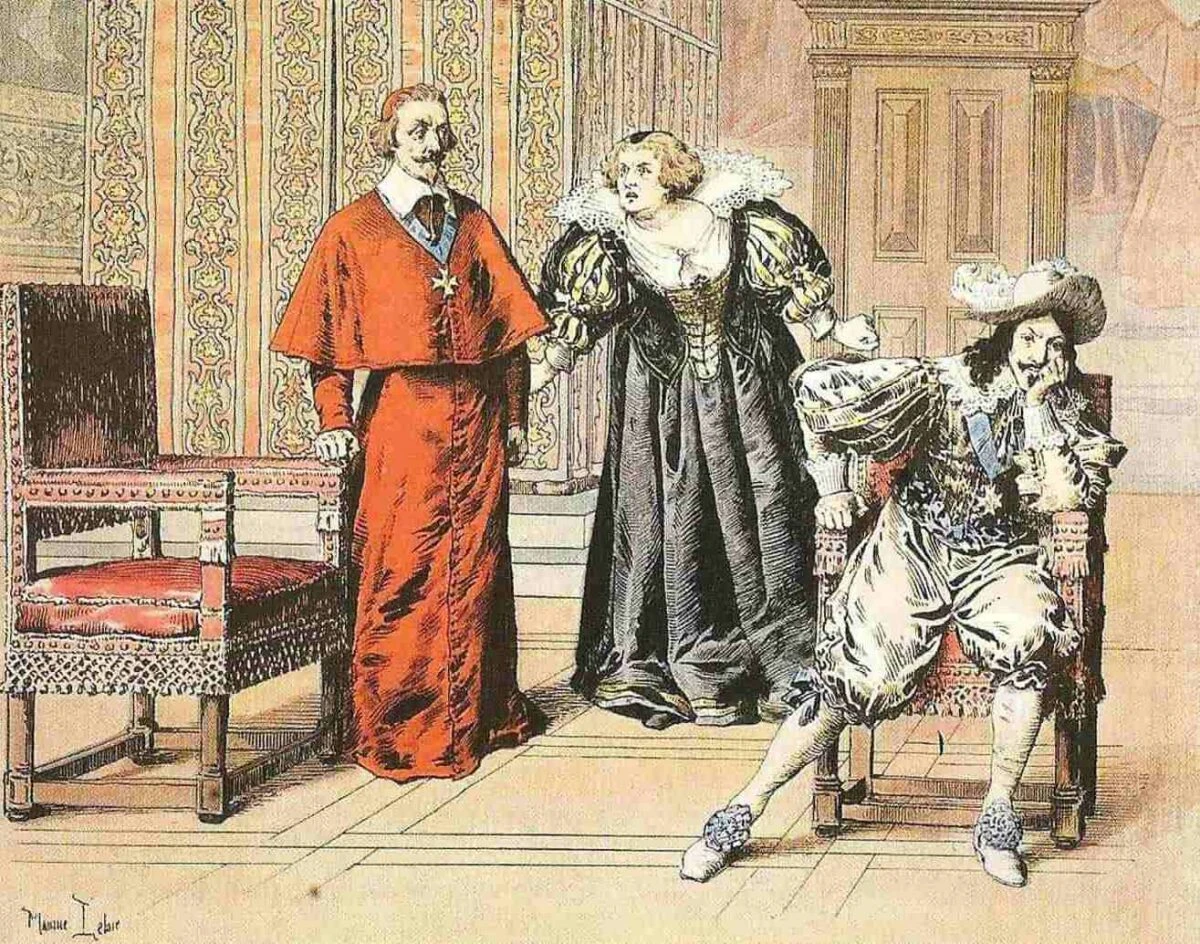
Cardinal Richelieu, Marie de Medici, and Louis XIII. Watercolor by Maurice Leloir. 1910
On November 11, 1630, Marie demanded her son make a final choice: she or the cardinal. The Queen Mother's supporters were so confident of victory that they began celebrating that very morning. But by evening, Louis XIII had made his decision—in favor of Richelieu. This day went down in history as the "Day of the Fooled." In July 1631, fearing for her life and freedom, Marie fled to Brussels. Everything remained in France: furniture, paintings, securities, and the family diamonds.
Exile: Brussels, London, Amsterdam, Cologne
The wanderings lasted 11 years. Richelieu eventually forced her out of Brussels, and from there, in 1638, Marie was forced to leave. She moved to England, then to Amsterdam, where she was still received with honor. Her retinue thinned, her debts mounted, and one monarch after another refused to quarrel with the all-powerful cardinal for the sake of the disgraced mother of the French king. 
Marie de Medici as the goddess Minerva. Rubens. The reality was much more modest than this image.
Her last city was Cologne. She was given shelter by an old acquaintance, Peter Paul Rubens, the artist from whom she had once commissioned the most important work of his life. On July 3, 1642, Marie de Medici died in his house on Flower Lane. Her only companion was a parrot, which she bequeathed to Cardinal Richelieu. The same one. 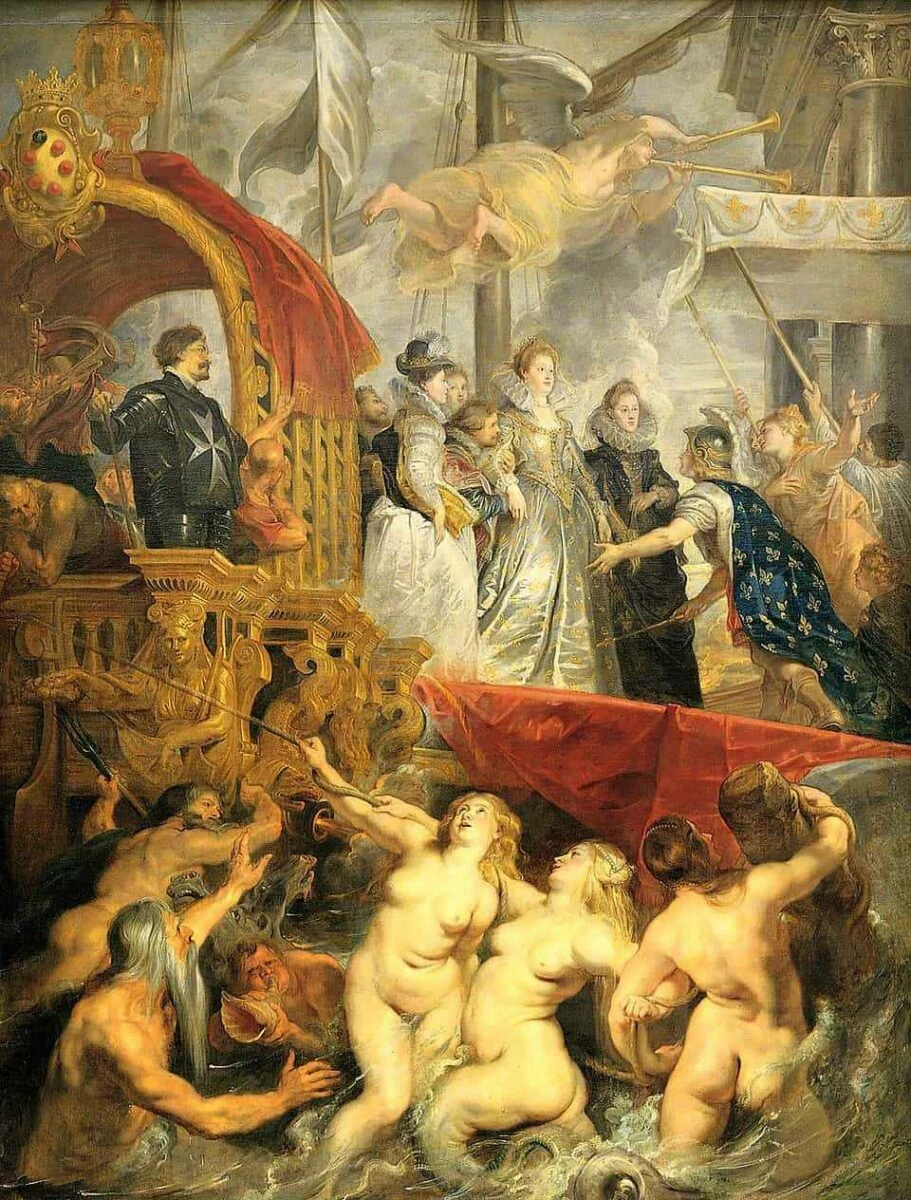
"Arrival in Marseille." Rubens, 1622–1625. Triumphal entry into France – in a painting, not in life
24 paintings and eternal life in the Louvre
The paradox of Marie de Medici's biography is that few remember her, yet her image was seen by millions. In 1622, while she was still in power, Rubens received a commission: 24 large paintings to decorate the Luxembourg Palace. The artist was to depict her entire life – from birth to triumph. 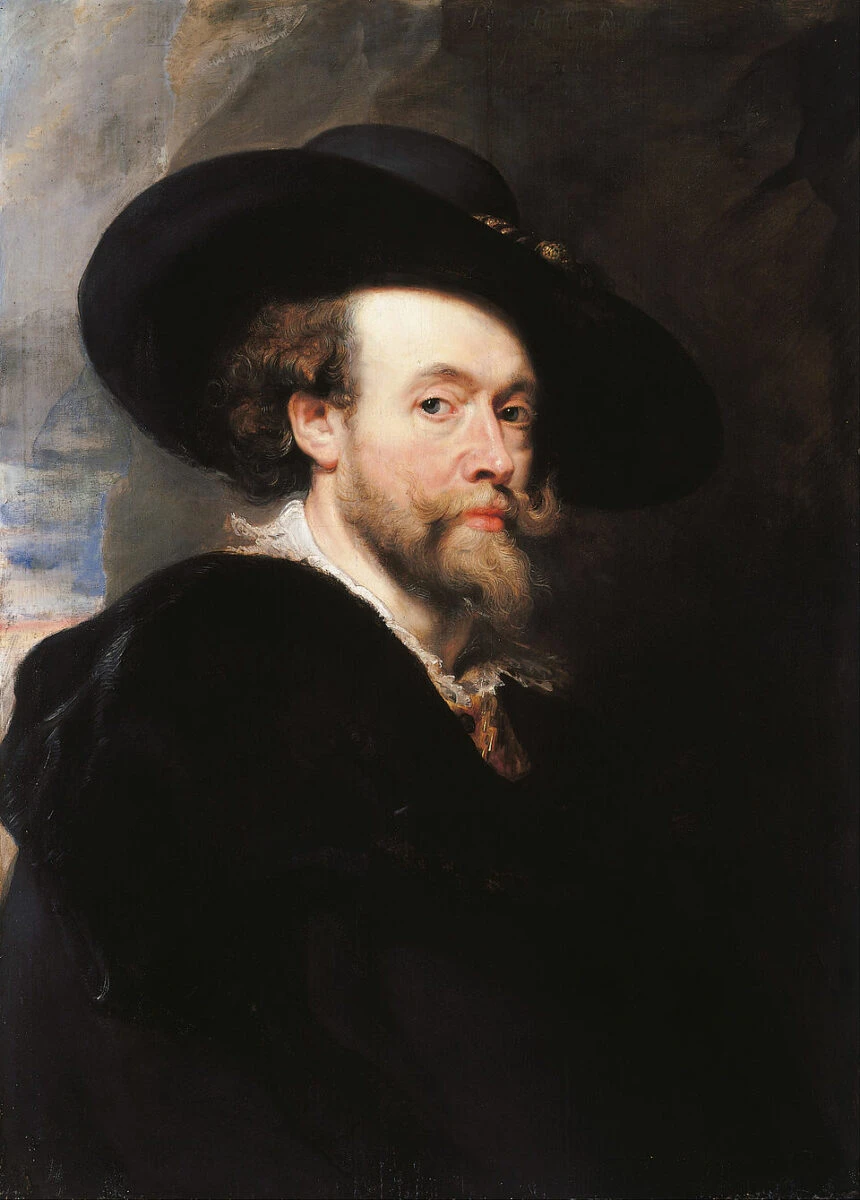
Peter Paul Rubens. Self-Portrait. 1623 – in the midst of work on the cycle for Marie de' Medici
Over three years, Rubens painted the cycle, in which the queen's scandalous biography was transformed into a series of allegorical triumphs. Where there was a real quarrel with her husband, the gods resolved the conflict. Where there was exile, Truth triumphed. Intrigues and failures disappeared, goddesses and cupids took their place.
Maria never saw the paintings in their full glory: by the time the cycle was completed, she was already in disgrace. The Luxembourg Palace, for which the cycle was painted, went to others. The paintings eventually ended up in the Louvre, and there they remain. A portrait of her, painted by Rubens in 1622, is also kept nearby in the Prado in Madrid: a woman who lost everything but her own likeness. 
The remains of Marie de Medici are kept in Saint-Denis. The same basilica where she was crowned in 1610.
What do you think: was Marie de Medici a victim of circumstance, or did she create the trap she found herself in?