OpenAI AI questions Erdős's hypothesis: mathematicians were surprised by a new discovery (photo)
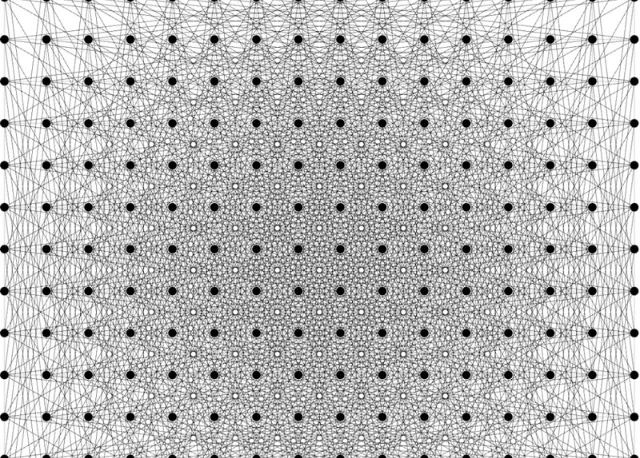
An OpenAI artificial intelligence model has achieved a major breakthrough in discrete geometry, offering a new solution to the famous unit distance problem, posed by Hungarian mathematician Paul Erdős in 1946. This is a problem that scientists had been unsuccessfully working on for nearly eight decades. According to the researchers, the AI not only found an unusual construction, but actually disproved one of Erdős's key assumptions about how the number of equally spaced pairs of points in a plane grows. While it was previously thought that optimal configurations should resemble square lattices, the OpenAI model proposed a completely different approach, demonstrating a more efficient result.
The mathematicians were particularly impressed by the system's ability to independently connect the geometric problem with advanced areas of algebraic number theory. The proof utilized methods related to infinite class field towers and Golod-Shafarevich theory—fields previously largely unrelated to this problem.
The work has already been independently verified by professional mathematicians and has generated widespread interest in the scientific community. Experts call the result one of the most striking examples of how modern AI systems can not only assist researchers but also generate original scientific ideas.