Olympus Mons on Mars: A Giant Volcano That Could Have Been an Island (2 photos)
Olympus Mons isn't just the largest volcano on Mars. It's the tallest known mountain in the entire solar system. Measured from base to summit, it's approximately 26 kilometers high, with a base diameter of about 500 kilometers. 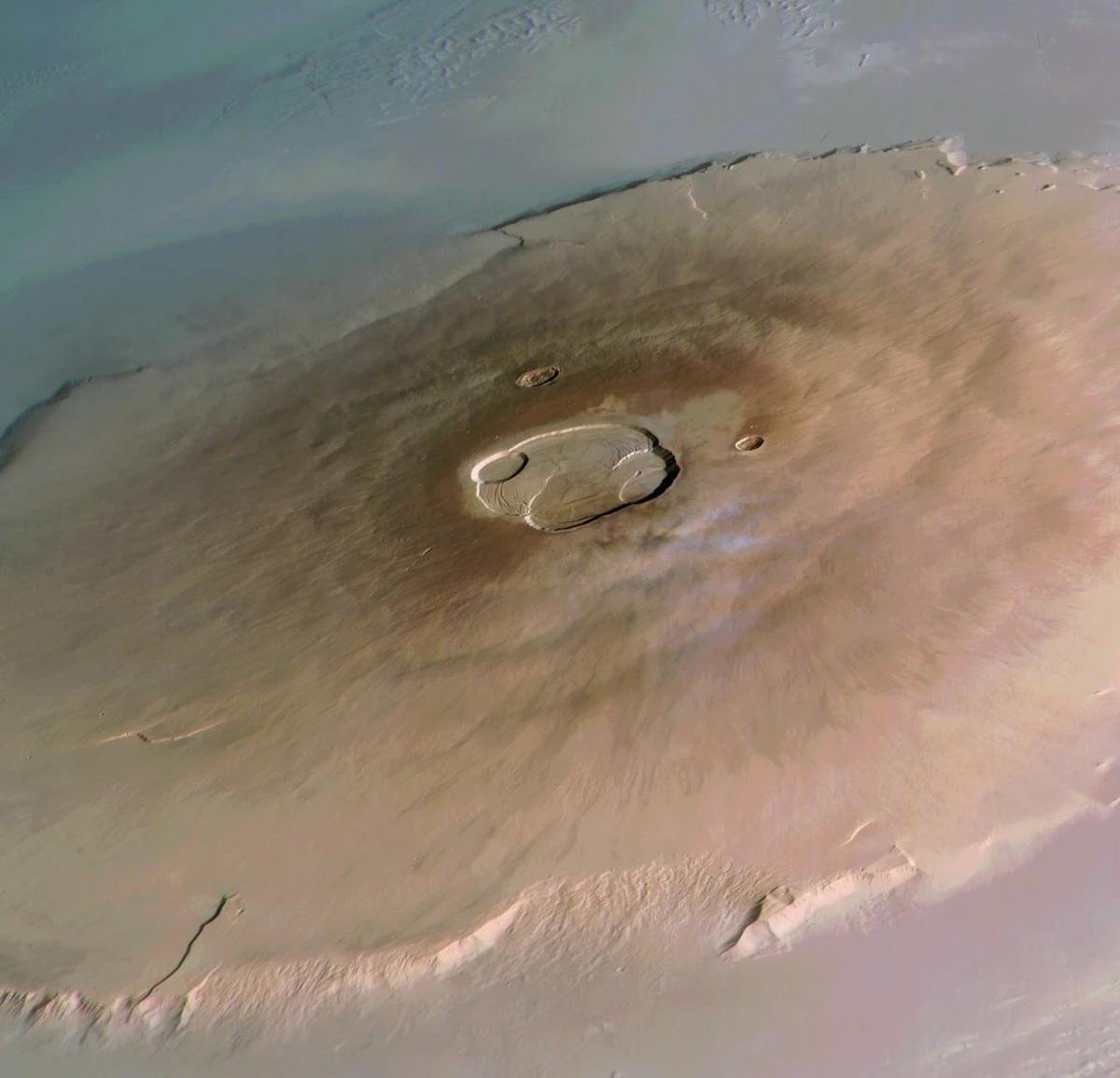
Olympus Mons, captured by the European Space Agency's Mars Express orbiter
For comparison, Earth's tallest mountain, Mount Everest, is 8,849 meters above sea level. Olympus Mons is almost three times higher.
Yet, if you were standing on its slope, you'd hardly realize you were standing on a gigantic mountain. Olympus Mons's slopes are very gentle: the rise is so extended that it resembles an "endless" plain rather than a typical volcanic peak. Only from space does the sheer scale of this structure become apparent.
Olympus Mons is a prime example of a shield volcano. Such volcanoes form when liquid lava slowly flows over vast distances. The lava hardens, and the next eruption covers it with a new layer, causing the mountain to naturally expand in size. On Earth, the volcanoes of Hawaii formed in a similar way, although the Martian giant is many times larger.
The reason for this size is linked to several characteristics of Mars. First, gravity there is significantly lower than on Earth, allowing volcanoes to grow much higher without collapsing under their own weight. Secondly, Mars likely lacked active horizontal plate tectonics similar to Earth. Because of this, the subsurface hotspot could have remained in one place for a very long time, feeding Olympus Mons with new lava flows.
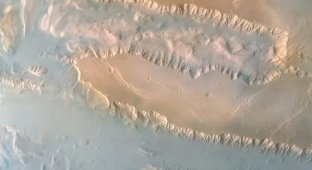
Of particular note is the fact that the base of Olympus Mons is bordered by a scarp several kilometers high, some features of which resemble structures that form on Earth when lava and water interact. One of the most intriguing hypotheses suggests that Olympus Mons formed near an ancient ocean or was a giant volcanic island. 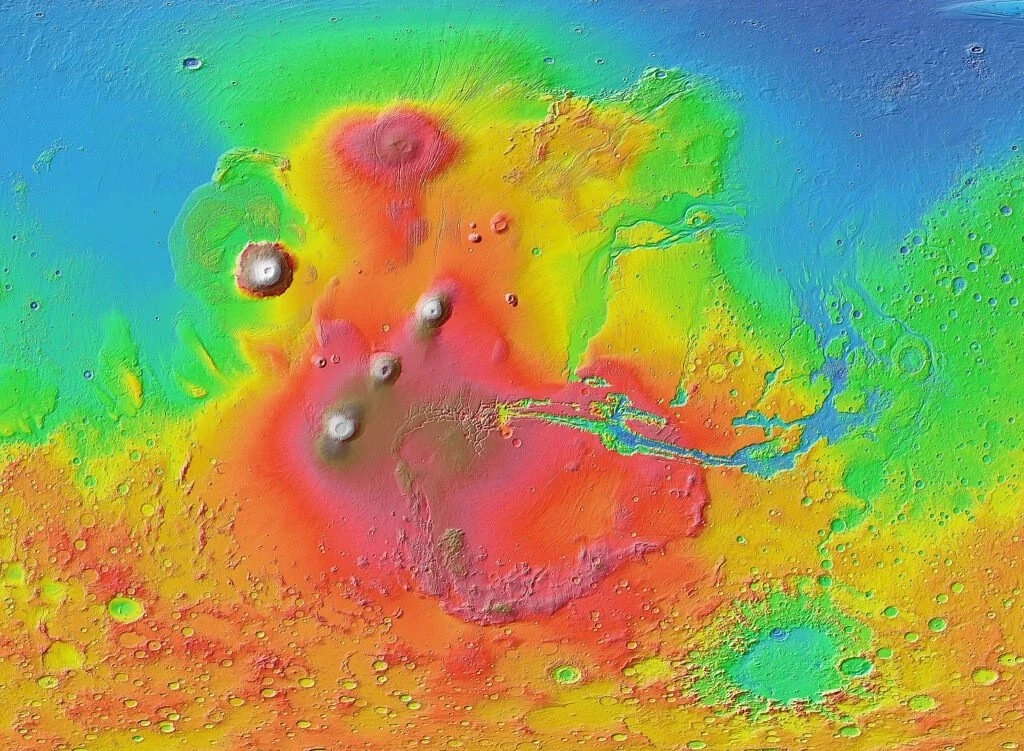
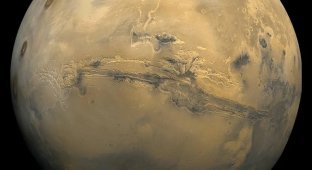
Alba Patera – at the very top; Four other extinct volcanoes are visible below (from top to bottom: Olympus Mons, Ascraeus Mons, Pavonis Mons, and Arsia Mons).
If this hypothesis is correct, then we are talking about events billions of years ago—long before the planet turned into a frozen desert.
Today, Olympus Mons is considered an extinct volcano, although in the past it may not only have erupted frequently but also remained active longer than most other volcanoes on the Red Planet.