How did the ancient Egyptians know about helicopters? The Mystery of Hieroglyphs with Pictures of Technology (3 photos)
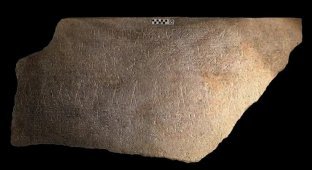
There's a photograph that's traveled around the world and spawned thousands of articles, dozens of documentaries, and one very persistent legend. It shows a stone beam in the Egyptian temple of Abydos, and among the carved hieroglyphs, people clearly see a helicopter and something resembling a modern airplane. 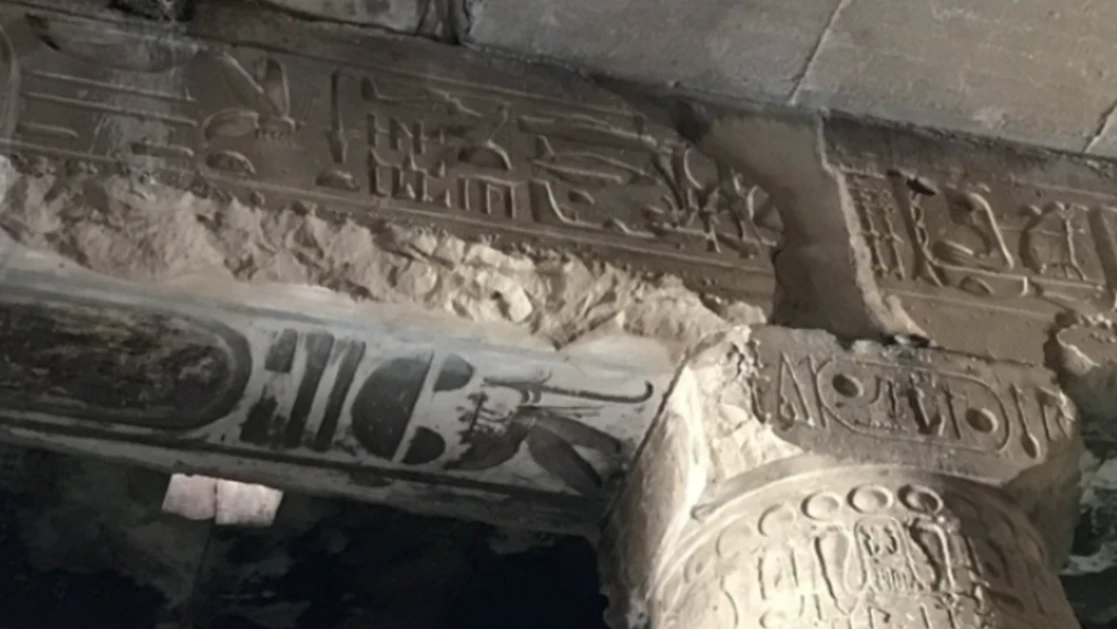
Of course, the most common opinion here is that the ancient Egyptians knew about our technology! So there were either aliens, or a generation of engineers, like in Aliens, or something along those lines.
But it's much more interesting than that.
How it all began
In the late 1990s, a certain Ruth Hover visited Abydos, one of Egypt's most ancient cities, home to the majestic temple of Pharaoh Seti I. She noticed an unusual fragment on one of the beams and photographed it. The photo spread among fringe groups on the internet—those same groups that had long been searching for evidence of ancient civilizations, aliens, and lost technologies. The discovery came in handy.
Later, television crews took up the case. The History Channel launched "Ancient Aliens," and the mysterious beam from Abydos became one of the main "evidence" that the Egyptians were familiar with our technology or received knowledge from extraterrestrial visitors. The image acquired the status of a conspiracy theory icon.
Why does the brain see a helicopter where there isn't one?
Before we delve into the Egyptians, it's worth understanding what's going on in our heads when we look at this photograph.
The human mind is a pattern recognition machine, and it works aggressively. Evolution has honed our ability to instantly pick out familiar shapes from chaos. Our ancestor, who saw a vague silhouette in the bushes and decided it was a tiger, even if it was just the wind, would have survived. Someone who hesitated to interpret it would not. 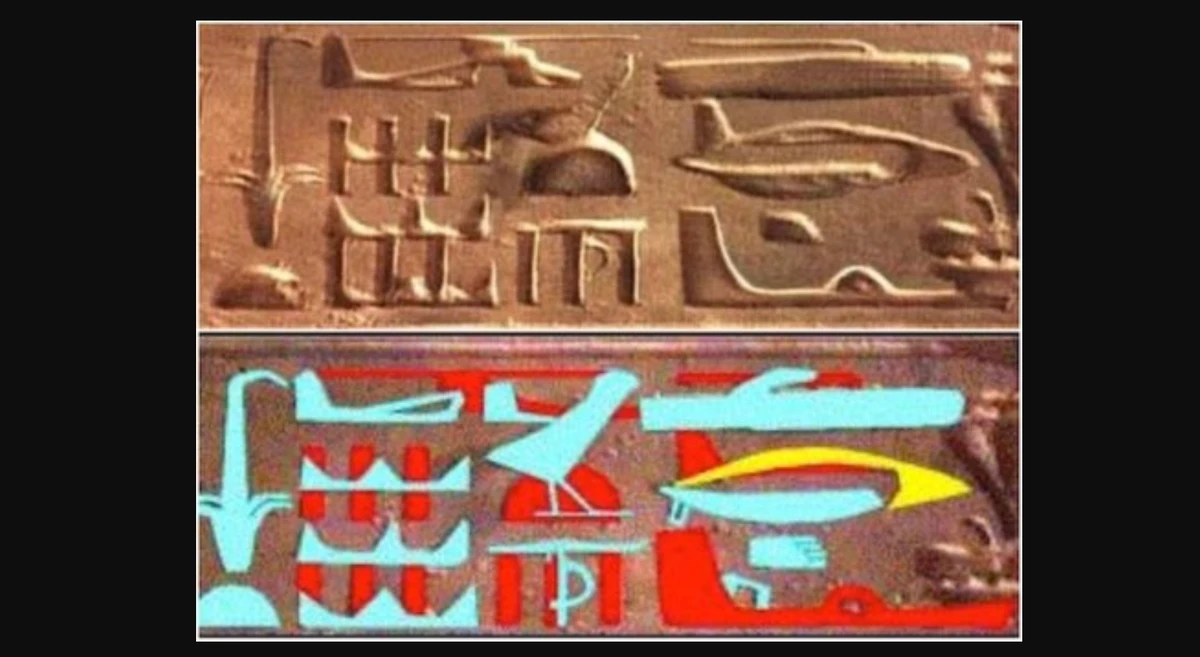
This phenomenon is called pareidolia—the tendency to see meaningful images where none exist. A face on Mars, someone's portrait on toast, a helicopter in ancient stone. The mind dislikes uncertainty. It immediately tries to fit the strange, the incomprehensible, the unfamiliar into familiar categories. Seeing angular contours on the beam, it fishes through its memory for any similarities and finds... a helicopter.
This isn't stupidity or gullibility. It's the basic architecture of human perception.
What's really going on on the beam
Now for the real explanation, which concerns much more understandable human things—vanity and... poor plastering.
The temple at Abydos was built by Pharaoh Seti I, father of the famous Ramses II. Seti was a great ruler, and, as was customary, he immortalized his name and titles on the walls of his own temple, including on that very beam.
When Seti died, Ramesses II ascended the throne. He went down in history as one of the most narcissistic pharaohs of all time—a man who rewrote battle results in his own favor and placed his name on other people's monuments. He did the same here. He ordered his father's inscriptions to be covered with wet plaster, the surface smoothed, and his own cartouches with names and titles carved over them.
The job was done. Both pharaohs were satisfied—one in heaven, the other on the throne.
Three Thousand Years Later
Centuries passed. Then millennia. Egypt changed gods, language, rulers, and religion several times. Year after year, the desert wind blew sand through the colonnades of Abydos. And the plaster began to crumble. 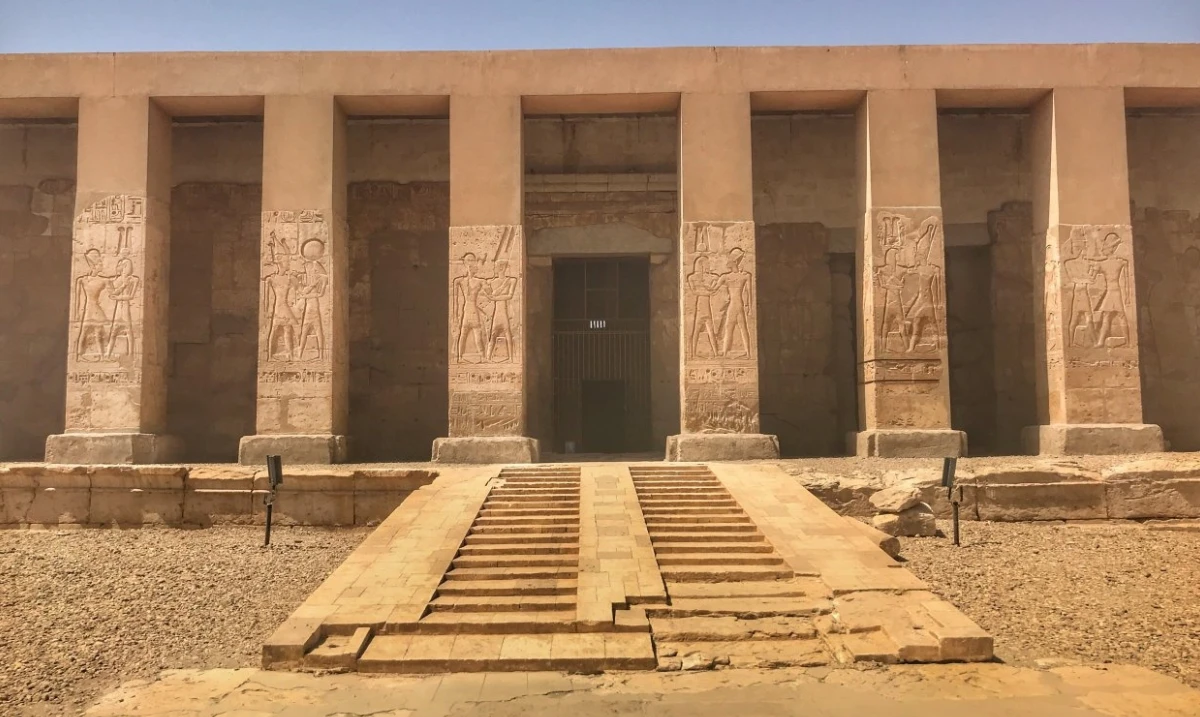
The fragile layer cracked and crumbled unevenly. In some places it held, in others it revealed old carvings. And then, in the spot where the plaster had partially fallen away, something unexpected happened. The lines of two different inscriptions—the one under the plaster and the one on top—overlapped. The hieroglyphs of the father and the hieroglyphs of the son merged into a single visual construct, unintended by either of them.
No Egyptian had ever seen this image. It didn't exist in their world. It arose from the destruction and millennia-long decay of plaster between two dead men who, even in life, had been rivals.
What does this say about us?
The story of the "helicopter hieroglyphs" isn't interesting because of what the Egyptians didn't know. It's interesting because of what it tells us about ourselves.
We live in an era when any photograph instantly spreads across the planet. A random photo taken by a tourist in the semi-darkness of an ancient temple ends up on a forum, from there in a documentary, from there in a conspiracy theory textbook. Each retelling adds credence.
This mechanism works because we want the world to be more interesting than it seems. We desire mysteries, connections, hidden knowledge. This human desire is good in itself. It is what drives true science. But without critical thinking, it devolves into pareidolia—we see a helicopter where two pharaohs simply fought over a wall.
P.S.: It should be noted that we cannot rule out such possibilities as ancient Egyptian communication with aliens or the actual existence of technology from some early civilization. But we must use the scientific paradigm, that is, take the method of cognition and criticism as a basis.