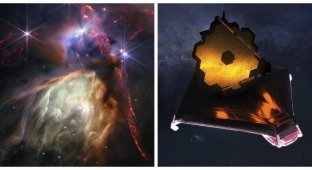
The clearest image of the R Leporis star, which is 500 times larger than the Sun (2 photos)
Looking at a clear night sky far from city lights, we see an endless black abyss, strewn with myriads of stars. In fact, only about 6,000 stars (about 3,000 in each hemisphere) can be discerned with the naked eye, and all of them appear to us as tiny, twinkling points of light due to atmospheric turbulence. 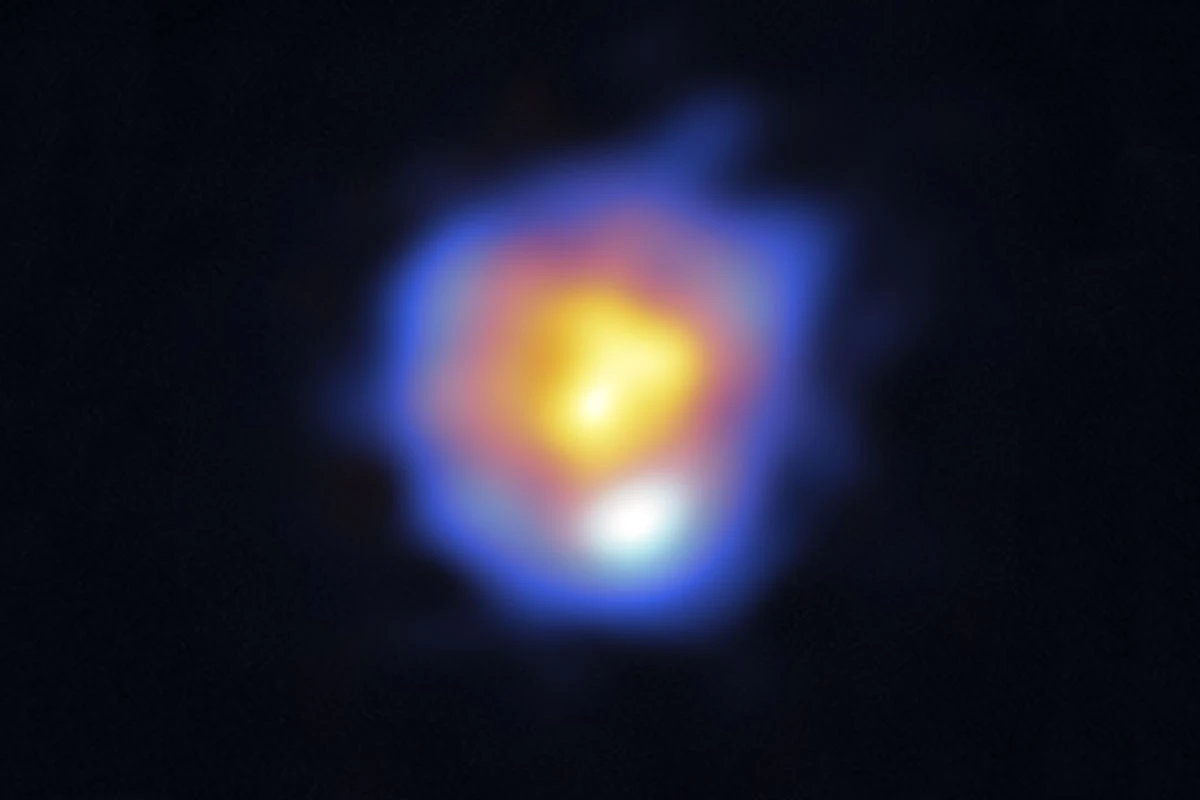
And we're talking about the closest stars to us—our cosmic neighbors within a few hundred light-years of our solar system.
Modern ground-based and space-based telescopes make it possible to overcome this limitation and observe distant stars in detail. This is not only fascinating but also allows scientists to study the processes of stellar evolution.
The Stellar Giant R Leporis
This is the most detailed image to date of the red giant R Leporis, obtained on November 15, 2023, using the ALMA radio telescope array in the Chilean Atacama Desert. This dying star, located in the constellation Lepus (The Lepus) at a distance of 1,490 ± 40 light-years from Earth, is in the late stages of its life cycle.
R Leporis is surrounded by a complex ring structure of gas and cosmic dust, which is constantly replenished by material flowing from the surface of the bloated and pulsating giant. Observations also recorded an unusual phenomenon: the star periodically "ejects" clouds of carbon soot into the surrounding space, like a giant cosmic volcano.
The radius R Lepus today is almost 500 times that of the Sun. If the star were in the same position as our Sun, all the terrestrial planets—Mercury, Venus, Earth, and Mars—would be within its envelope. Moreover, the giant's bolometric luminosity, that is, the total radiation in all spectral ranges, exceeds that of the Sun by more than 13,000 times. 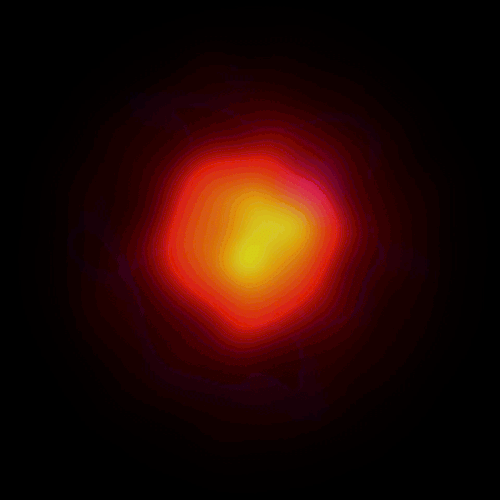
Simulation based on real images
Notably, R Leporis belongs to the class of carbon stars—its atmosphere is dominated by carbon over oxygen. This gives it a characteristic deep red hue and facilitates the formation of complex carbon compounds in the surrounding gas and dust envelope.
R Leporis and the Future of the Sun
By studying R Leporis, scientists are gaining a rare insight into the distant future of our own star. In 5-7 billion years, the Sun will undergo a similar red giant phase, growing in size and ejecting a significant portion of its material into space.
Ultimately, when the star has exhausted all its fuel and shed its remaining layers, all that remains is a "cinder"—a white dwarf, a superdense core of electron-nuclear plasma roughly the size of Earth but with a mass comparable to the Sun.
The complete cooling of the white dwarf will take tens of billions of years (trillions of years, according to some models), and during this time, it will serve as a reminder of the once-existing planetary system R Lepidoptera, which may have once been habitable.