A new reason to FEAR: killer holes that appear beneath you in the water, leaving no chance, and their fascinating physics (3 photos)
For hundreds of years, sailors have told terrifying tales of sea wonders—walls of water rising without warning and mysterious sinkholes swallowing entire ships. These descriptions were long dismissed as superstitious tales. Scientists tended to chalk them up to fear, fatigue, or exaggeration. After all, the very idea of the sea suddenly collapsing beneath one's feet or looming over a ship like a living wall seemed impossible. 
But in recent decades, science has confirmed that behind the myths lies reality.
Today, scientists confidently declare that so-called "rogue waves" are not a myth. These gigantic, suddenly emerging waves are a very real threat, and with the advancement of technology, they are being recorded with increasing frequency. In fact, no one doubted their existence any more. However, their opposite—so-called "rogue holes," or sharp depressions in the sea surface—remained only a hypothesis until recently. There was no evidence of their existence.
The situation changed in 2012, when a group of researchers from the Australian National University experimentally confirmed that "anti-waves" are real phenomena. These depressions in the water mirror the structure of colossal rogue waves. They have the same power, but they are directed downwards, not upwards.
Alas, the sailors of the past weren't so far off the mark. But while rogue waves have become part of the scientific picture, many mysteries remain about "holes." Why do we hardly see them in the open ocean?
The problem is clear. About 80% of the World Ocean remains unmapped, and visual observation of the seafloor has only been conducted for a measly 0.001%.
Sailors of past centuries, lacking satellite navigation and modern sensors, were much more attentive to the behavior of the sea. They had to rely solely on their own eyes and intuition. Therefore, their stories, although sometimes improbable, should not be dismissed out of hand.
Giant waves are not related to earthquakes and are not caused by underwater movements, which distinguishes them from tsunamis. They are formed by the complex interaction of waves superimposed on one another, concentrating their energy in one place. This makes them difficult to predict, but extremely dangerous for both ships and maritime infrastructure. 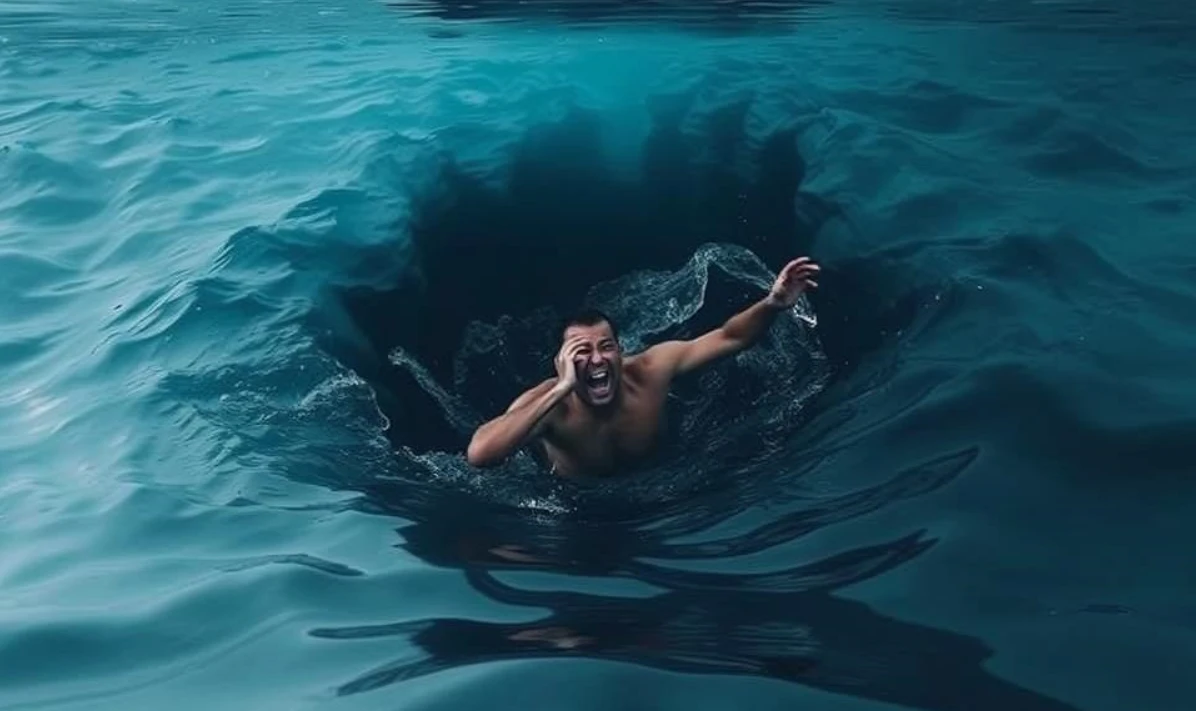
But "killer holes" are their mirror image. A 2012 study showed that such depressions can suddenly appear on the sea surface as a localized crater surrounded by two crests. This is a perfect inverse reflection of a rogue wave, only instead of an upward surge, there is a downward dip. It is hypothesized that huge holes in the sea are the reverse effect of a giant wave, but where exactly the sea surface will compensate, or, better yet, how, is difficult to predict. Hence the elusiveness of these phenomena.
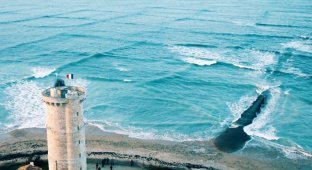
During his third voyage in 1498, Christopher Columbus recorded an unusual phenomenon. A terrifying roar and a wave "as tall as a mast" literally lifted the ship upward, after which it crashed into a deep trench. Later, in 1861, a gigantic wave reached a lighthouse on the west coast of Ireland, breaking the glass lamps inside and overcoming a 66-meter barrier of cliffs and structures. All of this remained the stuff of fairy tales.
It wasn't until 1995 that an anomalous wave was first recorded in the North Sea off the coast of Norway—it struck an offshore gas pipeline on December 31 and reached a height of 25.6 meters. This event, dubbed the "Draupner wave," became a turning point in the study of marine dynamics.
In 2000, the MaxWave project, implemented by the European Space Agency, provided tangible evidence. It turned out that rogue waves are not at all uncommon. Using satellite radar, researchers recorded dozens of waves taller than 25 meters. 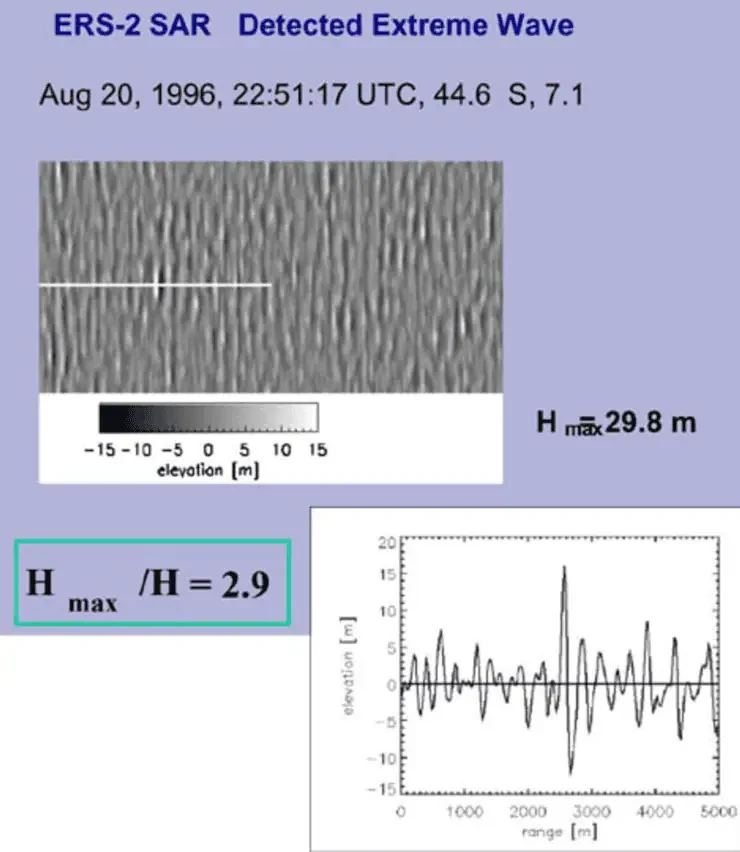
Although MaxWave did not directly report observing sea vortices, it did note strange, deep depressions accompanying the enormous waves. This led scientists to believe that rogue holes might be part of the same phenomenon—just a different aspect of it.
To test this hypothesis, Kyoto University conducted a unique experiment. In a 15-meter-long wave tank, researchers recreated ocean conditions and simulated both rogue waves and rogue holes.
Both rogue waves and their inverse counterparts are caused by the same nonlinear wave mechanism. Imagine an "energy shell" moving with the wave. If it coincides with a peak, a giant wave is formed. If it coincides with a trough, a hole is formed. These are two sides of the same physical phenomenon.
And in 2016, another study showed that similar structures exist in the real ocean. Analyzing satellite data and mathematical models, scientists recorded asymmetrical yet recognizable structures of rogue waves and troughs.
The arithmetic underlying rogue waves and holes is applied beyond hydrodynamics. Similar processes are observed in nonlinear optics, plasma physics, and even economics. Research into such waves opens up interdisciplinary prospects, from predicting financial crises to energy management in lasers. In the context of the channel, this is particularly interesting, since many quantum phenomena may obey similar mechanisms.