10,000 Naked, Wet Japanese Men Attempt to Catch Two Sacred Sticks (1 photo + 4 videos)
Category: Interesting photo stories, PEGI 0+
4 March 2026
While the Western world debates the boundaries of personal space, space at the Japanese temple Saidaiji Kannonin has shrunk to critical levels. 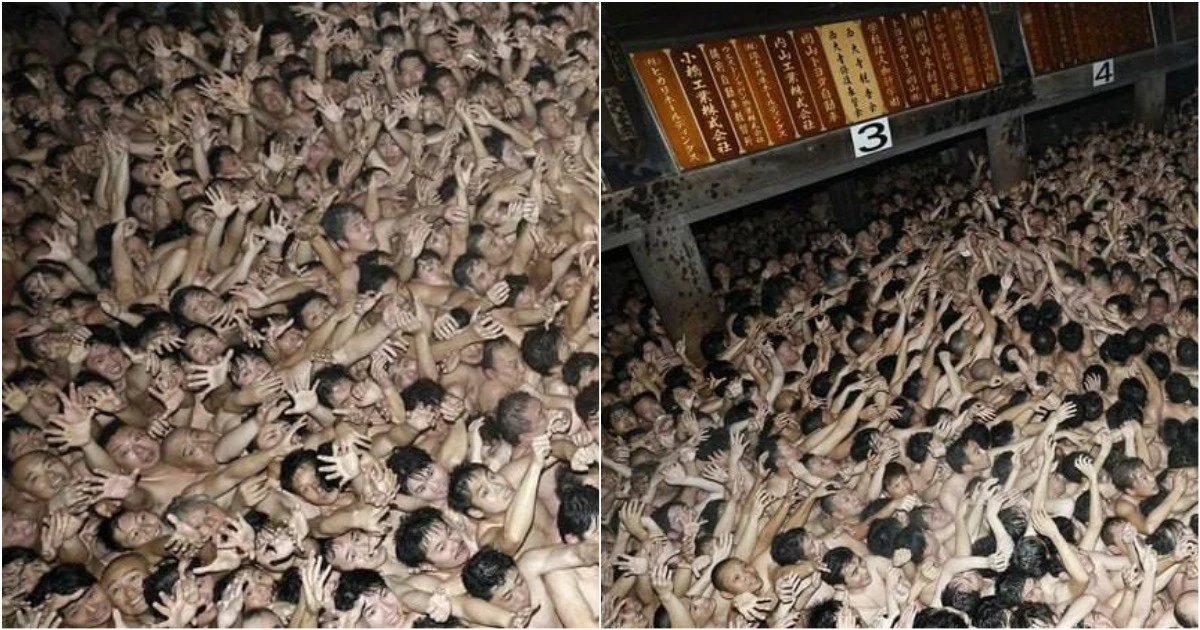
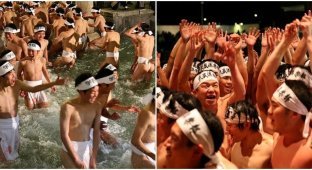
The traditional Hadaka Matsuri festival, with a history of over 500 years, once again proved that the desire for good fortune is stronger than the instinct for self-preservation and sub-zero temperatures. Around 10,000 men, clad only in fundoshi (traditional headbands), staged a mass "blessing fight."
The culmination of the festival came at 10:00 PM, when the temple's lights were completely turned off. At that moment, the priests tossed the grand prize—two sacred wooden sticks called "shingi," made of aromatic camphor—into the frenzied crowd.
To sweeten the deal for the other participants, a hundred bundles of ordinary willow branches were thrown after them, but only two could truly claim the title of "lucky winner of the year" (fuku-otoko). In complete darkness, thousands of people tried to find the coveted 20 centimeters of wood, triggering a stampede that sent six participants to hospital beds right from the epicenter of the action.
The rules for capturing the artifact are reminiscent of rugby in ultra-hardcore mode. Simply snatching the stick out of thin air isn't enough. It must be carried through a sweaty and extremely aggressive crowd to finally be slammed into a special box of rice (masu). It's at this stage that the struggle for the "blessing" becomes a test of ribs and jaws.
Considering that the participants are first doused with ice water for purification, and it's far from summer outside, the event turns into a unique physiological experiment in the body's survival in extreme conditions.
Interestingly, five centuries ago, the Japanese fought over paper talismans. But since paper had the unfortunate tendency to crumble in the hands of parishioners eager for happiness, it was replaced with sturdy wooden blocks. This solved the problem of preserving the artifact, but added work for traumatologists. What from the outside looks like a chaotic "sausage party" in maximum compression mode, for the Japanese themselves is an important act of strengthening community ties.
Okayama doctors, accustomed to the annual influx of such patients, point out that divine luck is distributed more effectively if the applicant has intact limbs. Nevertheless, the number of those seeking "wooden happiness" continues unabated.