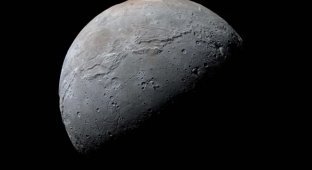
Pluto may have an ocean—right under its "heart" (3 photos)
There's a region on Pluto that anyone who's ever seen images of this dwarf planet in the Kuiper Belt will remember. This is Tombaugh Regio, or Pluto's Heart—a gigantic, heart-shaped region that extends approximately 2,300 kilometers. 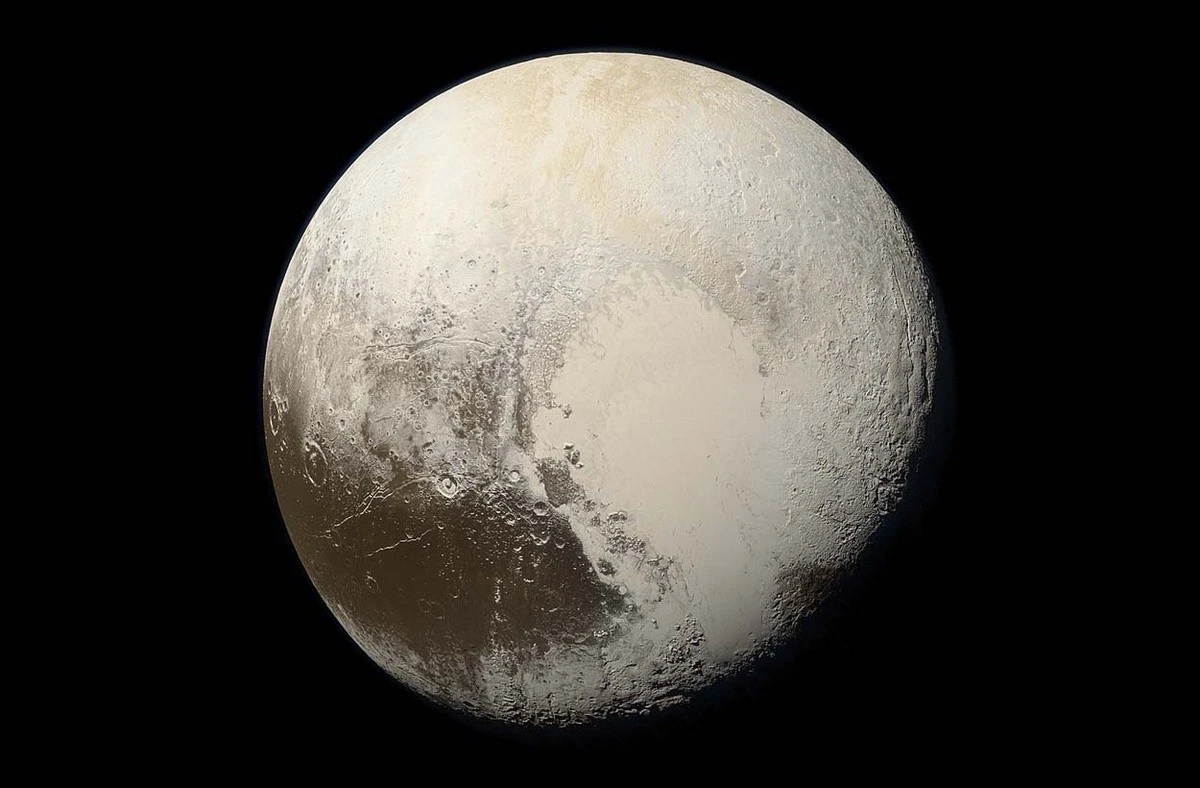
Natural-color image of Pluto, taken by the New Horizons probe on July 14, 2015, from a distance of 35,445 kilometers
The western part of this region is occupied by Sputnik Planitia, an icy plain measuring 1,400 by 1,200 kilometers. It is this plain that attracts particular attention.
For comparison, Pluto's average diameter is 2,377 kilometers.
Image Analysis
On July 14, 2015, NASA's New Horizons spacecraft flew past the Pluto system, transmitting numerous images back to Earth, including some quite detailed ones.
The researchers' attention—like that of anyone, perhaps—was immediately drawn to the "heart." Armed with all the available data, they began modeling to explain how such an unusual structure could have formed on the outskirts of the Solar System. Primarily, they focused on Sputnik Planitia—the western lobe of the "heart," which stands in stark contrast to the rest of the dwarf planet's surface. 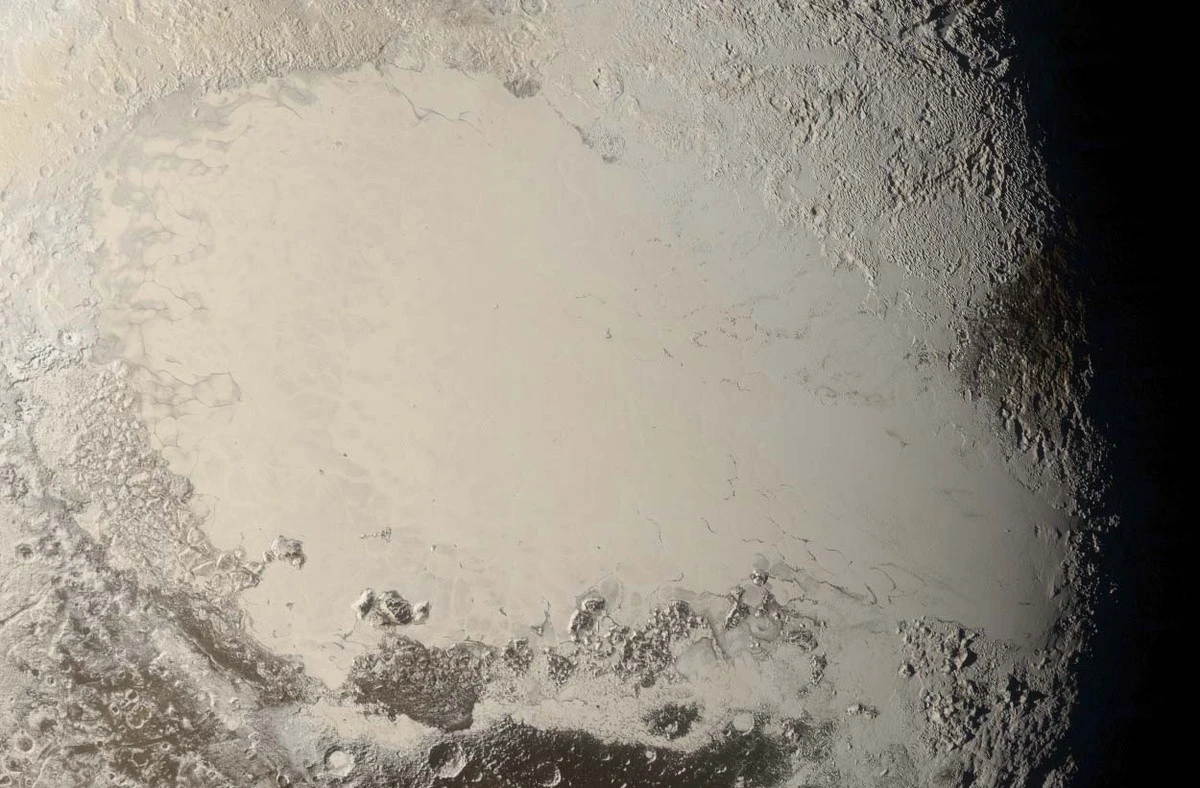
Sputnik Planitia
It was ultimately determined that Sputnik Planitia is covered by a thin layer of nitrogen ice, beneath which lies a "slab" of water ice 40 to 80 kilometers thick, acting as natural thermal insulation. A subsurface ocean may exist beneath it, and its presence influences stresses in the ice crust and the pattern of cracks on the surface.
Modeling showed that the salinity of this ocean is approximately 8% of the salinity of the Earth's oceans (meaning the water is not "seawater" but rather slightly salty).
The Power of Modeling
The foundation of modeling is the existing data (constants), to which are added the hypothesized phenomena and physical processes (variables and parameters). The model is then tested to see if it matches observations. If the result is negative, the variables are adjusted. However, modern supercomputers allow for the simultaneous consideration of many options, generating thousands, even millions, of models.
In modeling Pluto's subglacial ocean, the key parameter was its density, which depends on salt and temperature. If the ocean were too "light," the ice shell above would behave differently, and more fractures would be visible on the surface. If it were too "heavy," conversely, fewer fractures would be visible. Thus, by exploring possible ranges and comparing models with observed images, scientists were able to estimate the salinity of the hypothetical ocean.
It's important to understand that modeling isn't a flight of fancy, but a methodology honed over decades: it relies on measurements, physics, and statistics, not on the desire to "tweak" the results. The value and effectiveness of modeling is most easily seen on Earth: scientists constantly model things they don't directly observe (for example, predicting glacier melt, flood risk, pollution spread, or rock structure during mineral exploration), and then validate their conclusions against independent data and real measurements.
The Birth of an Ocean
Before New Horizons' encounter with Pluto, the concept of a subsurface ocean sounded like science fiction: the body is small, very far from the Sun, its structure doesn't allow for internal heat retention, and there's no internal heat left, as the dwarf planet has long since cooled. 
Northwestern part of Sputnik Planitia
Today, the probability of a subsurface ocean on Pluto is assessed as "high." It could have formed as a result of a very powerful ancient impact that formed a deep depression and melted a huge amount of water ice. Salts, geology, and environmental conditions did not completely freeze the resulting global body of water, but rather led to the formation of a thick crust above it. Today, gravitational interactions with Charon, Pluto's largest moon with an average diameter of 1,212 kilometers, play an important role in maintaining the ocean's liquid state.
What does this change?
If there really is an ocean beneath the "core," then Pluto is no longer just a "frozen rock" on the outskirts of the Solar System. If this subsurface reservoir is long-lasting enough, the dwarf planet could be considered a potentially habitable world.