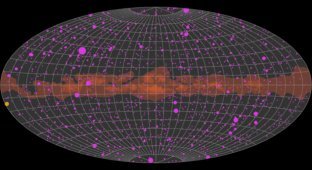
Where are the aliens? — The Fermi Paradox and its possible solutions (8 photos)
Many people interested in astronomy have heard of the Fermi Paradox. Its essence is that we don't see representatives of extraterrestrial civilizations, although they should exist ("little green men don't count"). 
I'll tell you about the origin of this paradox and possible solutions, and at the end, you'll learn about the connection between this issue and the scientist Konstantin Tsiolkovsky, who died 15 years before the paradox was formulated. But first things first!
The Emergence of the Paradox and Its Context
It was the summer of 1950. Several renowned physicists gathered in the cafeteria at the Los Alamos National Laboratory (yes, that's where nuclear weapons are developed) to eat and chat. Among them was Enrico Fermi, a world-famous scientist by then. He had won the Nobel Prize in Physics in 1938 and had participated in the development of the world's first nuclear reactor. 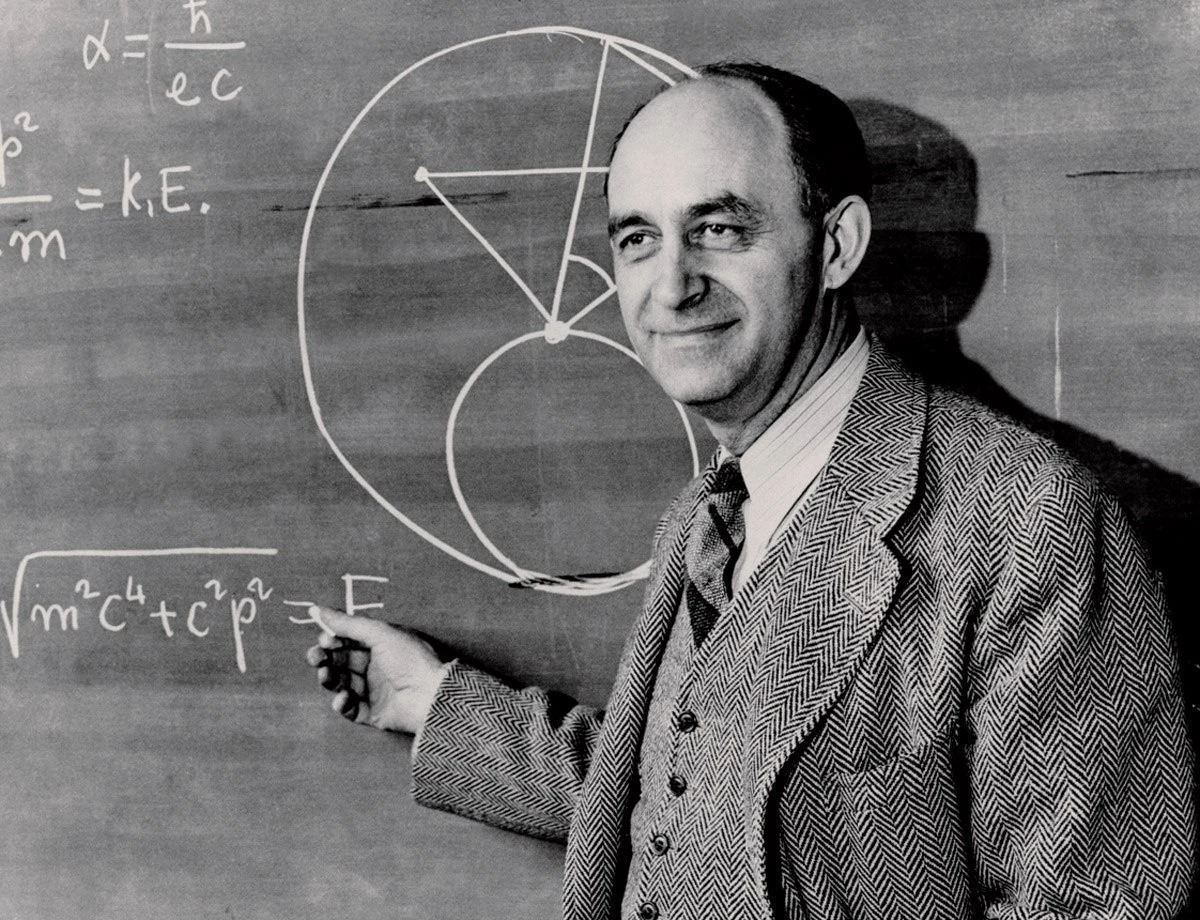
Enrico Fermi
During their conversation, the scientists began to discuss the possibility of extraterrestrial life. The occasion was a cartoon in The New Yorker magazine that jokingly depicted aliens abducting Earth's urns. To understand the essence of the conversation, it's important to understand its context. After all, at the time, humanity was taking its first steps into space, and the press was already reporting on UFOs. Fermi said something like, "Where is everybody?", referring to aliens who might allow themselves to be discovered if they truly existed.
In those distant years, many people sincerely believed that humanity would encounter extraterrestrial life in the foreseeable future. And this applied not only to ordinary people but also to scientists. For example, many seriously considered the existence of life on Mars (although some scientists doubted this even then). Since it seemed to the public that contact with aliens would soon be established, the logical question arose: "Why didn't they contact us sooner?" Therefore, Fermi's words were relevant in 1950. However, they are still relevant today! 
The Drake Equation
Since the middle of the last century, scientists have been trying to mathematically justify the possibility of the existence of extraterrestrial life seeking to contact us. Astronomer Frank Drake created a formula that can achieve the desired result. The equation looks like this: N = R* × fp × ne × fl × fi × fc × L. Those who can't stand formulas since school should probably close the article here, but I promise there won't be any more formulas, and we'll figure this one out very simply. 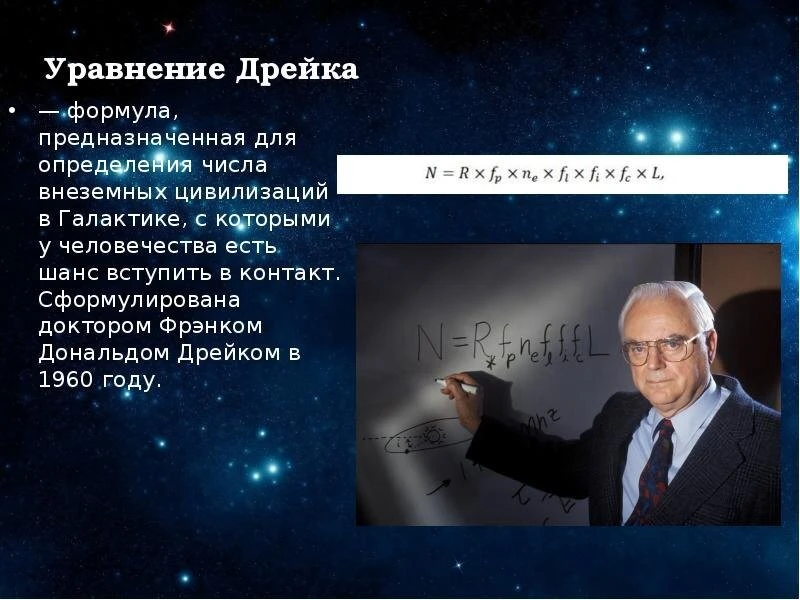
As you might guess, N represents the number of alien civilizations willing and able to contact Earthlings. To obtain this number, we first take R*—the number of stars formed in the galaxy each year. Most experts claim that one star is born in the Milky Way every year (for the equation, that's 1). This quantity must be multiplied by the number of stars (fp) (pardon the tautology) that have planets. This is approximately half the stars in our galaxy (0.5).
Then we multiply this by the number of planets in the solar system (ne) where life can exist. There should be approximately two. For example, in our Solar System, these are Earth and Mars. Then we multiply by the value (fl), which represents the emergence of life where it is possible. This is a highly controversial factor, since we can essentially only use the experience of our own planet. Yes, life arose on Earth, but that doesn't mean it will on other planets. Mars is a prime example (although life may exist there, or at least has existed there). In general, scientists have chosen the value of 1 for fl, although this is rather dubious. 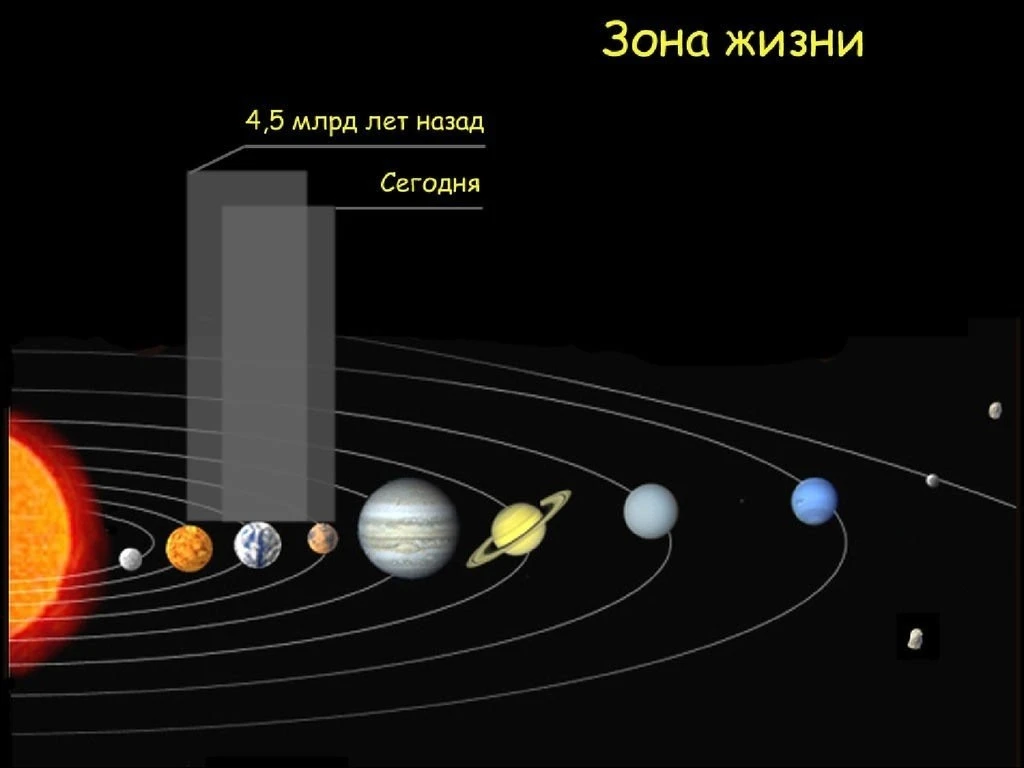
Number of planets where life could arise
Then all this is multiplied by the probability of life developing to the level of intelligence (fi) – that's about one hundredth of a percent. And this is a rather optimistic assumption. After all, approximately 3.5 billion years passed between the emergence of simple life forms and humans. And during this time, so many events occurred that the emergence of humans seems more like an exception than a pattern. It's fortunate that life has survived at all, considering asteroids, cold snaps, volcanic eruptions, and other cataclysms.
Finally, we multiply the result by the value fc, which represents the desire and ability to establish contact with an alien civilization. This is again debatable, because the experience is again based only on the experience of our planet. Aliens may not want to communicate with anyone at all. But scientists have agreed to give a hundredth of a percent (0.01). The final value, L, represents the number of years a technologically advanced society has existed. They cite 10,000 years, which raises questions. After all, the construction of the pyramids only began about 5,000 years ago. However, the estimate depends on our understanding of the meaning of the words "technologically advanced civilization."
So, what do we have? The equation looks like this: N = 1 × 0.5 × 2 × 1 × 0.01 × 0.01 × 10,000 = 1. So, does that mean there's only one civilization in the galaxy seeking contact? It's our Earth, of course. Then it's clear why we haven't found anyone! But it all depends on the numbers you use. The result could be several thousand. But there are also pessimistic estimates, expressed in hundredths and thousandths of a percent. In any case, the Drake formula has provided scientists with a mathematical explanation for the Fermi Paradox. But there are other points of view! 
Attempts to Solve the Paradox
The simplest and at the same time saddest answer is that we are alone in the Universe. Absolutely alone! The main argument is the fact that we find no traces of alien life in our Solar System or around nearby stars. Perhaps its emergence requires unique conditions (all of which we still don't know), which existed only on Earth billions of years ago. As sad as this hypothesis may sound, we are unable to refute it today.
Some scientists point out that we may be the only intelligent life form in the Universe. After all, the process of its emergence takes billions of years, during which, as noted above, a lot can happen. Or another option is possible. Civilization reached a high level of development and ceased to exist. For example, as a result of war. The Cuban Missile Crisis demonstrated that a single action can determine the fate of humanity. We chose a peaceful resolution, while someone on another planet could have ordered a nuclear attack.
And how do people even expect to detect life around other stars? That's right, with radio signals (other methods are not yet sufficiently developed). The idea is that if someone transmits a signal, either intentionally or accidentally, it will reach us sooner or later. It's not a bad idea, but distances must be taken into account. A radio signal reaches the nearest star system, Alpha Centauri, in about four years. Now remember that the first radio signals on Earth began to be transmitted at the turn of the 20th century. This means we can only be heard at a distance of about 125 light years. And that's without taking into account the signal strength. Considering the enormous size of our galaxy (its radius exceeds 50,000 light years), we haven't even begun searching on its scale! 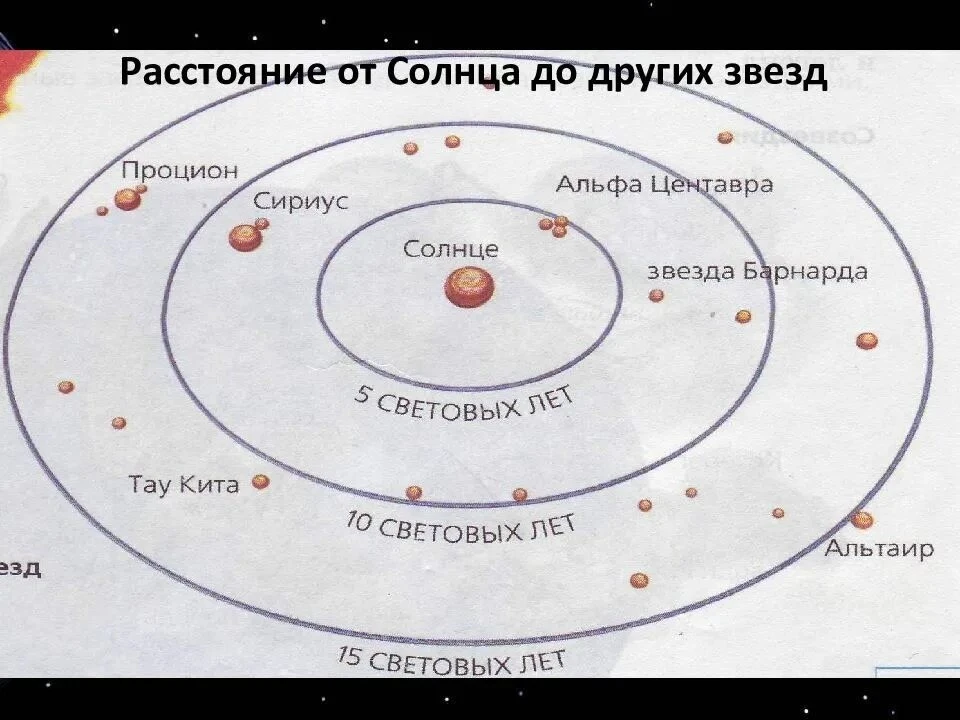
Nearest stars where radio signals from Earth could reach
There's also the zoo hypothesis, which seems interesting but still doesn't answer all the questions. They say alien civilizations are so advanced that we're like animals to them. Few humans interact with, say, ants. So they might not want to interact with us either. But one could argue. Humans interact with cats and dogs. Why are they so reluctant to interact with us? And, really, are all alien civilizations that advanced? Some might still be at our level!
As a further development of the zoo hypothesis, we can consider the possibility of a Dyson sphere. This is a theory developed by physicist Freeman Dyson. He posits that an advanced civilization could form a kind of shell around a star to maximize its energy. In this case, it would be unprofitable for such a civilization to search for anyone, as this would only lead to a waste of resources. This is an interesting theory, but it likely only applies to a fraction of aliens (if they actually exist). After all, such a sphere only exists at a certain stage of development. More or less powerful civilizations may not focus on their stars. 
Possible Dyson Spheres
There are other possible explanations for the Fermi hypothesis. For example, aliens may use communication methods other than radio signals. It's also not certain that they even want to make contact with anyone, which is why they carefully conceal any signs of their existence. But sooner or later, they could reach such a high level of development that their activities would be difficult to distinguish from natural phenomena. Incidentally, this hypothesis was supported by the Soviet astronomer Iosif Shklovsky.
The Fermi Paradox Before It Appeared
In fact, the preconditions for the paradox's formation existed long before it emerged. After all, humanity pondered the possibility of contact with aliens and the actual absence of such contact. Scientist Konstantin Tsiolkovsky supported the zoo hypothesis. He believed that the time had not yet come for aliens to contact humans, because we are like animals to them. However, as I wrote above, this is just one theory.
Where do you think everyone is? I'm waiting for your crazy (and not so crazy) comments.