Why Cashews Are Always Sold Shelled: It’s More About Safety Than Convenience (7 Photos)
We crack open pistachios ourselves and use nutcrackers on walnuts. But cashews always reach store shelves pre-shelled. 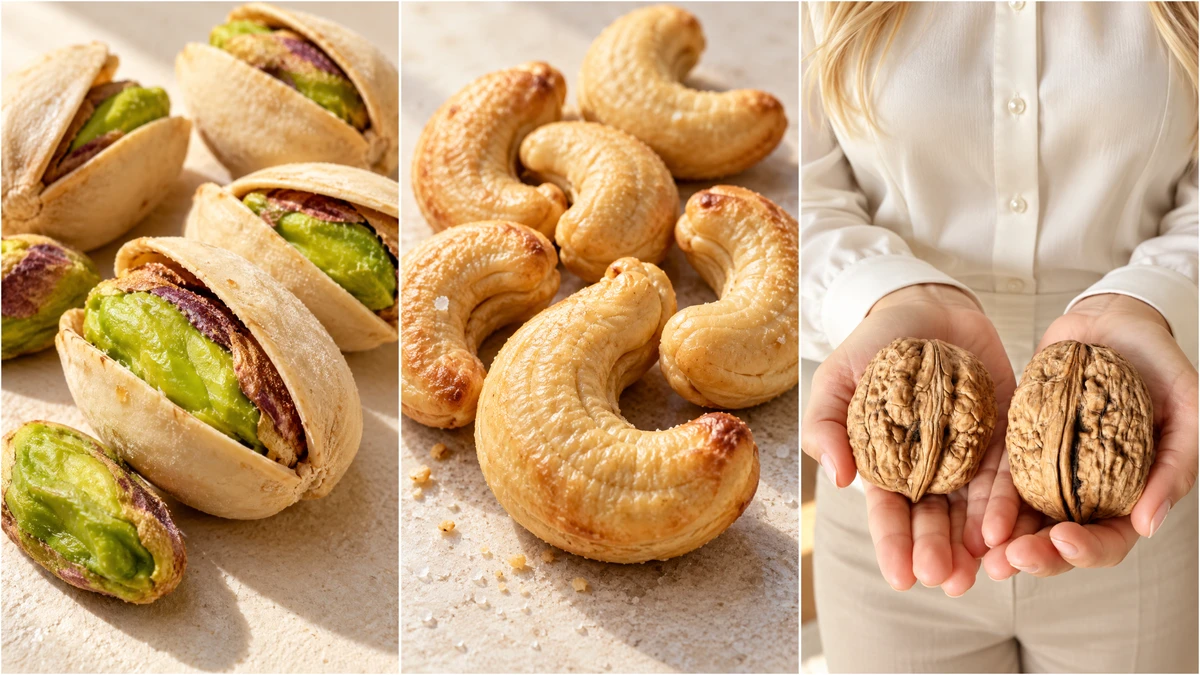
Their outer shell contains a caustic liquid that can cause severe skin burns if opened improperly. That is why cashews are shelled commercially, where the nuts are pre-treated before the kernels are carefully extracted.
What Lies Between the Shell and the Kernel
A cashew shell consists of multiple layers. Nestled between the outer and inner shells is a honeycomb-like spongy tissue saturated with a dark, oily liquid containing anacardic acids, cardol, and other active compounds. This mixture irritates the skin and can trigger contact dermatitis—a painful inflammation causing itching and rashes. 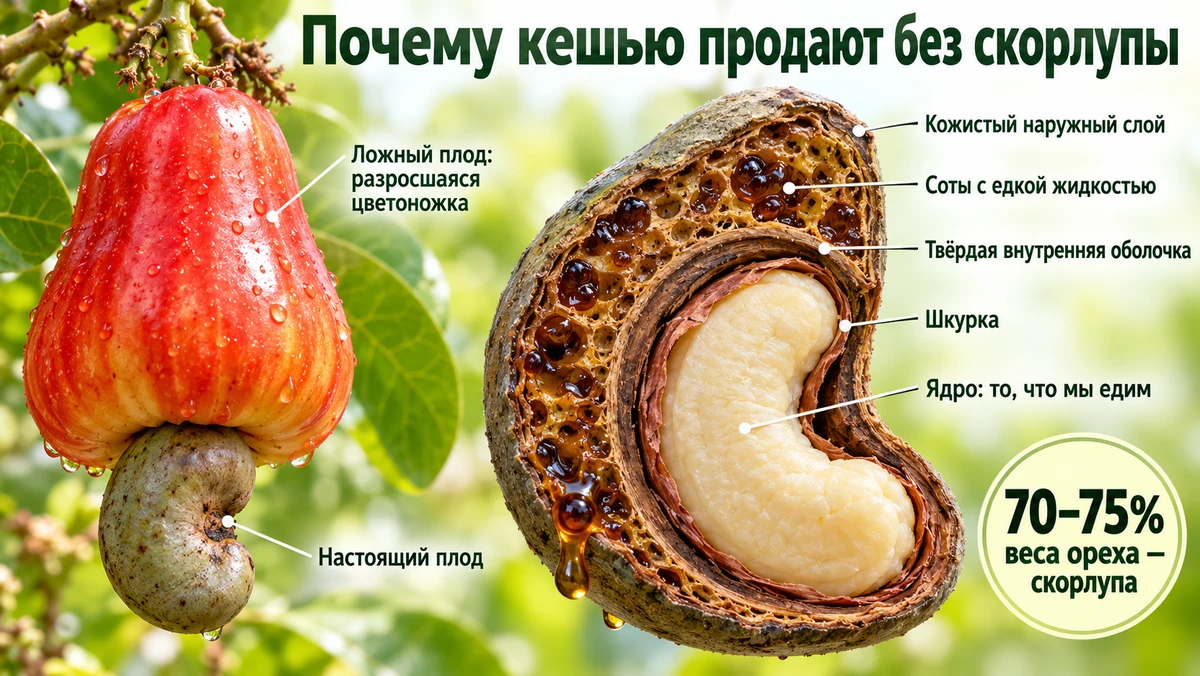
Some of these chemical components are structurally similar to those found in poison ivy, which causes itchy blisters upon contact. In fact, cashew trees belong to the same plant family, Anacardiaceae, which also includes mangoes and pistachios—though that botanical kinship doesn't mean their fruits are equally hazardous.
When shelling cashews, the main challenge is preventing this caustic liquid from coming into contact with workers' skin or contaminating the edible kernel inside.
How Cashews Are Shelled
First, unshelled cashews are typically steamed or roasted in specialized rotating drums. Another method involves dipping them into hot liquid extracted from the shells themselves. Heating softens the shell and helps separate the kernel, though extreme caution is still required throughout the process. 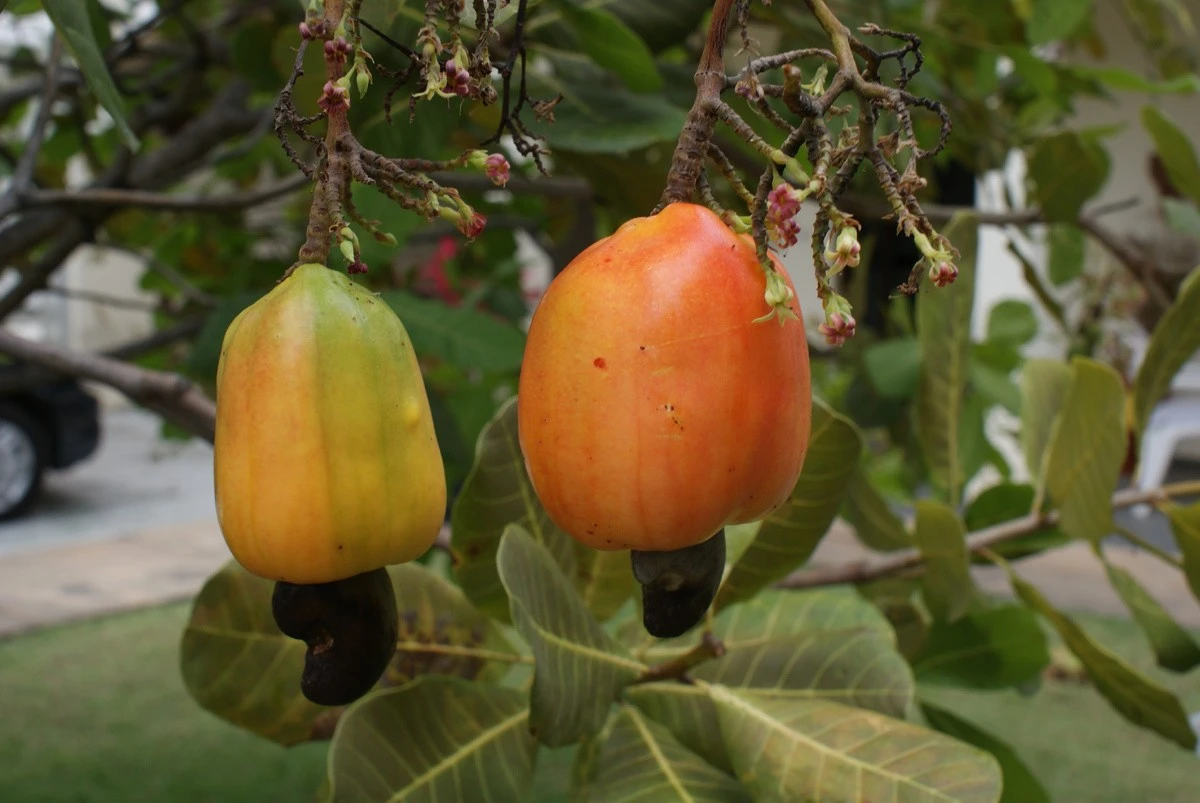
The familiar cashew nut hides inside a small shell beneath a juicy "cashew apple." While both parts are edible, they are processed very differently.
Next, the shells are cut open. Processing facilities often use machines fitted with cashew-shaped dual blades: an operator presses a lever or foot pedal, the blades slice open the casing, and the kernel is removed. Fully automated processing lines are also widely used.
The priority here is keeping the nut whole. Intact kernels fetch higher prices than halves or broken pieces, so careless processing directly leads to lost revenue. Broken fragments aren't wasted, though—they are sold for use in baking, confectionery, and processed foods. 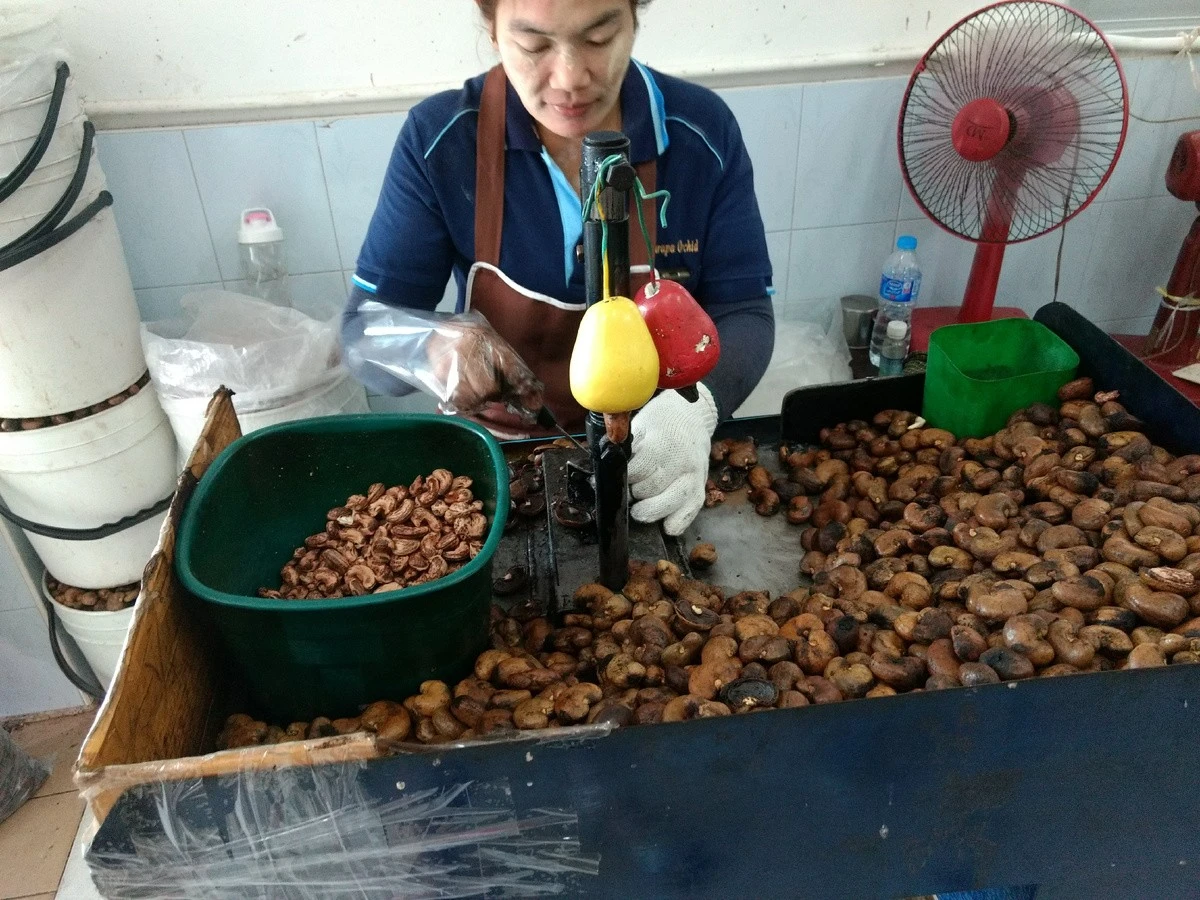
Cashew processing in Phuket, Thailand. Machine blades crack open the casing while gloves protect the worker's hands.
Once extracted, the kernels are dried, peeled to remove a thin inner skin, and sorted. Shells account for roughly 70 to 75 percent of a raw cashew's weight, meaning consumers ultimately end up with only about a quarter of the initial harvested mass. 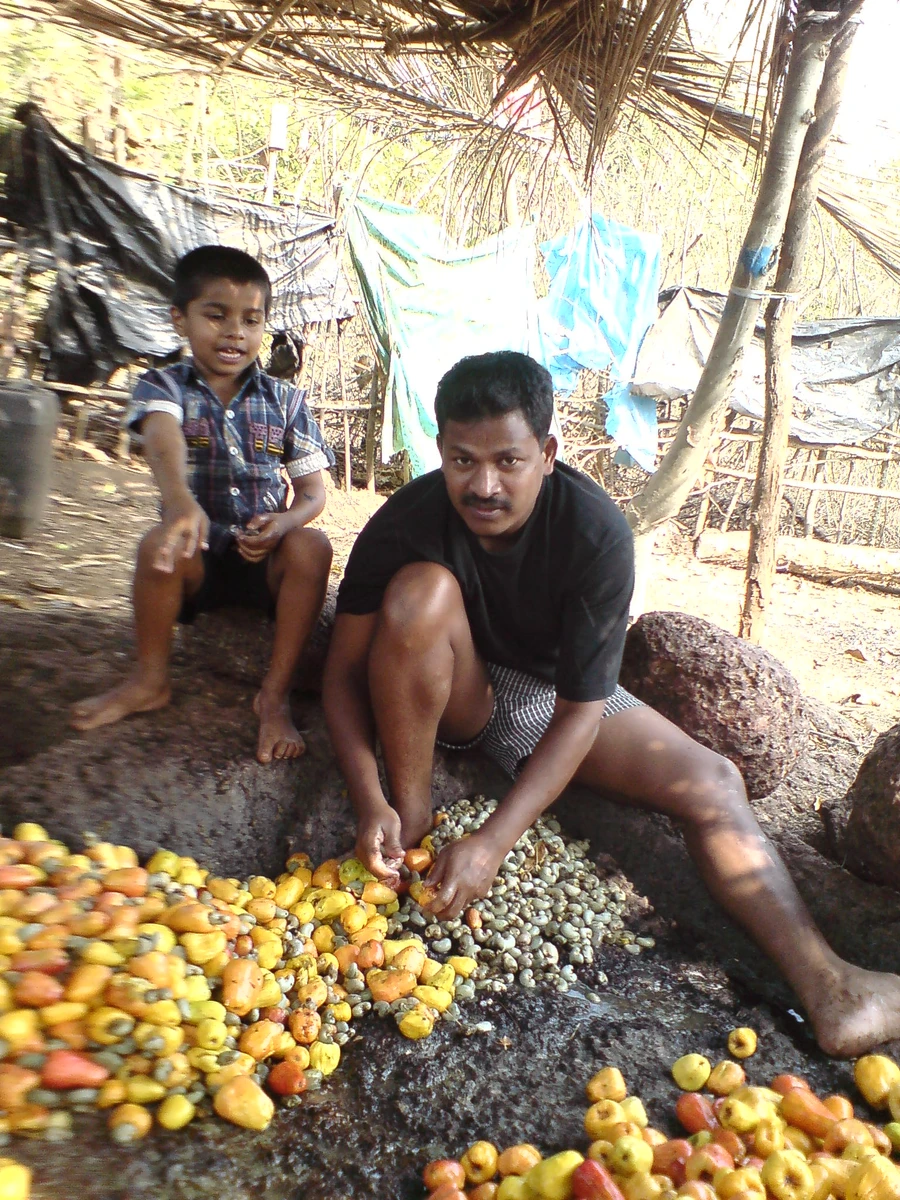
Before the juicy "apples" are processed, the nuts are detached from them. Each part of the harvest is prepared separately.
The grade code "W320" often printed on packaging comes directly from this sorting process. It stands for "Whole" light-colored kernels with a count of roughly 300 to 320 nuts per pound (about 454 grams). The lower the sizing number, the larger the cashew.
Even Souvenirs Have Caused Rashes
Handling raw cashew shells poses real risks to worker safety. A 2016 study surveying 301 female workers at processing plants in Kollam, India, found that 86.6% of those involved in roasting reported suffering burns. However, since both hot machinery and shell fluid present hazards in roasting areas, not all burns can be attributed solely to the liquid. 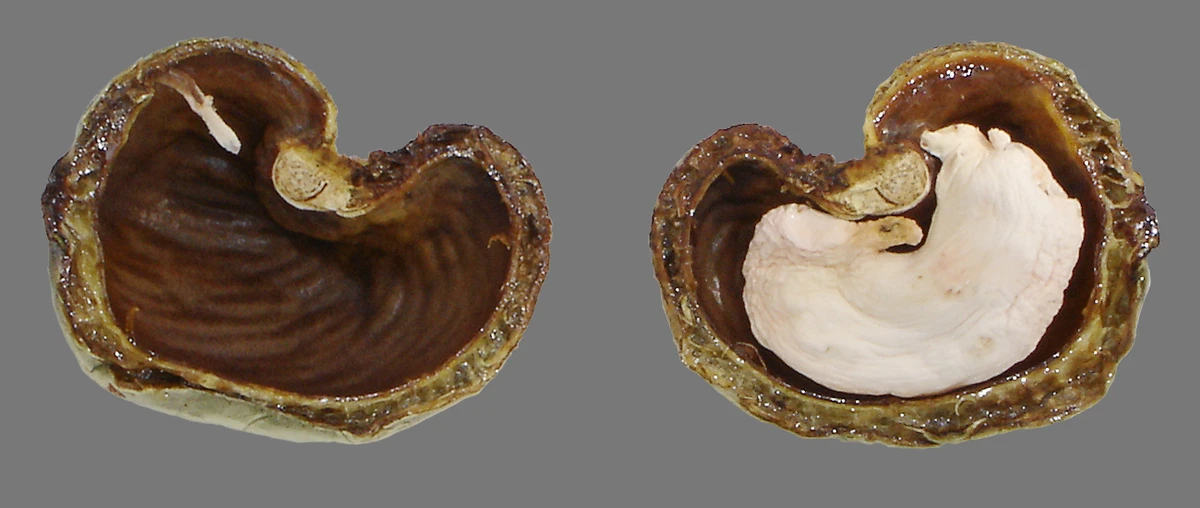
A cross-section of a raw cashew. Liquid visible along the shell edges illustrates why shelling requires extreme caution.
Improperly processed cashews have even made it to consumers. In April 1982, 54 people in Pennsylvania developed itchy rashes after eating cashews sold during a local Little League baseball fundraiser. Health inspectors examined 14 bags from the batch and found shell fragments in five of them.
A report by the US Centers for Disease Control and Prevention (CDC) documented another incident: four children developed contact dermatitis after playing with souvenir toy donkeys crafted from unshelled cashews and beads. Merely handling the toys was enough to trigger an allergic reaction.
Why Are Some Cashews Sold as "Raw"?
A "raw" label on a package usually just means the shelled kernels haven't been roasted for flavor. They have almost always undergone heat treatment during processing, such as steaming prior to shelling.
Furthermore, removing the shell does not eliminate food allergies to cashews. Allergic reactions are triggered by proteins within the kernel itself, so shell removal offers no protection to those with nut allergies.
Cashews Also Produce an Edible "Apple"
On the tree, the familiar cashew looks quite unusual. Hanging beneath a bright red or yellow juicy "cashew apple" is a small, curved pod in a grey casing. Hidden inside this pod is a single seed: the cashew nut you buy at the store. 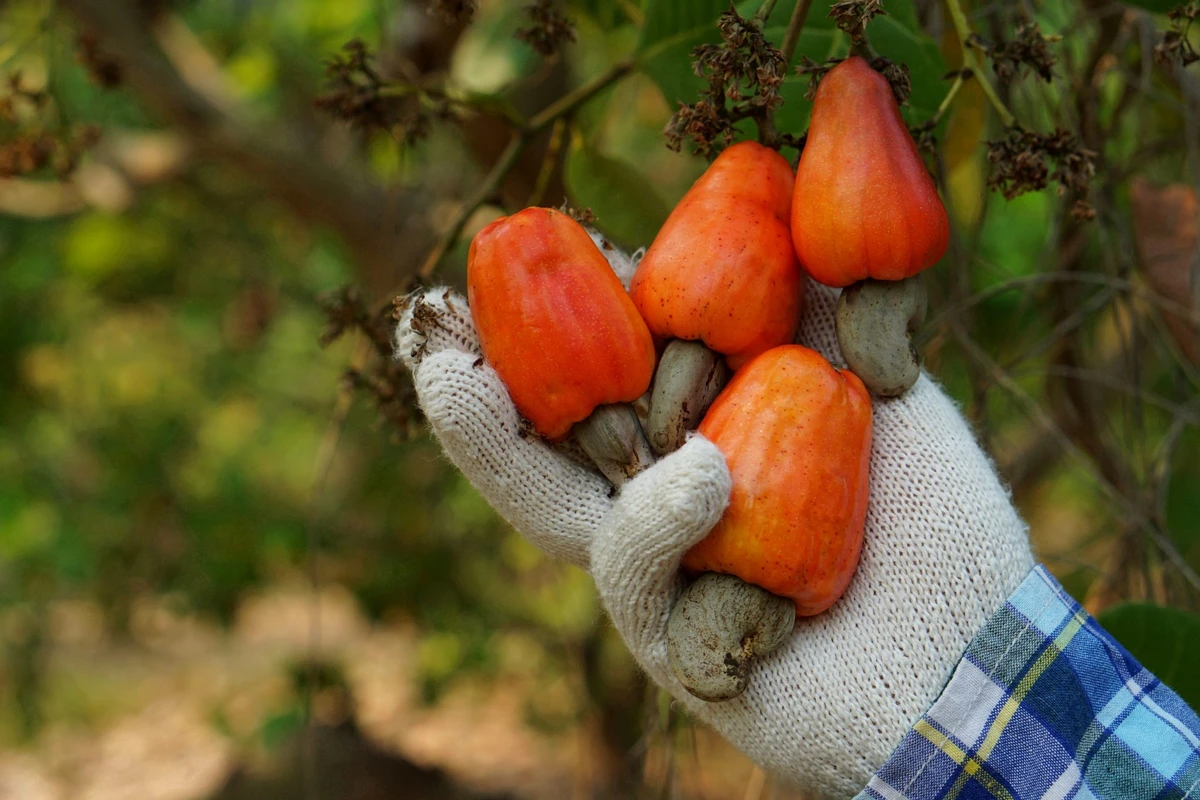
Cashew apples are crushed to extract their juice. Because they spoil quickly, processing must begin near the harvest site.
The "apple" is actually an accessory fruit formed from the swollen stalk of the cashew flower. Interestingly, the nut develops first, while the fleshy fruit above it expands later.
This fruit is also edible—juicy and sweet, though high tannin levels can leave an astringent sensation in the mouth similar to an unripe persimmon. In Brazil, cashew apples are made into juice and preserves, while in Goa, India, they are distilled into a popular liquor called feni.
However, cashew apples rarely make it to international market shelves. Their delicate skin bruises easily, and without refrigeration, they spoil within 24 hours. As a result, they must be eaten or processed right where they are harvested.
The toxic shells, on the other hand, enjoy a long industrial second life. Chemically processed cashew nut shell liquid is used as a raw material for resins, protective coatings, and friction linings in brake pads. So while that hazardous shell will never end up in your snack bag, it might very well end up in your car's brakes.