Not so "furious" after all: The *Furor*-class destroyers (6 photos)
Some of the world's first "classic" destroyers appeared, oddly enough, in Spain. The small, outdated navy of this once great power was in relative decline in the second half of the 19th century. This didn't stop its leadership from making ambitious plans to modernize its fleet. This is how the Furor-class destroyers came into being. 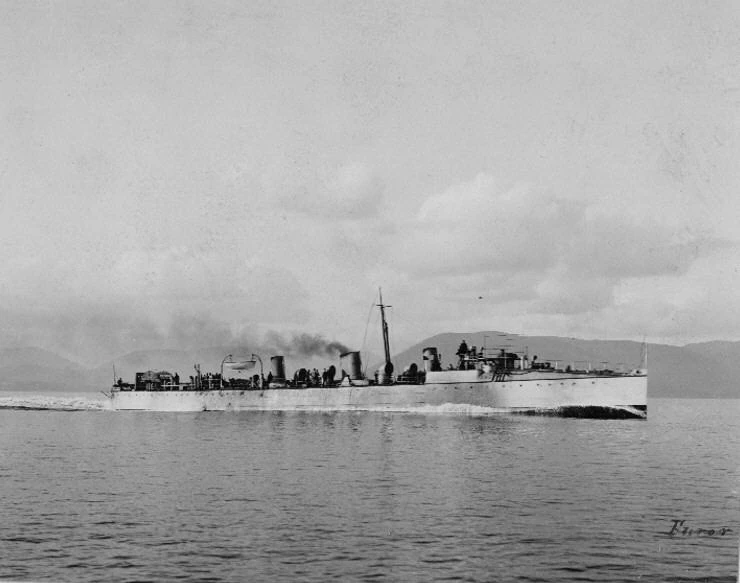
The destroyer Furor during sea trials in Great Britain in 1896
Since the early 1860s, the number of small torpedo boats has grown rapidly in navies around the world, posing an increasingly serious threat to capital ships. To protect the navy's battleships from such boats, coastal escort vessels were used, their displacement gradually increasing. Finally, in 1884, Fernando Villamil, an officer at the Spanish Navy Ministry, developed a concept for a larger, high-speed torpedo boat capable of escorting battleships on ocean voyages and attacking enemy ships with torpedoes. These ideas formed the basis for the ship Destructor, commissioned in 1887—the first "true" destroyer in the modern sense.
Encouraged by this success, the Spanish began developing a full-fledged series of destroyers based on the Destructor's design. This took them almost eight years—an order for six units was placed with the J&G Thomson shipyard in Clydebank, England, only in 1895.
The Furor-class destroyers had high sides and a ram-shaped bow, improving their hydrodynamic performance. Their hull length was 69.8 meters, their beam was 6.8 meters, their draft was 4 meters, and their displacement was 380 tons. Their 7,000-horsepower propulsion system consisted of two triple-expansion steam engines driving a pair of propellers. Steam was generated by four coal-fired Normand boilers, with smoke exhausted through three funnels. Due to their high engine power, hull lines, complete lack of armor, and small displacement, the destroyers could reach a speed of 28 knots, allowing them to catch and destroy any torpedo boat in existence at the time of their construction.
Despite their compact size and lack of armor, the Furor-class destroyers possessed powerful armament. It consisted of two semi-automatic 75mm Nordenfeld guns fore and aft, two 57mm Nordenfeld guns, and two 37mm Maxim automatic cannons mounted amidships. It also had two 350mm torpedo tubes.
The first two destroyers in the class, Terror and Furor, were laid down on December 1, 1895, and entered service in December 1896. Audaz and Osado were laid down in 1896, followed by Pluton and Proserpina the following year. Pluton was completed, launched, and entered service during 1897. The remaining ships were commissioned into the Spanish Navy in 1898.
It was that year that the crisis that led to the Spanish–American War erupted. Terror, Furor, and Pluton formed part of the First Squadron of the fleet under the command of Vice-Admiral Pascual Cervera y Topete. The force departed Cadiz on April 8, 1898, and arrived at St. Vincent on April 14. Almost all the ships in the squadron encountered various problems and consumed more coal than expected. Before the Spanish had time to resolve all the problems while docked at St. Vincent, war broke out, and at the request of the Portuguese authorities, they were forced to hastily leave the harbor. 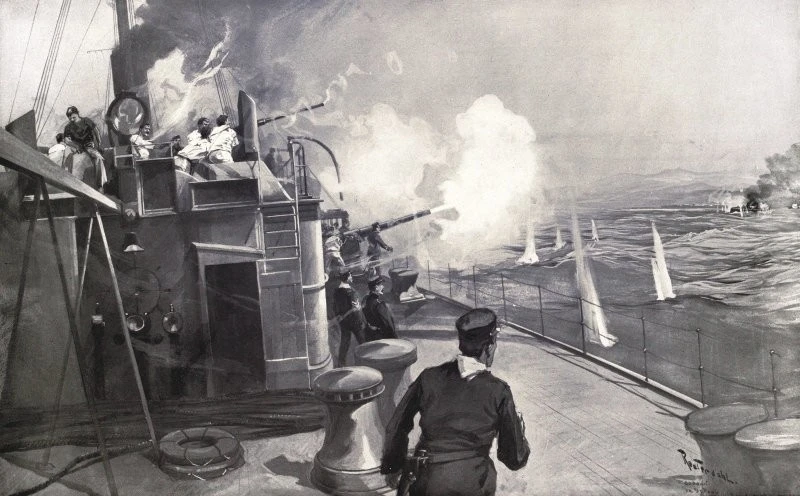
Auxiliary cruiser USS St. Vincent Paul repels an attack by the destroyer Terror during the Battle of San Juan on June 22, 1898. Engraving from the 1899 book "Illustrated History of the War with Spain."
On April 29, the squadron arrived in Puerto Rico, but since there were insufficient coal reserves there, Cervera decided to call at French Martinique. On May 10, Terror and Furor entered French territorial waters, but the French, maintaining their neutrality, refused to supply coal to the Spanish squadron. Moreover, since the American auxiliary cruiser USS Harvard had recently left port, international law prohibited the destroyers from sailing until 48 hours after the American ship. To compound the problem, Terror's engine suddenly failed. On May 12, under the pretext of inspecting its machinery, Furor set out to sea and, violating the ban, left Martinique's territorial waters and rejoined the squadron.
Leaving Terror in Fort-de-France, the squadron, after a stop in Curaçao, arrived in Santiago de Cuba on May 19, where it was blockaded by the US fleet on May 27. Under constant bombardment from American naval gunfire, Admiral Cervera attempted to break out of the harbor on July 3. His four cruisers led the way, followed by Furor and Pluton, bringing up the rear. The Americans fired their first salvos at the destroyers and, after scoring several hits, switched their fire to the cruisers. This allowed the destroyers to break the blockade and escape the main American force, but ultimately it did not save the Spanish ships.
The armed yacht USS Gloucester, although less heavily armed, pursued Furor and Pluton. The yacht's rapid-fire guns easily penetrated the destroyers' unarmored sides, disabling their armament, engines, and crew. Soon, Pluton, heavily damaged, sank off the coast of Cabañas Bay. The remaining Furor resisted for another five minutes, after which it also exploded and sank. The few surviving crew members were later rescued by ships of the American squadron. 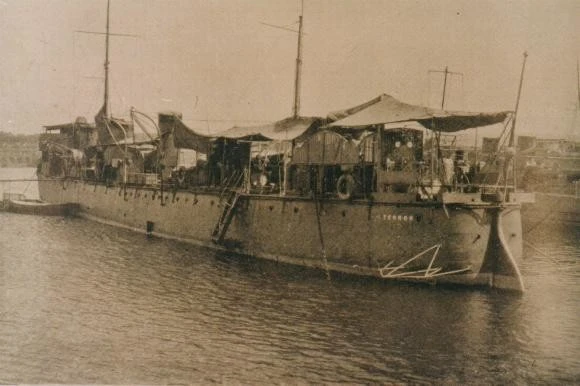
Destroyer Terror after the battle with USS St. St. Paul, June 22, 1898
After repairing its engine, the Terror left Martinique on May 17 and arrived in San Juan, Puerto Rico, but soon found itself blockaded there by another American squadron. A small Spanish flotilla, consisting of the Terror, the unarmored cruiser Isabel II, and the gunboat General Concha, attempted on June 22 to break the blockade, something Cervera would try a few days later off Santiago de Cuba.
A pair of American auxiliary cruisers—USS St. Paul and USS Yosemite—entered the harbor and began an artillery duel with the Spanish. The slow Isabel II and General Concha were forced to turn away, while the Terror headed for the St. Paul, intending to torpedo the cruiser at close range. From a distance of almost 5 km, the St. Paul fired. Paul opened fire on the destroyer and scored several hits. The lack of armor resulted in serious damage—the Terror's hull was penetrated, and its boilers and engines were disabled. With difficulty, the Terror returned to base, where it remained until the surrender, after which it was towed back to Spain. 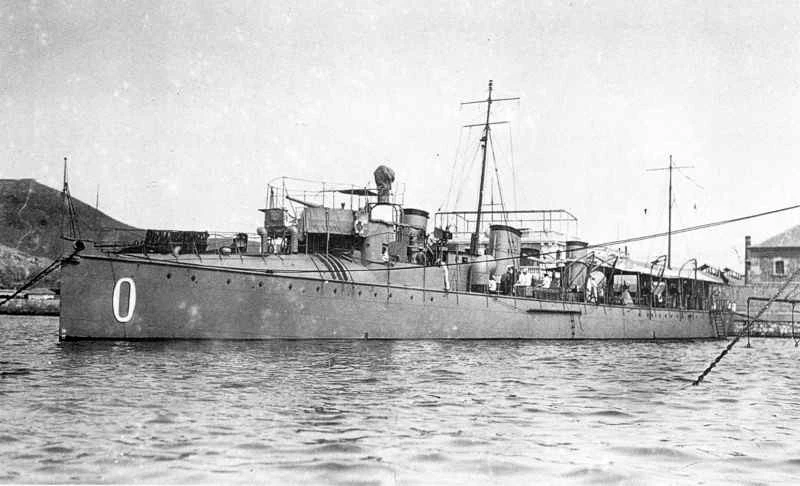
Destroyer Osado in 1920
The remaining three Furor-class destroyers—Audaz, Osado, and Proserpina—never saw any combat action. They were assigned to Admiral de la Cramara's auxiliary squadron, which was supposed to pretend to come to the aid of Admiral Cervera, who was blockaded in Cuba. This demonstration failed under pressure from Great Britain, so on June 16, the squadron left Cadiz for the Philippines, planning to participate in military operations against the United States. While anchored in Port Said, the fleet received news of the defeat at Santiago de Cuba. Fearing a possible American raid on the mother country, the Spanish ordered the ships to return. However, an armistice was soon signed, so no raid took place.
After the loss of the American and Pacific colonies to the United States, the Spanish concentrated their fleet in Europe. Terror, Audaz, Osado, and Proserpina mostly went to sea only for exercises, and from 1911 onward, they provided cover for the Spanish army's ground operations in Morocco. At the same time, all the destroyers underwent modernization, during which one of Prozerpina's funnels was removed.
However, no modernization could stop time. In 1920, Terror was converted into a minelayer, decommissioned in 1922, and scrapped two years later. Audaz, meanwhile, was transferred to the newly formed naval aviation unit as a service vessel in 1922, but was decommissioned in January 1924 and sold for scrap on June 6. 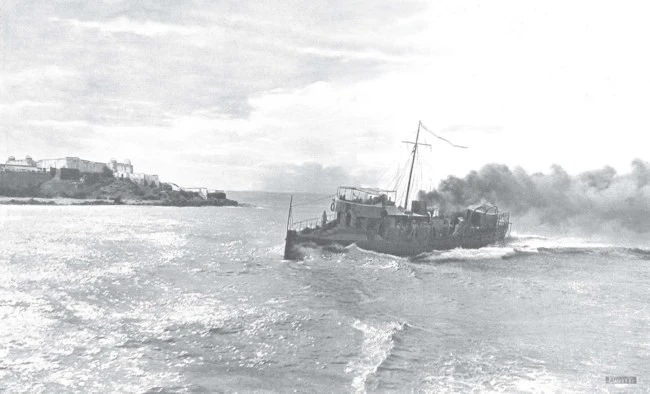
The destroyer Terror during the Spanish landing at Larache, Morocco, in June 1911, which triggered the Rif War.
Osado would have served slightly longer if it had not been caught in a storm in 1923. The destroyer was severely damaged and nearly sank. She lay idle for several years, as repairs were deemed unfeasible, until she was finally decommissioned in January 1925. Proserpina remained the only Furor-class destroyer in active service, and she continued to see active service until early 1931, when she finally fell into disrepair. In the spring, the ship was removed from the fleet and sent to the scrapyard.
Thus, one of the first major destroyer series was not very successful. Three Furor-class destroyers that participated in the battles were quickly disabled. Furor and Pluton were both sunk by a single armed yacht. However, since the Furor class proved to be one of the harbingers of the destroyer era, it is worth remembering that a successful class of ship is not always created on the first try.