How the robber "Big Nose George" became a pair of shoes and an ashtray (9 photos)
A museum in the small American town of Rawlins, Wyoming, houses a grisly exhibit: a partial skull and a pair of men's shoes made of human skin. DNA testing shows that all these items belong to the same person: George Parrott. He hardly sought such notoriety when he robbed stagecoaches, set ambushes, and killed sheriffs in the Wild West. 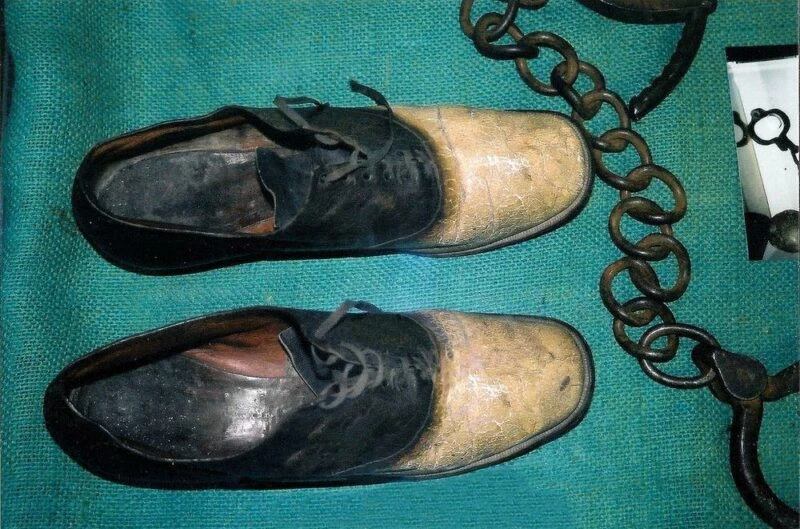
George Parrott's Fatal Mistake
19th-century America is remembered for its lawlessness and rampant crime. At the time, George Parrott commanded a gang of robbers. His prominent nose earned him the nickname "Big Nose George." 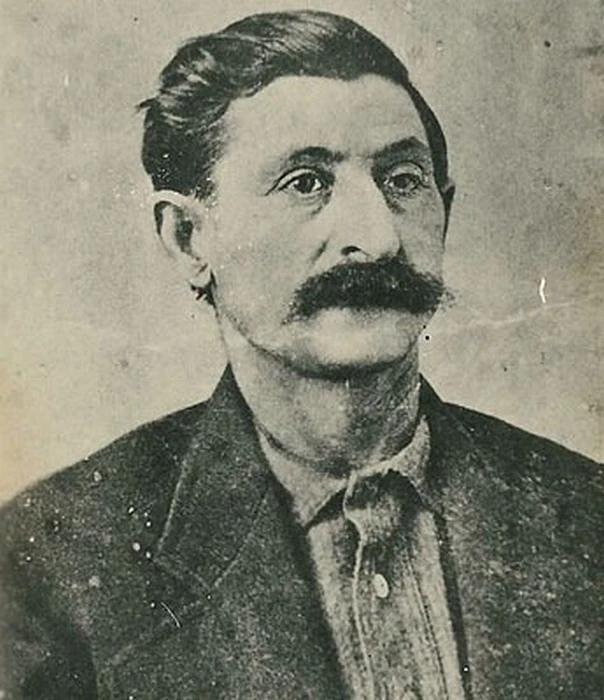
The only surviving photograph of George "Big Nose" Parrott
The gang leader made a fatal mistake in 1878 when he decided to rob a Union Pacific train carrying wages for the company's workers.
Armed bandits set up an ambush on a deserted section of track. They had previously removed a spike from the track to derail the train. But a trackman noticed the damage, replaced the missing spike, and alerted the sheriff of the potential attack. When the train carrying the valuable cargo passed through the ambush at full speed, Big Nose George realized his plans had been discovered. The leader led the gang to Rattlesnake Canyon, near the town of Elk Mountain. 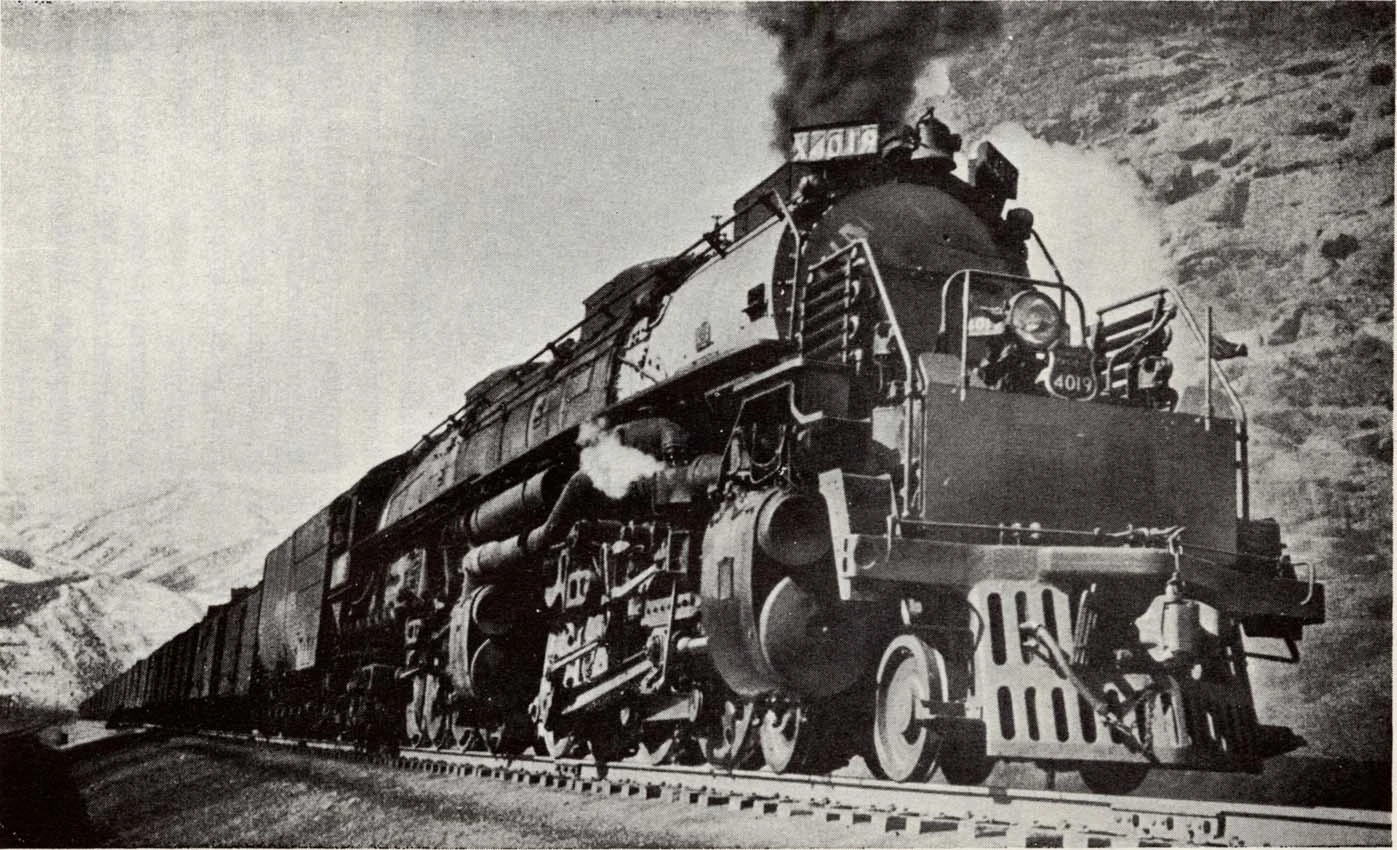
A Union Pacific train, founded in 1862.
Local police deputy sheriff Robert Widdowfield, along with company detective Tip Vincent, began investigating the incident. They arrived at the scene of the failed sabotage and began following the gang's trail. Upon reaching the canyon, they discovered a hastily abandoned campsite. Unfortunately, while inspecting the remains of a fire, the deputy was killed by a bandit's bullet. The robbers also killed the railroad detective with another shot.
Arrest and Attempted Escape
The murder of the two officers caused a major stir. The railroad company announced a large reward for the capture of the gang leader. The initial sum of ten thousand dollars was quickly doubled. At the time, that was a huge sum. But despite the company's generosity, the thugs remained at large for another two years. 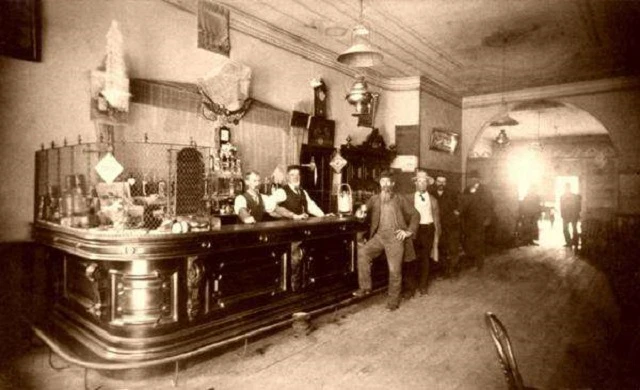 In the end, drunken bragging proved their undoing. The gang's long-nosed leader got drunk at a bar and began bragging about killing two officers in Elk Mountain. The drunken leader and his companion were arrested and transported to the police station in a town called Rawlins. The court sentenced them to death by hanging, setting the execution for April 2, 1881.
While awaiting execution, the prisoner wasted no time. Using a pocket knife, he patiently filed down the fastenings of the shackles. On March 22, he finally managed to free himself from the bonds that bound him. The prisoner ambushed prison guard Robert Rankin in the washroom. With his last strength, the victim called out to his wife, Rose. Rose proved to be a brave woman. Armed with her husband's revolver, the brave woman returned the escaped prisoner to his cell.
Death and the Afterlife
George Parrott was not destined to live out his sentence. Angry townspeople took the law into their own hands. They lynched the killer in the middle of town, throwing a noose over the crossbar of a nearby telegraph pole. During his short and turbulent life, Big Nose George never married. His body ended up in the city morgue among the unclaimed. 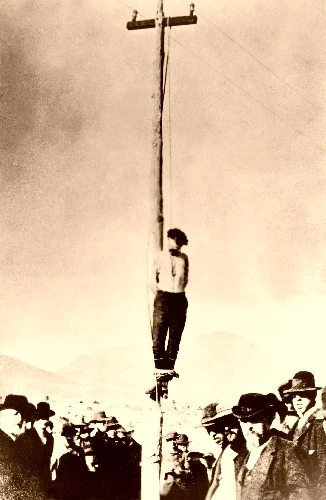 Such corpses are often used for scientific research. Doctors Thomas Magee and John Osborne were given the opportunity to closely study the killer's body. The scientists hoped to obtain scientific confirmation of the well-known theory about the natural inclination of certain individuals toward criminal activity. Unfortunately, a craniotomy and brain examination proved this theory untenable. The brains of murderers and robbers were no different from those of ordinary law-abiding citizens.
Dr. John Osborne's research took a strange turn. The scientist made a plaster cast of the deceased's face. He then removed large pieces of skin from the corpse's thighs and chest. Dr. Osborne sent the scraps of human skin to a shoemaker in Denver. The researcher wanted to sew a medical bag and a pair of shoes from them. Ultimately, he was disappointed with the design of the new shoes. He commissioned the shoemaker to sew the shoes so that the nipples would be positioned at the toes. The shoemaker failed. Despite this, John Osborne wore this pair of human skin shoes for quite some time. 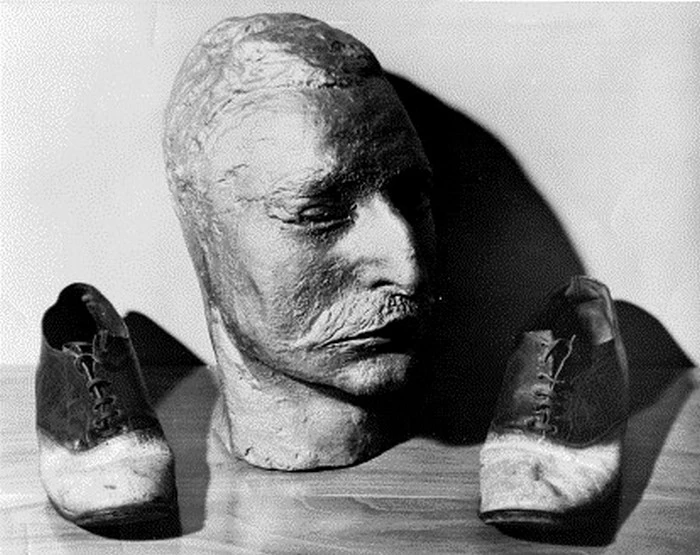
The unsuccessful robber and lynch victim George Parrott.
For a whole year, the doctor continued his strange research. He placed the dismembered body in an oak barrel. A saline solution prevented the decomposition of the dead flesh. Then Big Nose George was finally preserved and buried behind Dr. Thomas Magee's office.
The subsequent fate of the researchers is noteworthy. John Osborne traded a scientific career for politics. He entered Wyoming history as the first Democratic governor. He later became the right-hand man of President Wilson's Secretary of State. Rumor has it that politician John Osborne wore the legendary boots for quite some time. He didn't even change his shoes for his own inauguration ball in 1893. 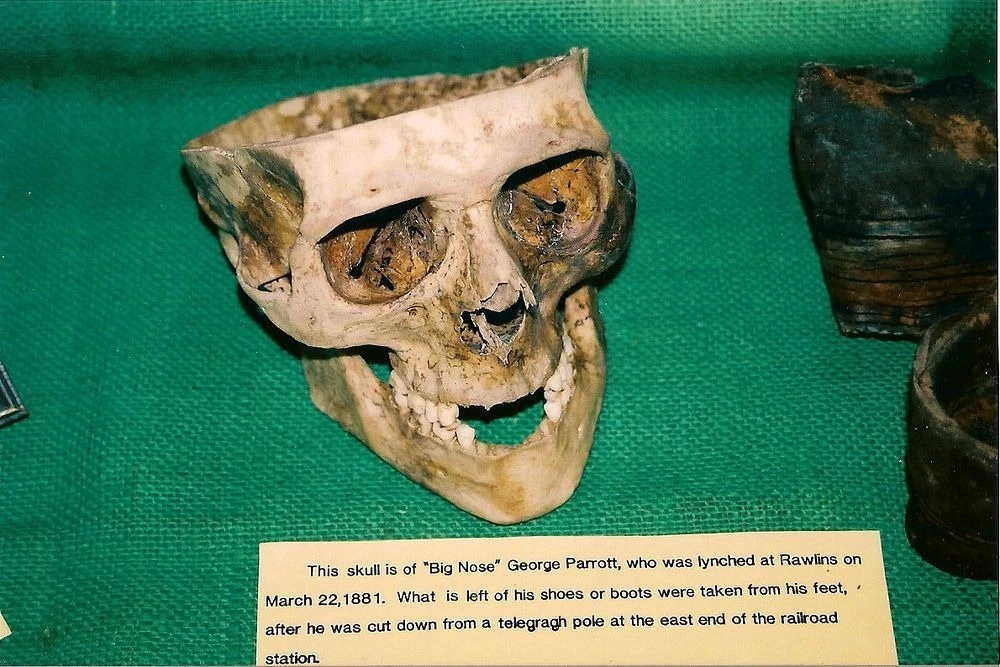
The Skull of Big Nose George.
The doctor presented the second half of the skull to a young assistant named Lillian Heath. She went down in the annals of Wyoming as the first female doctor. Big Nose George's parietal bone made an excellent ashtray. Lillian Heath later used it to prop open the door to her office.
Oblivion and New Popularity
The brutal criminal's fame quickly faded into oblivion. He was forgotten until 1950. Construction workers stumbled upon a strange barrel during excavation work. Excavation work had to be suspended. The barrel's contents didn't surprise local police at all. An identification test was ordered. Lillian Heath's legendary ashtray was immediately recalled. The skull fragments were a perfect match. A second test was conducted in 1960, when the police began using DNA testing. 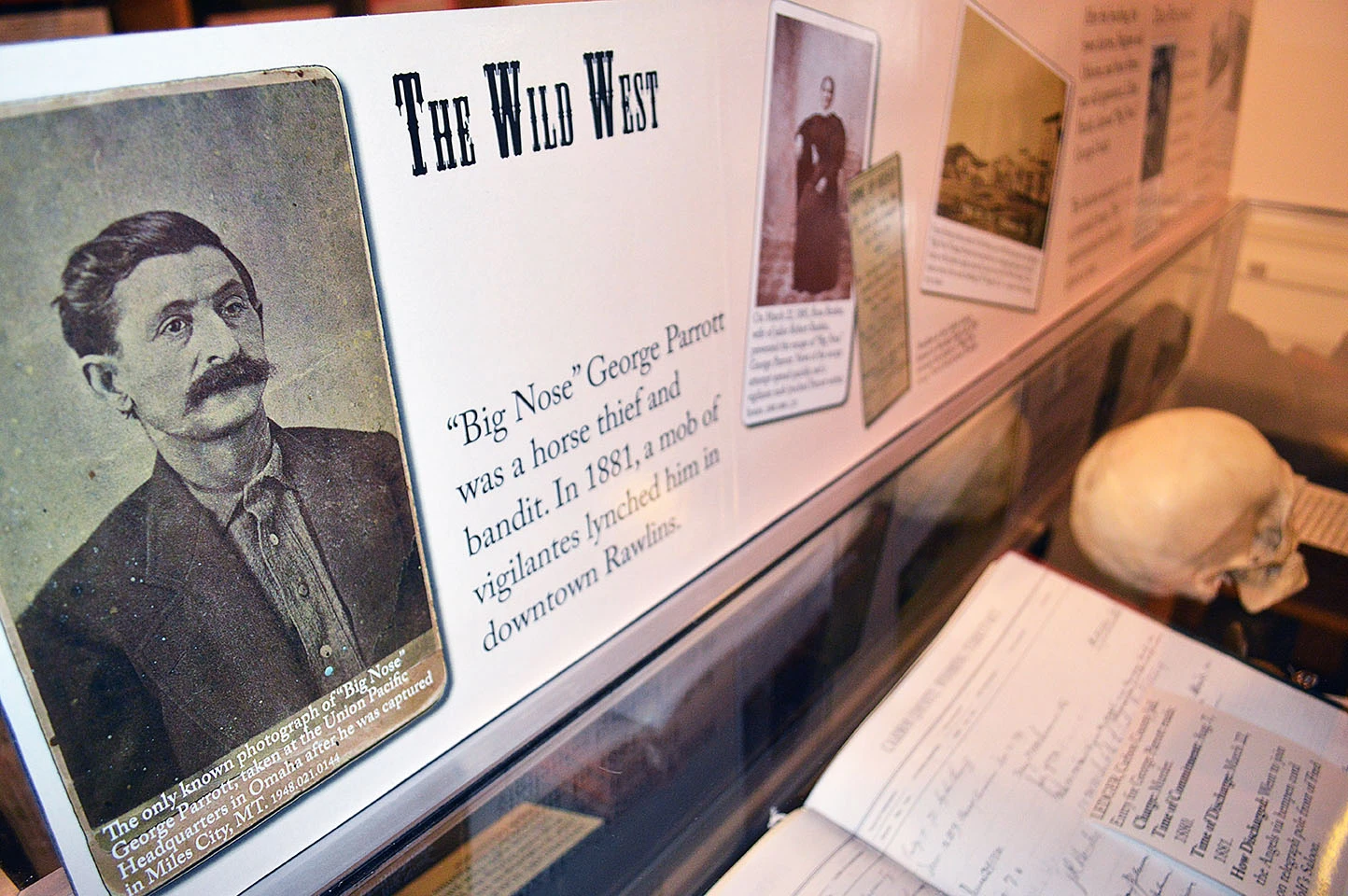
Exhibits at the Carbon County Museum
DNA samples taken from the boots, skull, and bones revealed that all the items were part of a single individual – George Parrott. The police archives retained the only photograph of the brutal criminal. The evidence now serves as museum exhibits. It is noteworthy that the upper and lower parts of the skull are kept in museums in different American states.