Running aground on underwater rocks or getting stuck on a mudflat is no worse than a serious fire on board or a hurricane snapping masts like matchsticks. 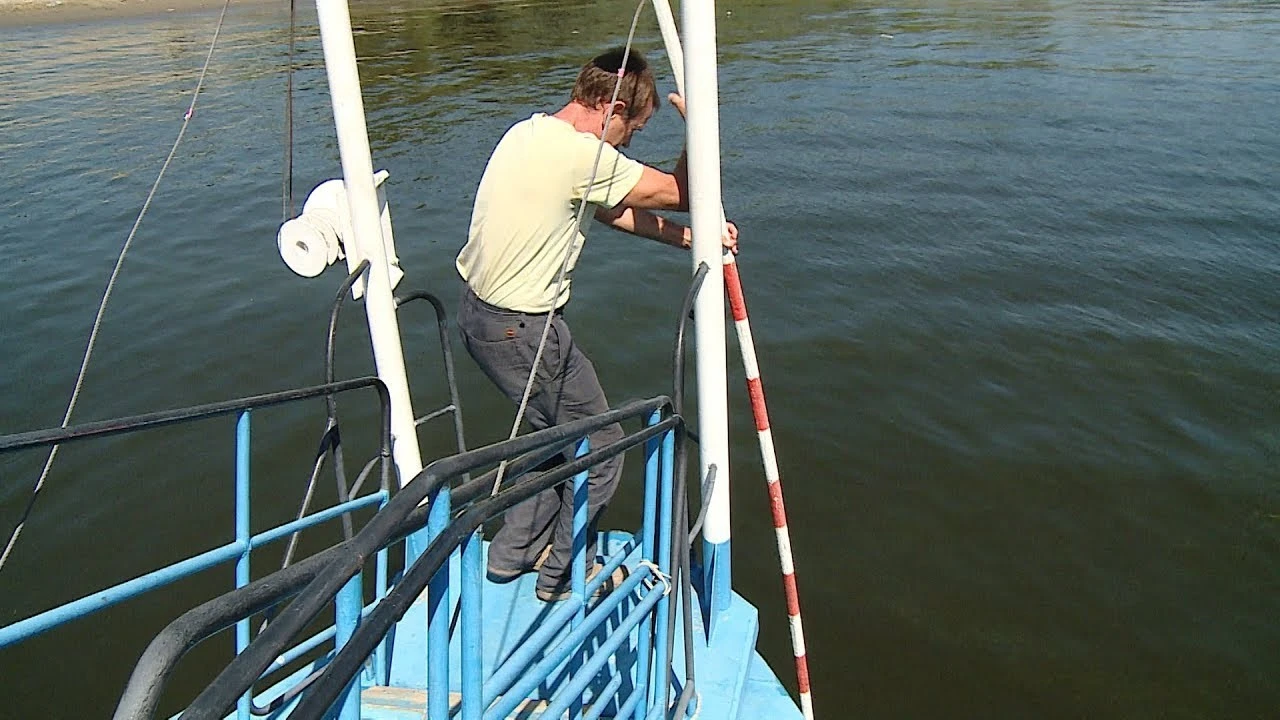
Seven feet under the keel is easy to measure. But what if there are a thousand?
So, it has long been customary, especially in unfamiliar waters, to know exactly what those legendary seven feet are. When watercraft were quite small and the area of navigation was close to the coast, a pole with marks was enough to measure the depth. And they still find use today.
It's called a sounding rod, a nod to the time when depth was measured in feet. It's standard equipment and was attached to the side of the storm channel, though it was painted black and white. 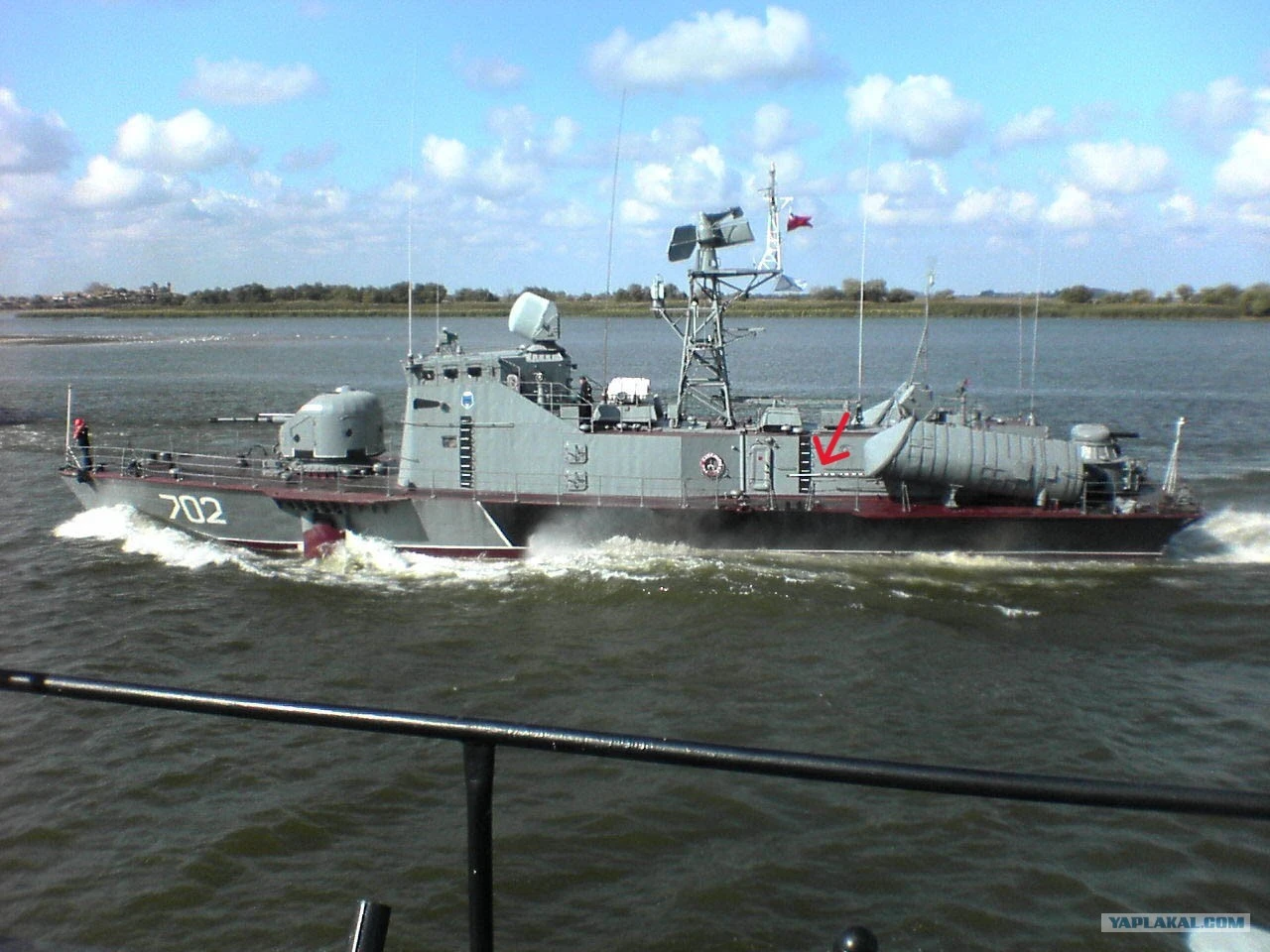
Sounding rod on board a small-size reconnaissance ship
The shallow depth and draft made it perfectly suitable for use with a sounding rod. However, on larger ships with high sides, no sounding pole can reach the bottom, so since ancient times, sounding lines have been used. These usually consisted of a conical weight, usually lead, tied to a long towline called a sounding line (I apologize to salty sailors for the towline, but this post can also be read by purely landlubbers unfamiliar with maritime terminology).
The sounding line has marks (or, in nautical parlance, "marks") attached at regular intervals. Since measurements sometimes had to be taken in the dark, these marks were previously cut out of leather and had various shapes so they could be distinguished by touch. 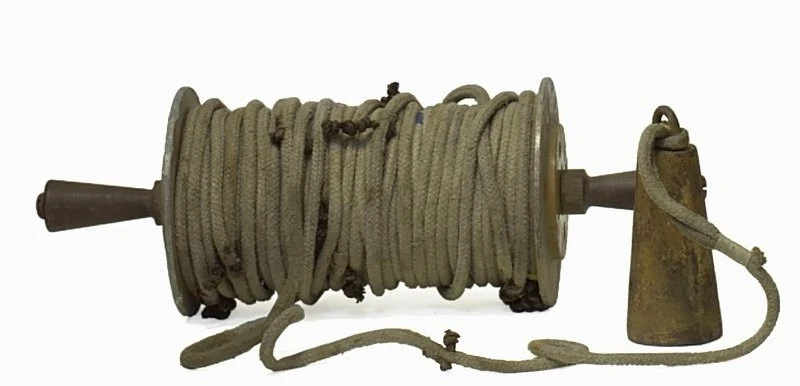
Hand-held sounding line
If the vessel is stationary, taking depth measurements is easy, but if underway, it required some training. The sounding line was cast forward along the vessel's course. When the weight reached the bottom, which was felt by the tension on the sounding line, the sounding line's crewman slowly pulled in the slack line until it stood vertical. At that point, a mark on it indicated the depth at that point.
This operation was not for the faint of heart.
The lead itself could weigh up to 5 kg; on the battleship Archangel Raphael, it weighed around 8 kg. However, the greater the expected depth, the heavier the lead was used to reduce the bending of the lead line under the oncoming water flow. Such leads were called diplots. It's not easy for one person to handle this, so several sailors took part in the measurements. 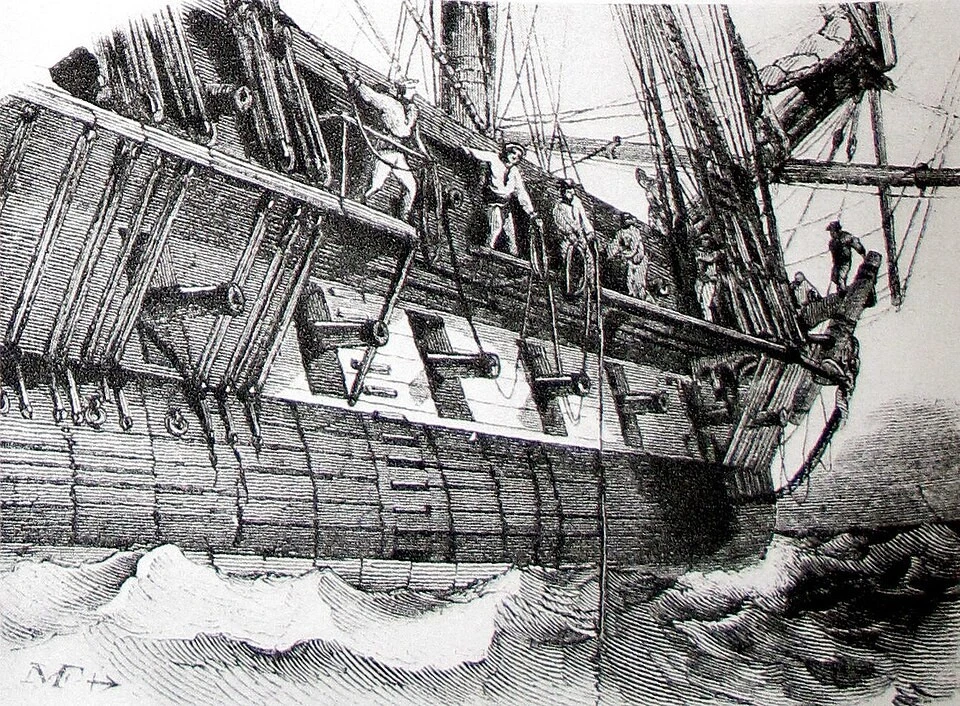
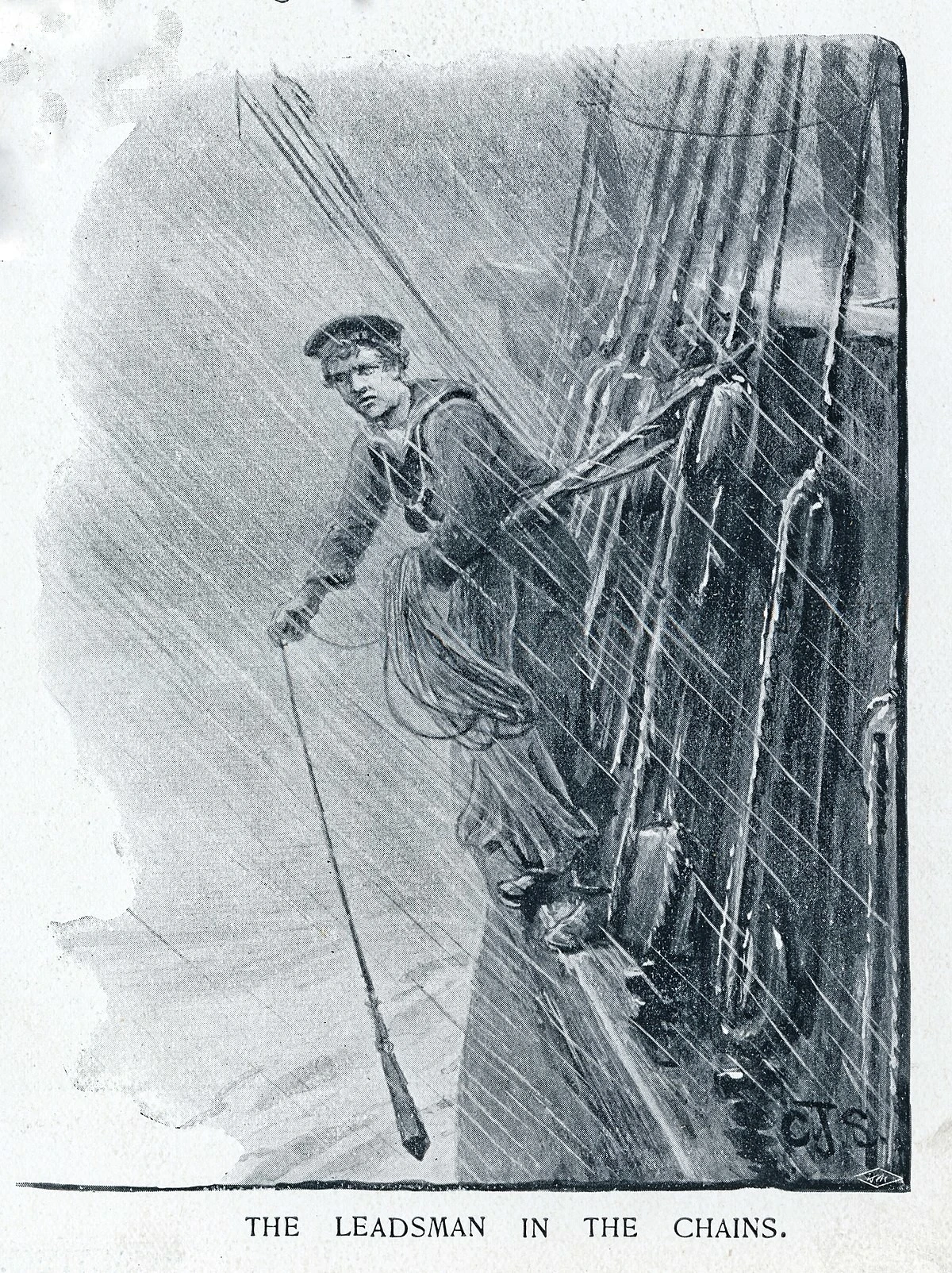
But often, it's important to know not only the depth in a given spot, but also the texture of the bottom. If, for example, the bottom is rocky, the anchor won't hold, and it's better to look for another spot. Therefore, a trench was dug in the lower part of the sounding line and filled with thick lard. After sampling, the sounding line yielded adhered soil samples.
How do you know when the sounding line has reached the bottom? If the depths were shallow, the lead line operator might feel a release of tension on the lead line or the impact of the lead line hitting the bottom. If the depths were greater, the lead line's reeling speed was closely monitored. Upon reaching the bottom, this speed would decrease sharply.
However, over time, it became necessary to measure depths of thousands of feet, for example, when surveying the route of an underwater cable or, in general, when mapping the seabed over large areas.
However, the impact of the lead line hitting the bottom at depths of 3,000–4,000 meters is not transmitted up the line at all, and the weight of a long length of released lead line is so significant that even after the lead line reaches the bottom, the lead line continues to reel overboard, seemingly at the same speed as before. The weak sounding lines of the time made it impossible to retrieve the sounding line; the line usually broke when attempting to retrieve it, and therefore the final sign of the sounding line reaching the bottom—a soil sample—was also absent.
James Clark Ross, head of the British Antarctic Expedition (1839–1841), succeeded in devising the first method of measuring ocean depths that allowed him to detect the moment the sounding line reached the bottom.
He noticed that the sounding line initially accelerated, then gradually slowed down, and then, after a certain point, moved completely steadily. After some thought, he concluded that as the lead line's length increased, its friction with the water column and its own buoyancy began to slow the reel's rotation. Once the lead line reached the bottom, its length no longer changed, meaning the weight of its hanging portion also remained the same. It simply settled on the bottom, causing the reel to rotate evenly. Noticing the start of this uniform rotation would indicate that the lead line had reached the bottom. 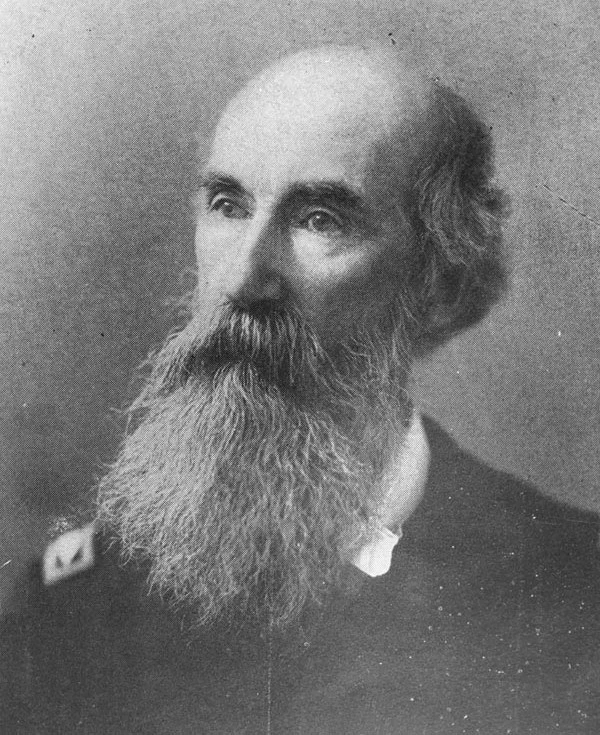
Midshipman John Mercer Brooke of the United States Navy
In 1854, Midshipman John Mercer Brooke of the United States Navy devised a way to release the weight upon reaching the bottom, which prevented the sounding line from breaking during hauling while simultaneously delivering a sample of the sediment to the surface as proof of this achievement.
Below is a schematic diagram of the device and how it worked. 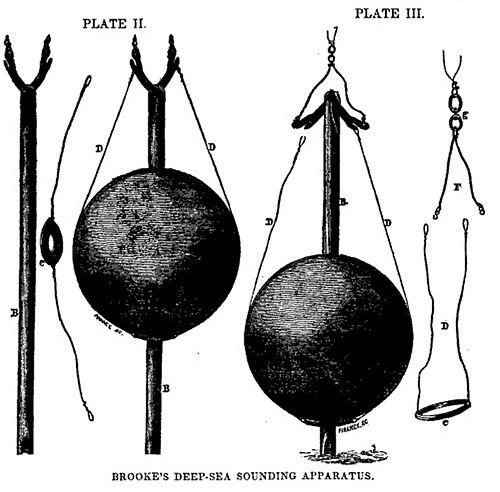
Upon reaching the bottom, the tube rests against it, and the ball continues to descend, rotating the levers on which it is suspended. The levers pivot downward, the ball's mount slides off, and the ball remains on the bottom. A lightweight tube containing a bottom sample was guaranteed to rise to the surface. This arrangement allowed for the use of a thinner lead line, which would inevitably break when lifting the entire load, and therefore allowed for more reliable detection of the moment of bottom contact using Ross's method.
Soon after, Brooke's sounding was used to survey a line from Ireland to Newfoundland to determine the bottom topography for the first underwater telegraph cable (by the American Lieutenant Berryman on the steamship Arctic in 1856).
And then, like a cornucopia of variations on this device, a flood of ideas began to appear. 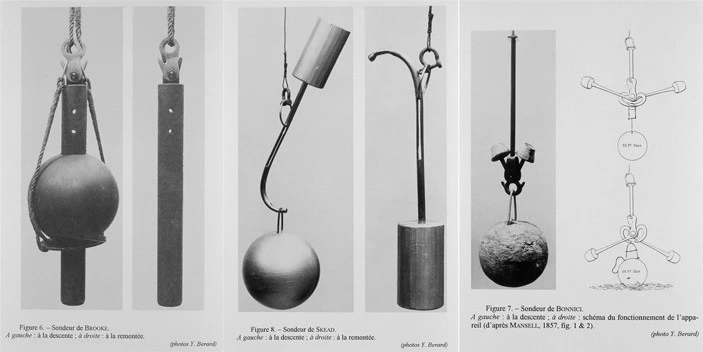
The famous English physicist William Thomson (later Lord Kelvin) also contributed to depth measurements. I like this story about him:
"William Thomson (Lord Kelvin) once cancelled his lecture and wrote on the board:
"Professor Thomson will not meet his classes today."
The students decided to play a joke on their professor and erased the first letter in the word "classes" (it became "lasses" - girls).
The next day, Thomson saw this correction, but without losing his composure, he erased another letter in the same word and silently left. (It became "asses" - donkeys. Or backsides, depending on your preference.)
He came up with this idea: Previously, the lead line was freely let out from the reel so as not to disrupt the regularity of the change in the intervals of equal lengths of lead line (which was the essence of (Ross's method), Thomson began to brake the reel, and at each moment of the measurement with a force equal to the weight in the water of that portion of the lead line that had already been released overboard; i.e., the braking force also increased and increased as the length of the lead line overboard increased. Consequently, the rotation of the reel was determined solely by the weight of the lead line, and when the latter reached the bottom, the reel stopped automatically, thereby indicating the end of the depth measurement. Thus, the need to note the intervals of the lead line's runoff disappeared. 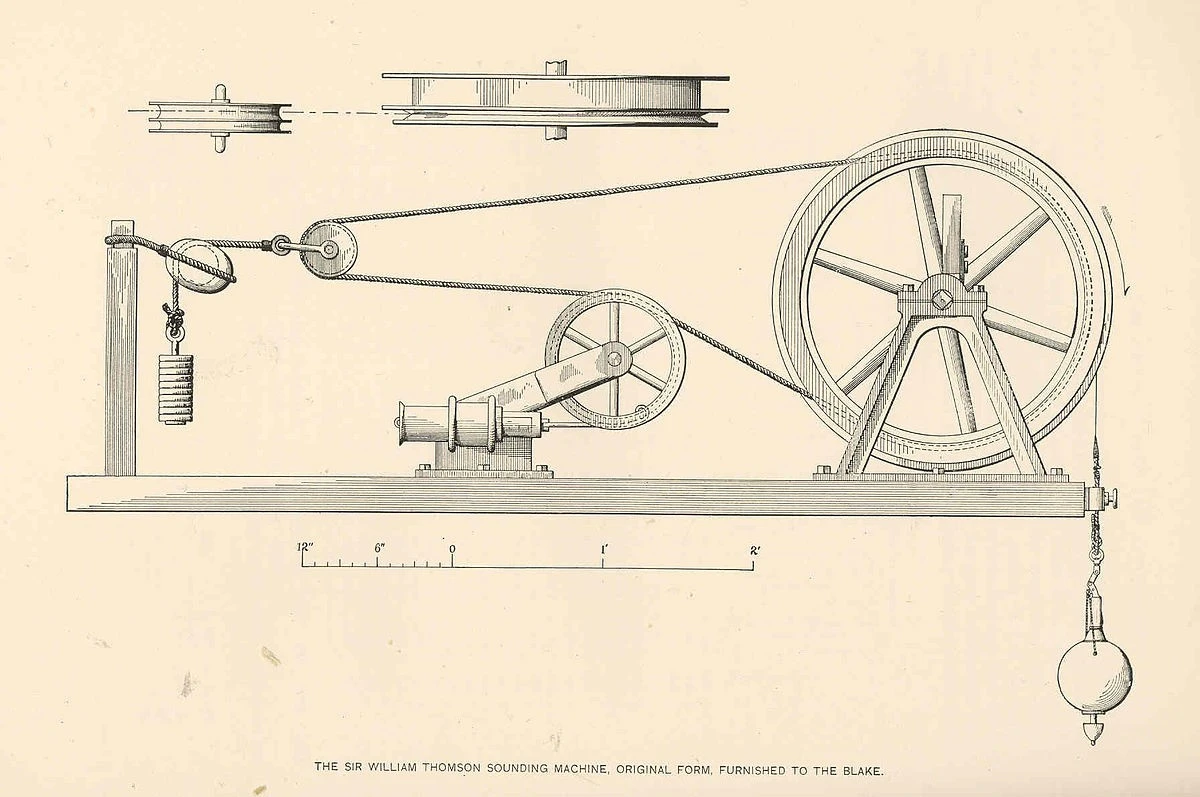
Thomson replaced the plant lead line with a wire one, first using piano wire, and then They began to manufacture galvanized wire with a diameter of 0.7-0.9 mm specifically for sounding lines, with a tensile strength of 105-300 kg. Wire sounding lines have many advantages: they take up very little space, can be wound on a small reel for up to 10,000 m, do not get wet and do not need to be dried; they sink to the bottom faster, and their light weight allows for quick recovery, especially since there is no need to raise the water that has soaked the plant sounding line. They also bend less during the inevitable drift of the ship during depth measurements.
He didn't stop there; various versions appeared, including those with a manual sounding line (the dial on top shows the length of the sounding line).
He also used a different measuring principle. A glass tube with a sealed tip was lowered to the bottom along with a weight. On top. It was coated on the inside with a compound that changed color when it came into contact with water. As it descended, the air in the tube was compressed by the pressure of the water coming from below. After reaching the bottom, the device was raised, the length of the wetted surface of the tube was measured, and special formulas were used to calculate the water pressure, and therefore the depth reached by the device.
In fact, over a hundred different depth-measuring devices have been patented, but echo sounders—devices that measure the time it takes for a sound wave to travel to the bottom and back—have become prevalent. Knowing the speed of sound in water, it's easy to calculate depth.
However, navigators don't have to calculate anything. The device itself displays the final result.
Does this mean that traditional sounding lines, consisting of a weight tied to a marked line, are a thing of the past? Not at all. And every vessel and ship has one. :)
Well, that's how it is.
I'll add my own personal opinion. I only saw these in training. But unfortunately, after the KMB and three months of training, I had to finish my military service ashore due to health reasons.
Add your comment
You might be interested in:












Scientists repainted cows as zebras and got an unexpected

Amazing Irish tap dance

Hyundai sets record sales thanks to unexpected models (2

Brad Pitt has sold his legendary mansion in the Hollywood

Production of an inexpensive electric sports car SC-01 has

Volkswagen to restore famous minibus that survived

A rare sports Mercedes-Benz SL 65 AMG Black Series with

Mini-train for harvest on a field in China (2 photos + 1

In Belarus, the goalkeeper scored a goal with a shot across

How to start a 102-liter engine

Protective film Removing it with a power screwdriver

When a child plays hide-and-seek at a professional level

Man sets up bedroom camera and discovers the reason for his

Super dads who swoop in to save the day

Precision carpentry

Looks like it's time to buy WinRAR
How to hang wallpaper neatly

How metal buckets are made in Pakistan
