A deep azure crescent moon against the darkness of space is the final image of Neptune taken by NASA's Voyager 2 spacecraft on August 27, 1989. 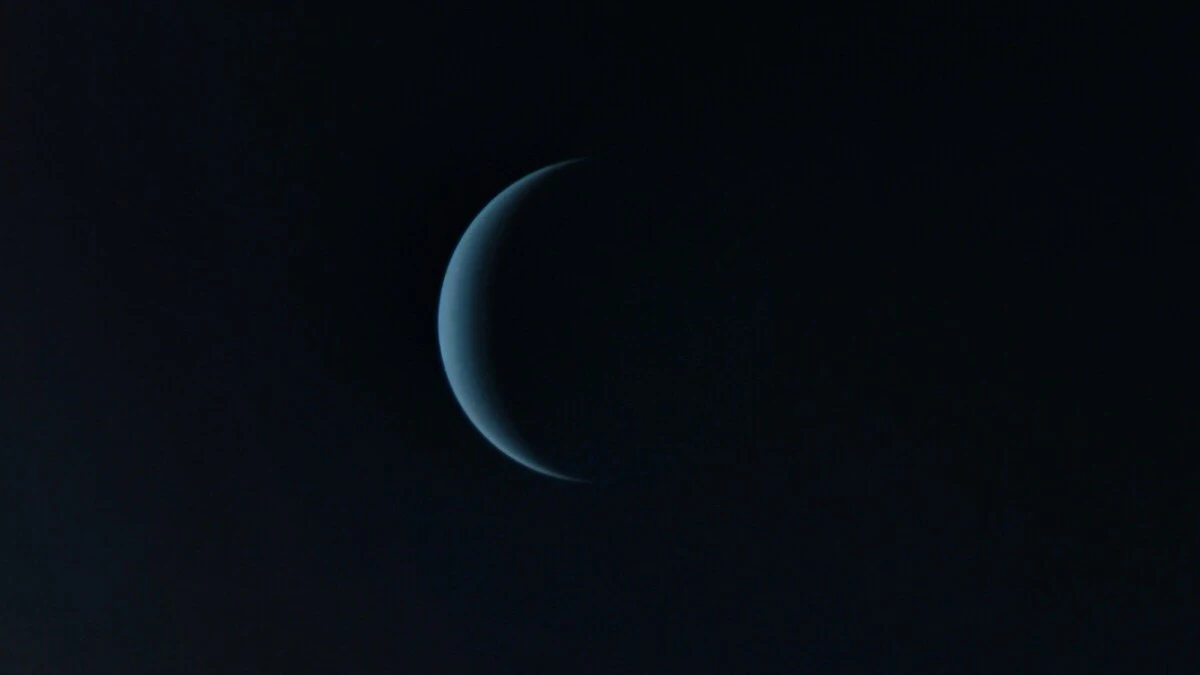
Thirty-five years later, this image, taken from a distance of 4.35 million kilometers from the ice giant, remains the last known image of the most distant planet in our solar system.
Voyager 2 is the only probe to have visited Neptune. This visit marked the culmination of its epic "Grand Tour" of the outer Solar System, during which it also encountered Jupiter, Saturn, and Uranus. After a flyby of the Neptune system, the spacecraft headed for the edge of the Solar System to become one of the first human explorers in interstellar space.
Secrets of the Blue Giant
Neptune has a dense atmosphere composed of hydrogen (74%), helium (25%), and methane (1%). Despite the negligible methane content relative to hydrogen and helium, it is this saturated hydrocarbon that determines the planet's color scheme. This is explained by the fact that methane molecules effectively absorb red light from the solar spectrum and reflect blue light—a physical process known as Rayleigh scattering.
Interesting fact: if Neptune were in Earth's place, it would appear to us as a pale blue sphere. However, in reality, the ice giant is 30 times farther from the Sun than Earth and receives 900 times less light. This cosmic "twilight" transforms blue Neptune into the mysterious dark azure world we see in the Voyager 2 image. 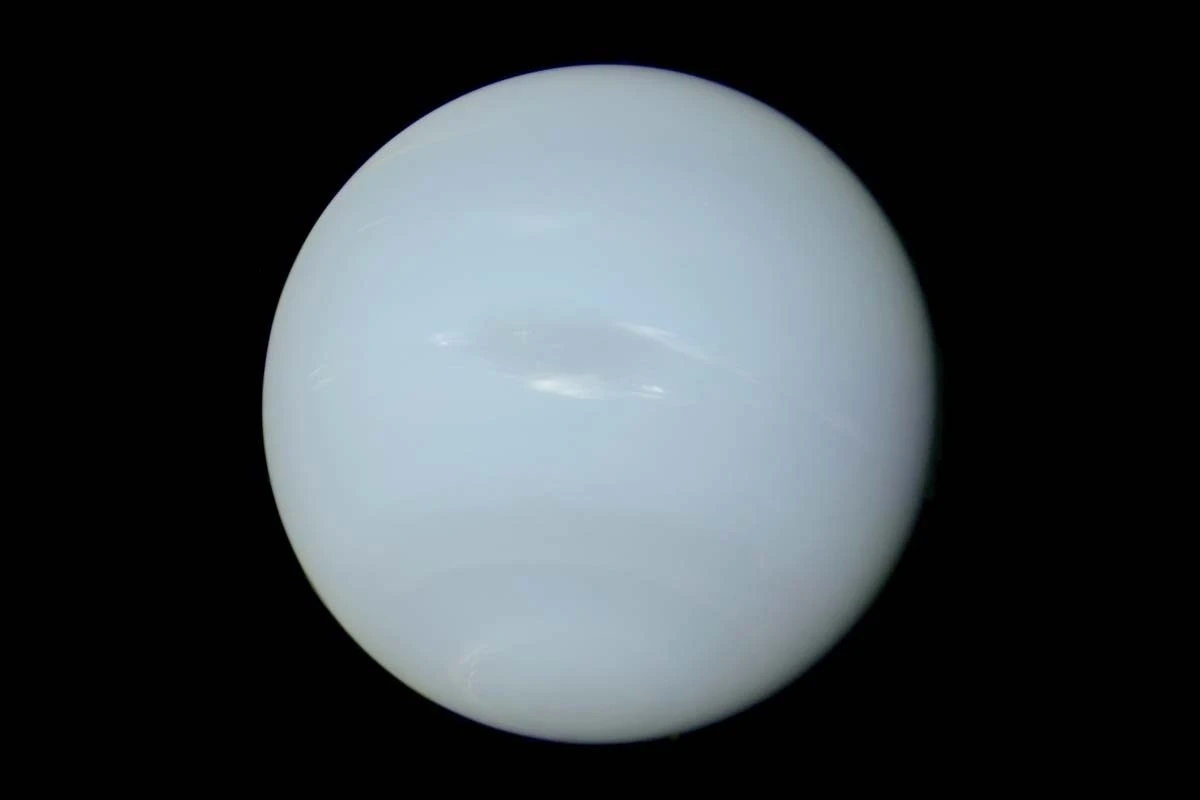
This is what Neptune would look like if it received as much sunlight as Earth.
The Fastest Winds in the Solar System
Neptune's upper atmosphere, cooled to approximately -220 degrees Celsius, is home to the most powerful winds in our solar system. Their speed can reach an incredible 600 meters per second, or 2,160 kilometers per hour!
For comparison, during Hurricane Patricia, the fastest-ever recorded wind speed, wind speeds reached "only" 346 kilometers per hour. This is a real mystery for scientists, as Neptune receives very little solar energy. The nature of such winds remains unknown.
Mysterious Rings and Moons
Voyager 2 also confirmed the existence of a dark ring system around Neptune and collected data on some of its moons. The most intriguing of these is Triton, covered in nitrogen ice and orbiting the planet in the opposite direction. Available data indicate that Triton was once a dwarf planet in the Kuiper Belt. 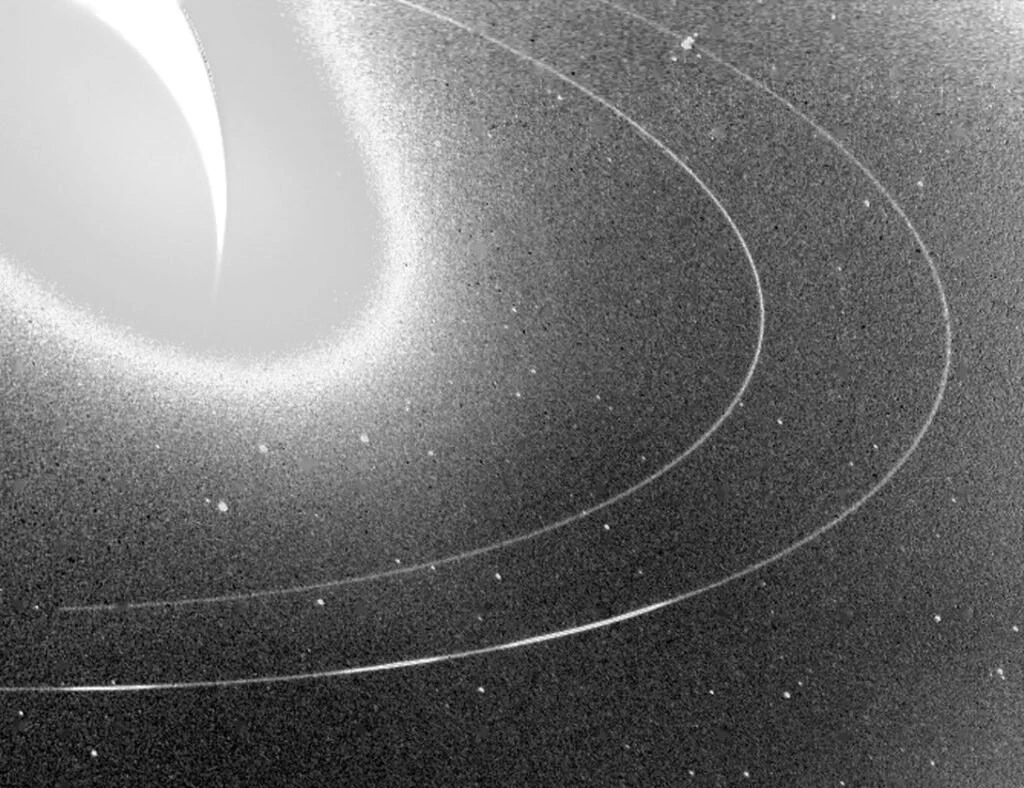
Neptune's ring system observed by Voyager 2
On Triton, Voyager 2 recorded a surprising phenomenon—cryovolcanism. Liquid nitrogen erupted from the depths of the Neptunian moon through cracks in its surface, creating geysers up to eight kilometers high and feeding the thin atmosphere.
Anticipating a New Visit
Since the Voyager 2 flyby, humanity has not sent any dedicated missions to Neptune, so today scientists have to make do with data obtained from ground-based observatories and space telescopes. Combined with the data transmitted by Voyager 2, this information helps us better understand the evolutionary path of Neptune and the Solar System as a whole. 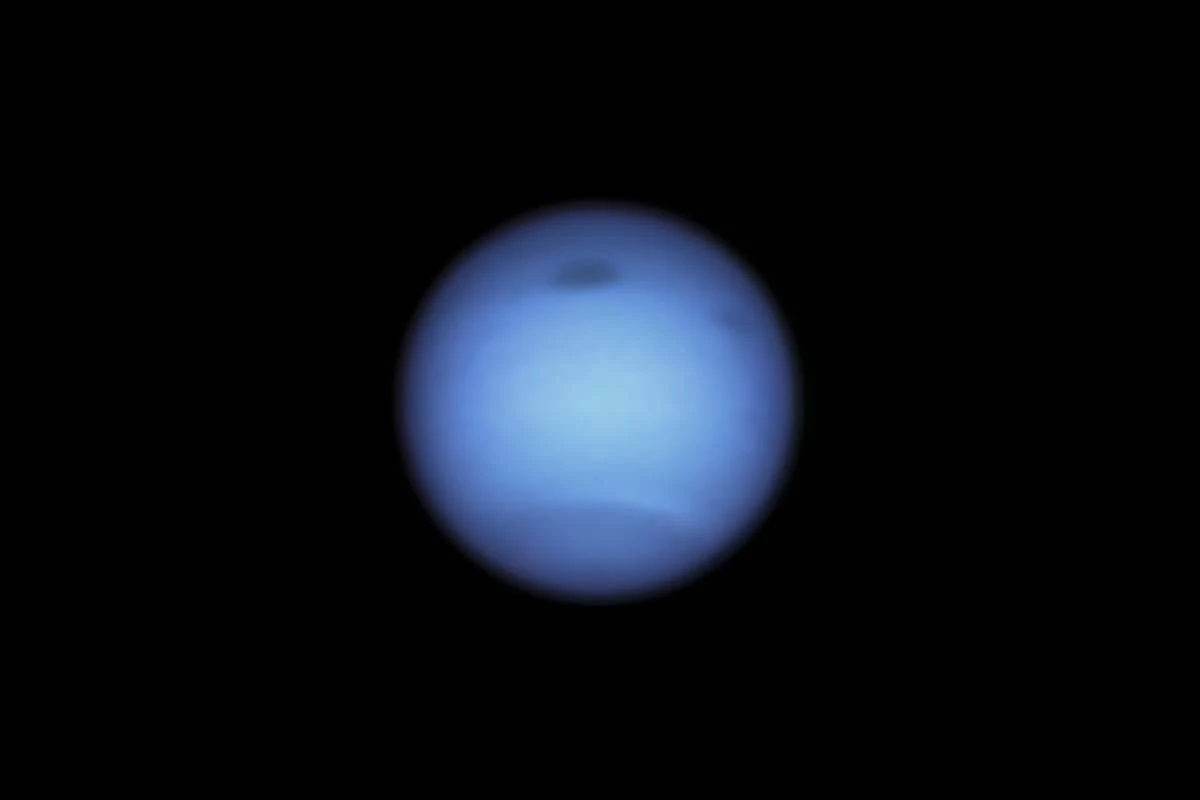
Neptune, as observed by the Hubble Space Telescope on December 15, 2020
NASA and other space agencies are discussing a new mission to the ice giants, but even if it is approved, reaching Neptune will be decades away.
Therefore, the deep azure crescent of Neptune, captured by Voyager 2, is more than just a historic achievement. It is a symbol of the human quest for knowledge and a reminder that even the most distant worlds can be brought a little closer thanks to science and technology.
Add your comment
You might be interested in:














Protective film Removing it with a power screwdriver

Precision carpentry

Looks like it's time to buy WinRAR

When a child plays hide-and-seek at a professional level

Super dads who swoop in to save the day

Athlete in Bavarian dress flies over a lake on a hydrofoil

How to hang wallpaper neatly

Man sets up bedroom camera and discovers the reason for his

The Terminator's tears: Figure decides to scrap its old
