Unreliable power. The BL 14"/45 Mark VII gun – the strength and weakness of the last British battleships (6 photos)
One of the previous articles touched on the topic of British battleship guns during the First World War. The 381mm BL 15"/42 Mark I proved to be very successful and remained in use until the end of the battleship era. But technological progress did not stand still, and in the 1930s, Britain began developing the last battleship gun in the history of the Royal Navy – the BL 14"/45 Mark VII. It proved to be very controversial. 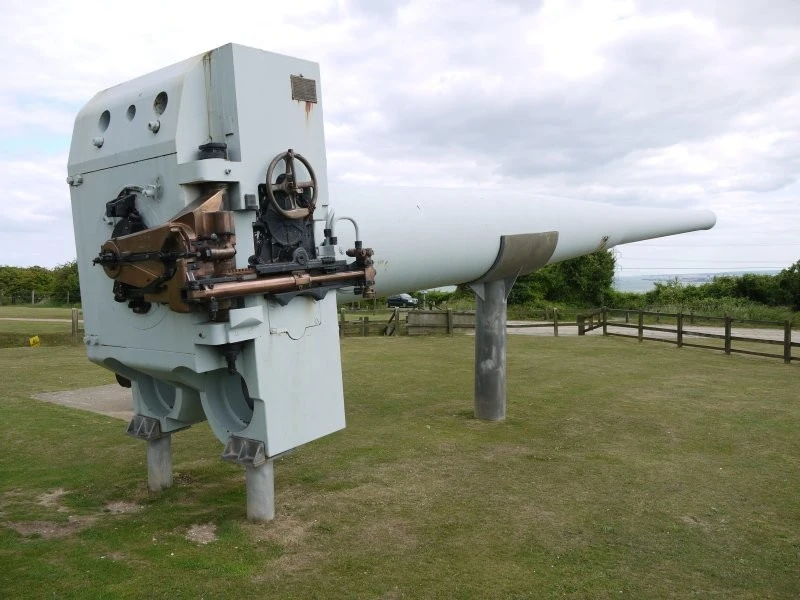
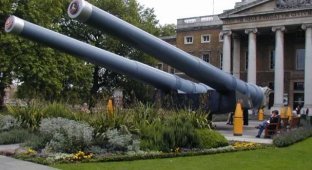
356mm BL 14"/45 Mark VII gun at Fort Nelson, UK. Previously stored in storage, it did not see combat action. participated
After World War I, the Washington Naval Treaty limited the number of battleships in the navies of participating countries and the caliber of their guns. In compliance with the treaty's terms, Great Britain acquired only two new ships during the interwar period—HMS Nelson and HMS Rodney, both armed with 406 mm guns. Neither the battleships' layout nor their armament proved particularly successful, which predetermined a return to previous construction schemes.
Development of a new class of battleships began in 1928, but progressed very slowly. The caliber of the new guns was a primary issue. The British couldn't afford to design dual-caliber guns like the Americans, so after much debate, they settled on 356 mm. In many ways, this was a step backwards—the Nelson-class had 406 mm guns, and the older Queen Elizabeth and Revenge carried 406 mm main guns. 381 mm. However, this was compensated for by good armor penetration and a high rate of fire.
The guns were designated BL 14"/45 Mark VII. A total of 78 units were produced (including prototypes) – 24 by the Royal Ordnance Factory, 39 by Vickers-Armstrong, and 15 by William Beardmore & Company. Of these, the first 39 guns weighed 80,865 kg, or 92,042 kg with counterweight. Engineers then changed the breech shape, resulting in the guns without the breech becoming lighter – 80,256 kg, but with the counterweight, the weight increased to 92,956 kg.
Otherwise, the technical specifications of the guns of both subseries were identical. The barrel length was 45 calibers (16,002 mm), and the overall length of the gun was 16 532 mm. The barrels were rifled, with 72 grooves each, one groove per 6.208 mm of length. Each had a constant twist rate of 30 calibers. The BL 14"/45 Mark VII was designed for 356 mm ammunition weighing 719-723 kg. The muzzle velocity was 757 m/s. This was achieved with lower bore pressure than the previous 381 mm gun. This resulted in a good barrel lifespan of 340 rounds with a full warhead. 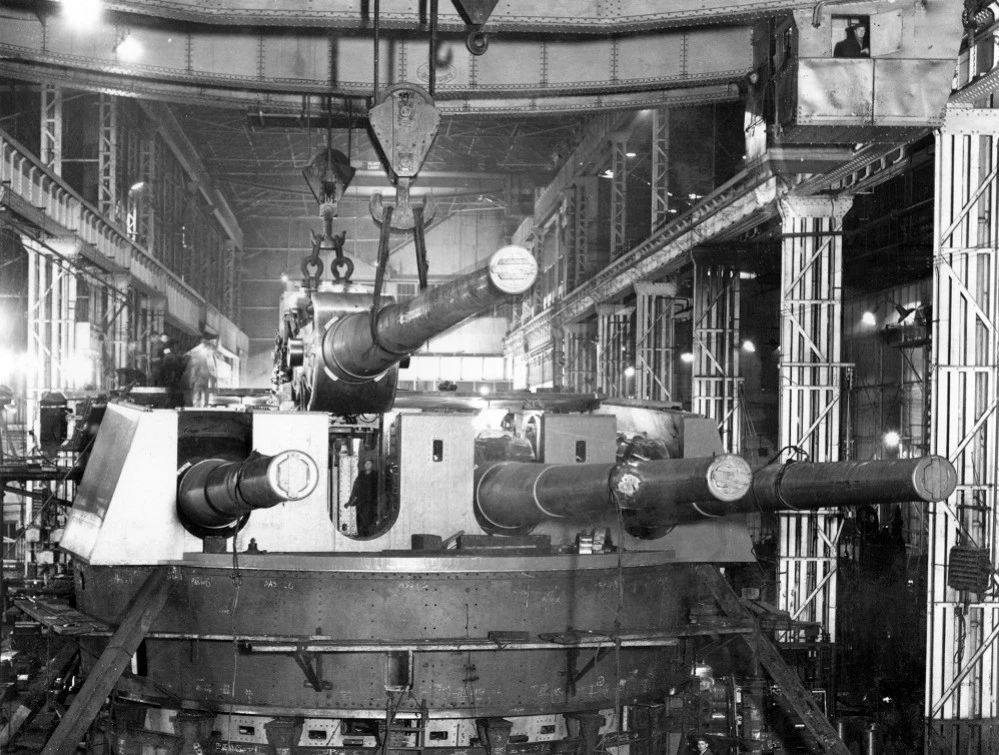
Assembling a quadruple turret with a 356 mm Guns for the King George V-class battleships at the Vickers-Armstrong factory in Newcastle-upon-Tyne, April 30, 1940.
A new armor-piercing shell, the Mark VIIb, was developed for these guns. The shell cup was made of high-strength steel. The 356 mm shell contained approximately 2.5% (18.1 kg) of explosive—a mixture of 70% trinitrophenol and 30% dinitrophenol. This made the shell less prone to premature detonation, a characteristic of British shells used in World War I. The shell had a well-streamlined shape, and the fuse was located in a special bushing, somewhat removed from the base. This increased the probability of its detonation on oblique impacts, allowing the 356 mm BL 14"/45 Mark VII shells to penetrate similarly thick barbette armor on German battleships. Battleships.
The BL 14"/45 Mark VII guns on the King George V-class battleships were mounted in one twin and two quadruple turrets. The turrets and feed mechanisms featured numerous anti-explosive measures and interlocks, which improved safety but increased the system's complexity and overall weight. The turrets weighed 1,557 tons for the quadruple Mk III and 900.5 tons for the twin Mk II. During service, the quadruple turrets proved less reliable than expected. Rushed construction under wartime conditions, insufficient clearance between the rotating and fixed turret structures, and insufficient full-charge firing exercises led to problems during extended combat missions. actions. 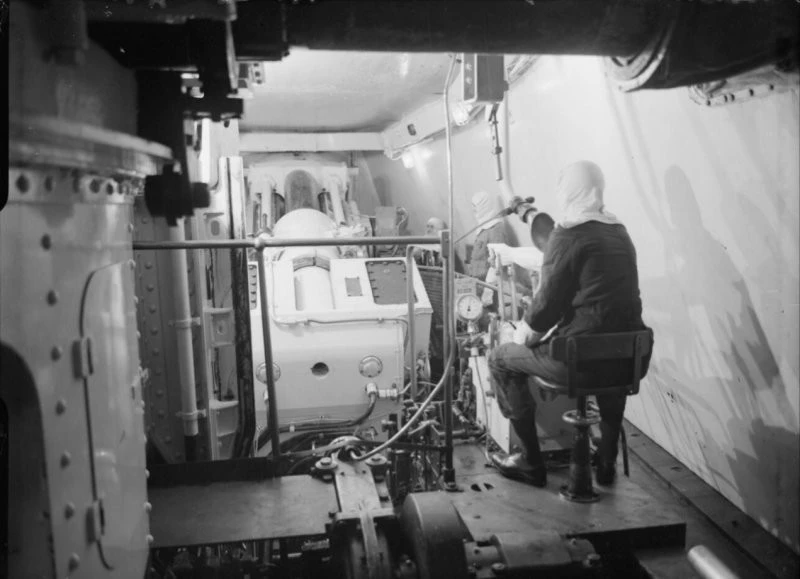
The interior of one of the main battery turrets of HMS King George V, with a BL 14"/45 Mark VII gun
The first experience with the new guns was a battle in the Denmark Strait. The still-under-equipped HMS Prince of Wales engaged the German battleship Bismarck and the heavy cruiser Prinz Eugen on May 24, 1941. Due to its course, it could only fire its forward turrets, but they fired 55 shells in 18 salvos in nine minutes (74% effectiveness). Water constantly flooded the four-barreled forward turret, which soon jammed. Also, a shell in the aft turret slipped from its chute and struck the loading mechanism, disabling it. Nevertheless, HMS Prince of Wales managed to seriously damage Bismarck with three hits.
During the battle with the Bismarck on May 27, 1941, the battleship HMS King George V experienced no problems firing for only the first half hour. Then the feed mechanism jammed, and the forward quadruple turret was out of action for 30 minutes. All four guns in the aft turret were also forced to cease fire, but for a shorter period—seven minutes. The twin turret also ceased firing for several minutes. In addition to complete turret failures, individual guns also malfunctioned. Overall, the twin turret performed better than the quadruple turrets, and occasionally it was the only one firing. As a result, HMS King George V's firepower was only 20% of its intended effectiveness. 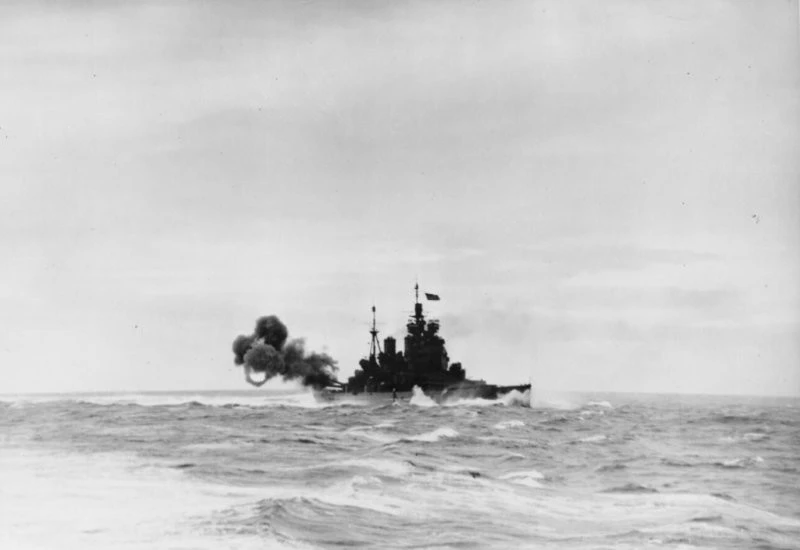
HMS Duke of York firing her main battery during exercises on February 27, 1942
During the Battle of North Cape on December 26, 1943, HMS Duke of York fired 450 main battery shells in 77 salvos over two hours. Despite improvements made since the pursuit of the Bismarck, some BL 14"/45 Mark VII guns continued to fail. Only the left gun in the twin-barrel turret experienced no problems throughout the battle. In the aft turret, three of the four guns simultaneously failed for 15 minutes. Overall, due to breakdowns and delays, HMS Duke of York's fire efficiency was 68%, and she could have fired approximately 200 additional 356mm shells if she had been able to fire all her barrels.
After these three engagements, the King George V-class battleships had no further engagements with enemy ships. They were deployed several times to bombard coastal fortifications, where the BL 14"/45 Mark VII proved effective. A pair of these guns were also installed off the coast of Dover to bombard the occupied continental coast and passing ships. They were named "Winnie" and "Pooh," but, not being particularly effective, they were supplemented with other mounts. They were dismantled in 1956. 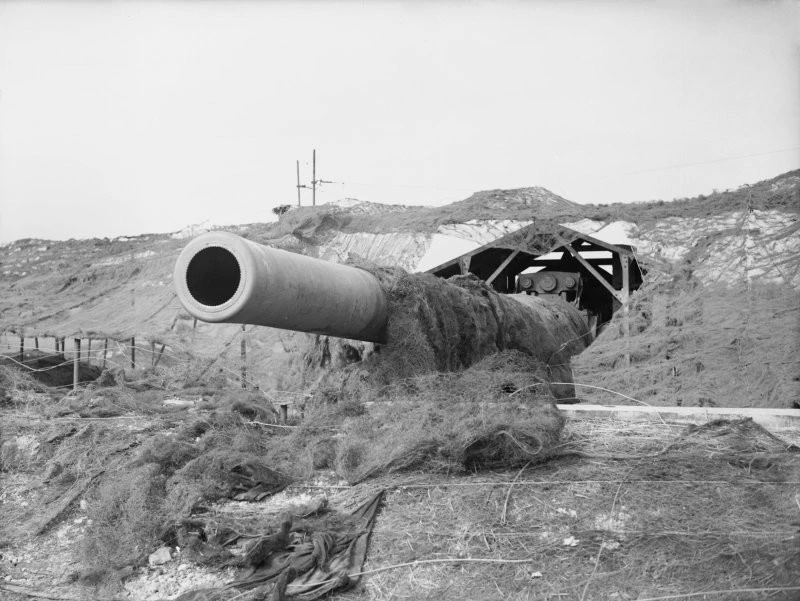
BL 14"/45 Mark VII "Winnie" coastal gun near Dover
Thus, the BL 14"/45 Mark VII guns had rather questionable characteristics. On the one hand, they were able to penetrate the barbettes of German battleships and disable their rangefinders, turning the enemy ships into easy targets for torpedo attacks. The guns fired very effective armor-piercing shells and were guided by decent radar, which contributed to increased accuracy. On the other hand, the design's imperfections led to constant breakdowns of both guns and turrets, which negated these advantages. Nevertheless, despite its technical difficulties, the BL 14"/45 Mark VII gun became, in a sense, a British symbol of World War II, the main participant in the final battleship clashes.