A symbol of the dreadnought era. The best British gun, the BL 15"/42 Mark I (5 photos)
When studying naval warfare and the history of warships, attention is often overlooked for its core principles—the weapons themselves. Therefore, it's worth examining the history of large-caliber naval guns, which drove scientific and technological advances in the early 20th century. For example, the BL 15"/42 Mark I gun is considered one of the most widely produced, reliable, and longest-lasting in the history of the British Royal Navy. 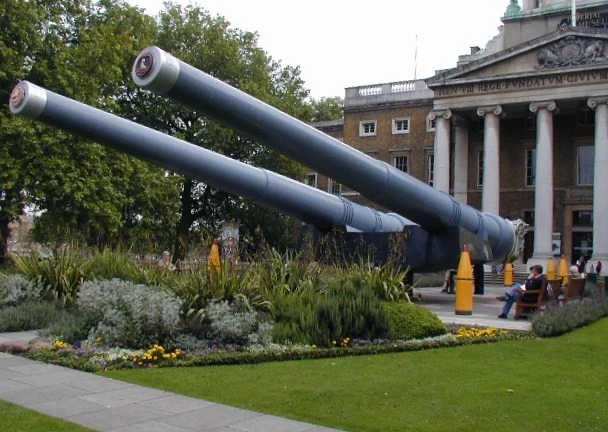
BL 15"/42 Mark I guns and their shells in front of the Imperial War Museum in London. The near gun is from the battleship HMS Ramillies, the far gun is from the battleship HMS Resolution.
By the early 1910s, the British Admiralty had concluded that the 13.5-inch BL Mk V naval gun was becoming obsolete. These 343 mm guns, mounted on pre-dreadnought battleships, were no match for the latest German artillery. Therefore, while developing the new battleship designs that would become the Queen Elizabeth class, the British began developing a new gun, this time with a 381 mm caliber.
The final years of peace were marked by the dreadnought race between Great Britain and Germany. The rapid buildup of the Kaiserliche Marine placed strict deadlines on the British. In 1912, Vickers, Son, and Maxim presented their design for a 381 mm gun for future battleships. At the Admiralty's request, the lengthy prototype development and testing phase was skipped, and the gun, codenamed BL 15"/42 Mark I, went into production.
Of course, this was a great risk, but the guns proved themselves completely worthwhile. The final technical specifications were as follows. Several layers of rectangular steel wire were wound around the inner tube of the barrel, the liner, and were closed at the top by an outer tube-casing with a piston-type breech. The barrel had fine rifling, 11.3 mm wide, with 76 grooves. The gun with breech weighed 101.6 tons. The barrel length was 16 m (42 calibers), and the full barrel length was 16.52 m (43.36 calibers). The gun was designed for projectiles weighing 871 kg and could impart a muzzle velocity of 750-800 m/s. Barrel life was 350 rounds at full charge.
The firing range varied. Initially, at an elevation of 20°, the BL 15"/42 Mark I naval guns had a range of 21,702 m. This elevation angle was typical for all Mk I turrets mounted on warships. However, some improvements were made based on experience at the Battle of Jutland. The battlecruiser HMS Hood, still under construction, received a unique mount, designated Mk II, which increased the basic firing range at the same elevation angle. The remaining ships, during various post-war upgrades, increased the range of their 381 mm guns to 30,680 m by converting the turrets to an elevation of 30°. 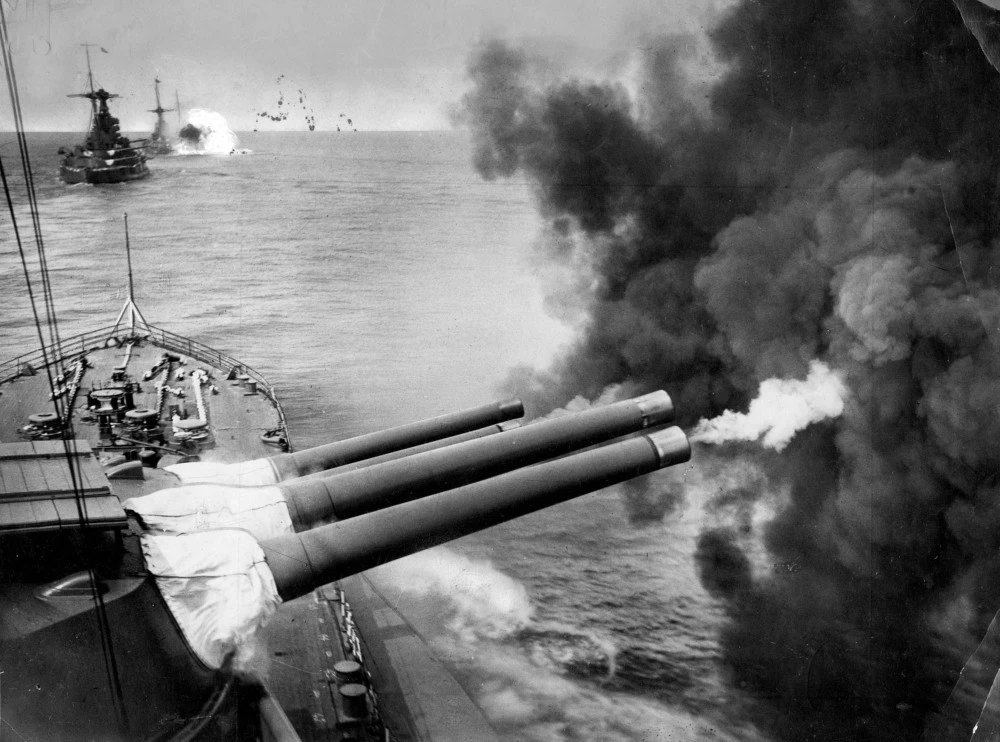
Battleship HMS Valiant firing her BL 15"/42 Mark I guns during exercises, circa 1939
Those battleships that had not been modernized and had guns with an elevation angle of 20° were given "supercharges" during World War II: when firing Mk XVIIB or Mk XXII shells, the muzzle velocity increased to 804 m/s and the range to 27,370 m. The last British battleship, HMS Vanguard, had both the ability to fire "supercharges" and the ability to aim at 30°, so her obsolete The guns could reach a target at a distance of 34,630 meters.
As for coastal artillery, without turrets limiting their aiming angle, these guns could hit targets up to 40,500 meters.
Initially, three types of shells were used: armor-piercing, shrapnel, and high-explosive—all weighing the same 871 kg, with a soft cap and filled with trinitrophenol. In 1918-1919, a slightly lighter armor-piercing shell with a hard cap was adopted, containing 20.5 kg of a mixture of 70% trinitrophenol and 30% dinitrophenol, which is less liable to detonation. This composition subsequently replaced pure trinitrophenol in manufactured shells. In addition, shells with a hard cap were produced in limited quantities for experimental purposes. With ammothol and trinitrotoluene. The propellant charge consisted of MD45 cordite.
The BL 15"/42 Mark I guns were produced for a short time: from 1912 to 1918. During this time, 186 were assembled at six different factories, the majority of which (49 units) were supplied by Vickers Limited in Barrow-in-Furness. Of the 186 guns produced, 122 were soon mounted on Royal Navy warships: the Queen Elizabeth and Revenge-class battleships, the Renown and Courageous-class battlecruisers, as well as HMS Hood, and the Erebus, Marshal Ney, and Roberts-class monitors. The dismantled guns were later used to arm the battleship HMS Vanguard. 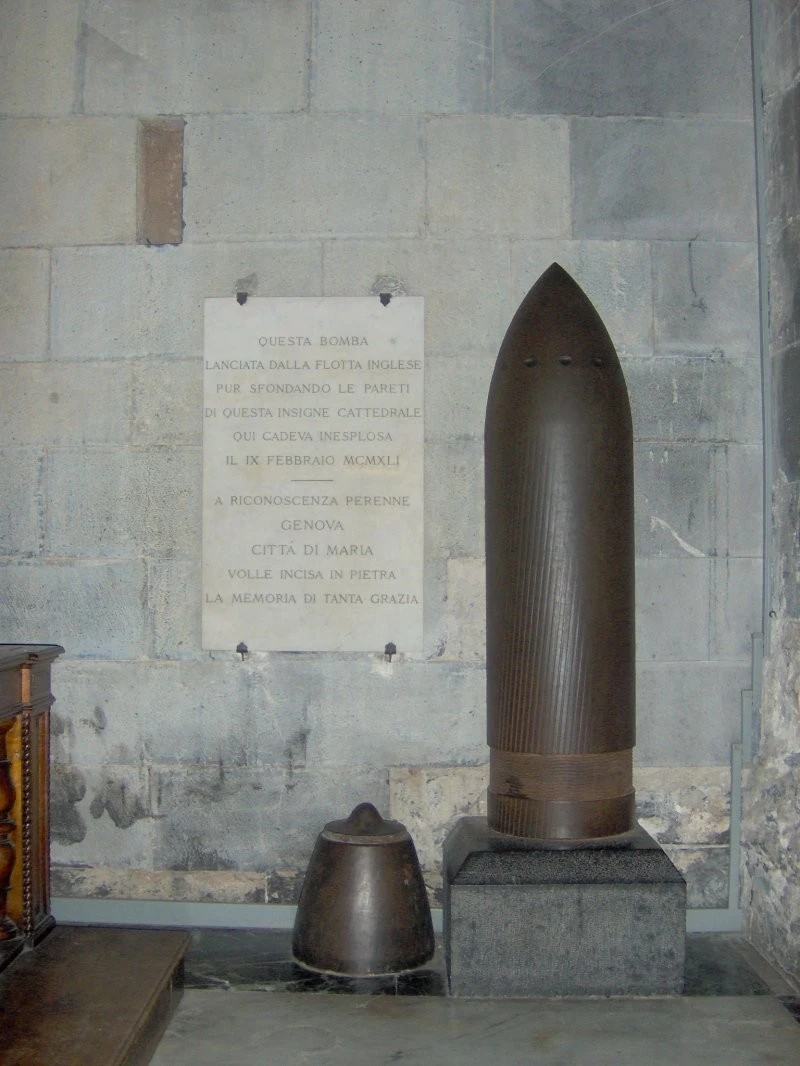
Unexploded 381 mm shell from a BL 15"/42 Mark I gun. Fired by the battleship HMS Malaya on February 9, 1941, during the shelling of Genoa.
The remaining guns were either stored in warehouses or used for coastal defense. In the 1930s, five 381 mm guns were installed in Singapore, and in the 1940s, two more were installed on the coast of Kent. They were used throughout the war to shell the French coast across the English Channel.
The combat history of ships armed with BL 15"/42 Mark I guns is well known – the First and Second World Wars, minor conflicts… However, it should be noted that during the Battle of Jutland, In 1916, the new guns of British battleships fired (and hit) at a distance of 17,800 m, which was a record at the time. In 1940, during the Battle of Calabria, the same guns set an absolute record for effective fire, when a 381 mm shell from the battleship HMS Warspite struck the Italian battleship Giulio Cesare at a range of 24,100 meters. 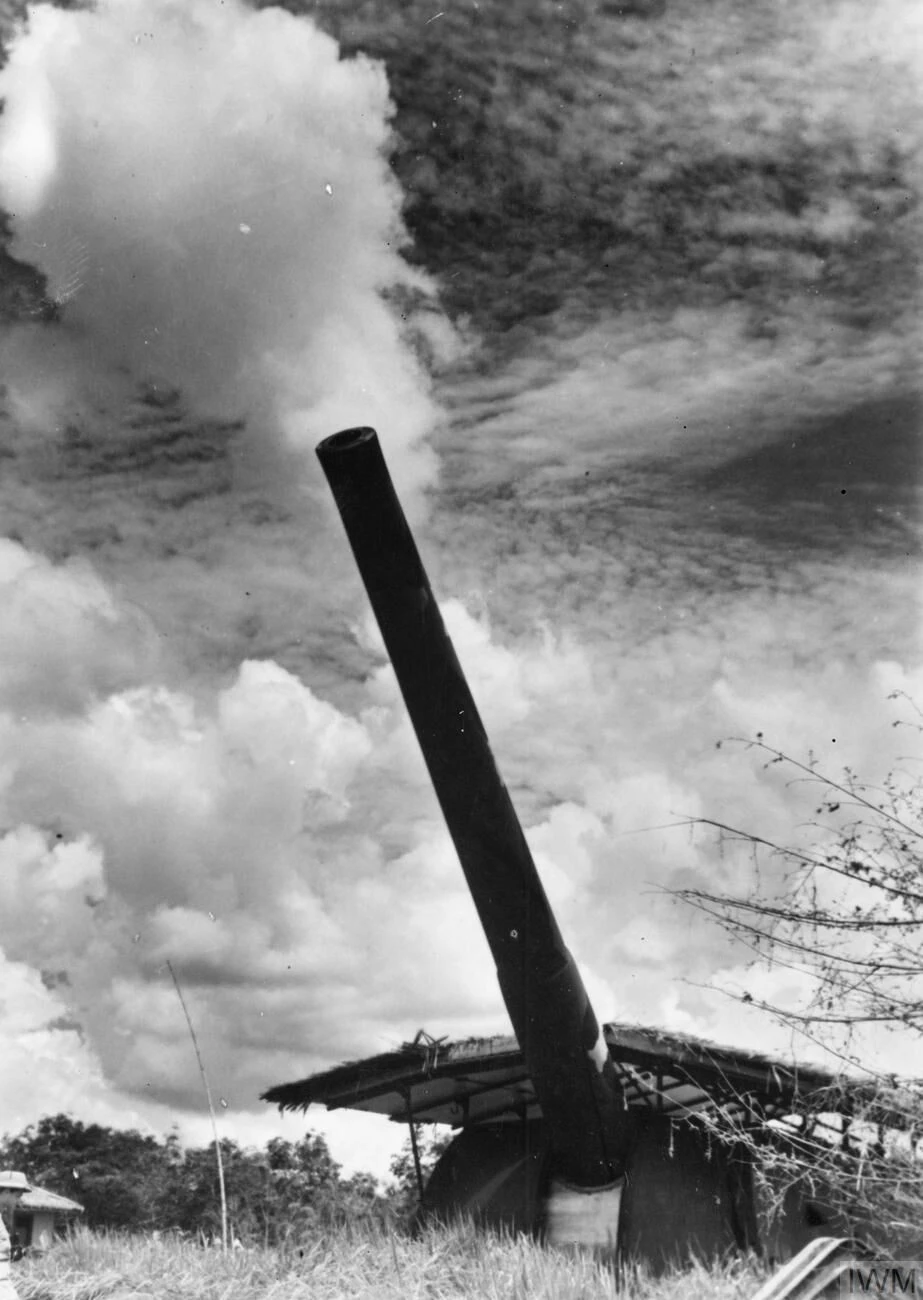
A BL 15"/42 Mark I gun from the Singapore coastal defenses fires at a high elevation. Exercise on December 8, 1941.
Furthermore, at that same time, the now significantly outdated guns demonstrated their effectiveness during the raid on Mers-el-Kebir, during which the British used BL 15"/42 Mark I guns. They sank the French battleship Bretagne, hit Provence, and the newest battleship Dunkerque. The latter's 225 mm main armor belt was penetrated twice.
It's no surprise that specialists and naval historians often call the BL 15"/42 Mark I a symbol of the dreadnought era and the finest British gun. It served from 1915 to 1959 and remained the most effective against all types of targets throughout its service life. Its successor, the BL 14"/45 Mark VII battleship gun, became merely a symbol, but never came close to matching the true utility of its predecessor. Two BL 15"/42 Mark I guns survive today—both removed from Revenge-class battleships and mounted in front of the Imperial War Museum in London.