Simone de Beauvoir’s Male Harem: The Three Men in the Life of Feminism’s Pioneer (9 photos)
The world’s most famous female philosopher and a founding figure of modern feminism, Simone de Beauvoir was an outspoken advocate for open relationships. Yet despite championing non-committal unions, she maintained deep, long-lasting bonds with a select few men in her own life. 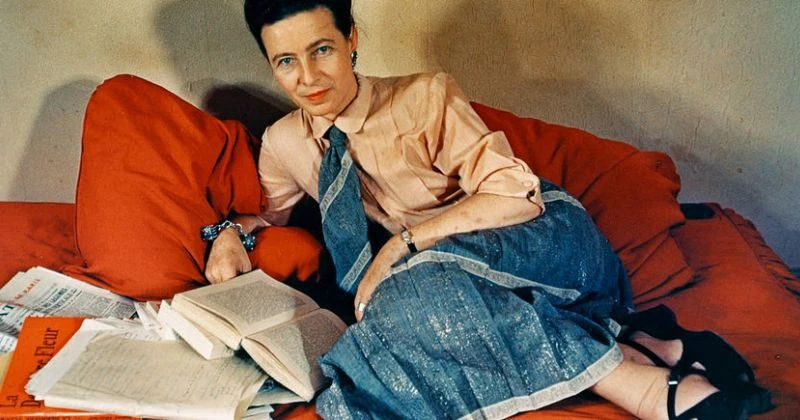
Born into a respectable French family, nothing in Simone’s early childhood hinted at the rebel, atheist, or brilliant thinker she would become. She grew up as a typical, intelligent, and lively child—if perhaps a little overly impressionable.
Her parents enrolled her in a Catholic school that encouraged intense religious fervor, where Simone would pray herself to tears. At times, the young Beauvoir prayed with such intensity that she believed she could hear the voices of angels, sending her into states of ecstatic devotion. 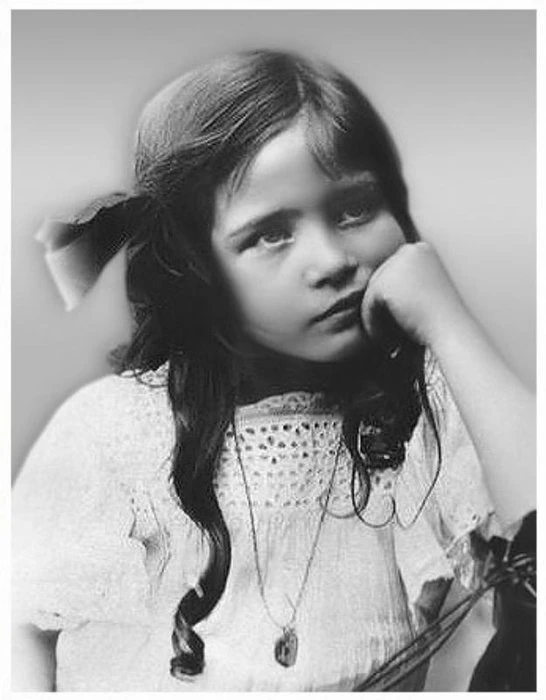
Simone de Beauvoir as a child
Everything changed when she hit adolescence. The turning point came when a priest at her school publicly humiliated her. While reprimanding her for a minor infraction, he pressed his hand firmly onto her head, forcing her into a subservient posture so she couldn't look up.
Most students would have dismissed the incident and forgotten about it immediately, but for Simone de Beauvoir, it became a vivid symbol of an overbearing system crushing individual freedom. She fixated on the moment, and those reflections played a defining role in shaping her worldview.
At fourteen, she suddenly realized she no longer believed in God. Overwhelmed by a profound sense of isolation, she burst into tears. Realizing she had only herself to rely on in a cold, indifferent world was terrifying for the sensitive teenager.
Around the same time, Simone grew close to a cousin whose lifestyle was far from conventional. Through him, she learned about the dark underbelly of Paris and the characters who inhabited it. She began frequenting night bars in the city's seedier neighborhoods—not drawn by the vice, but driven by a fascination with observing, listening, and analyzing human nature. 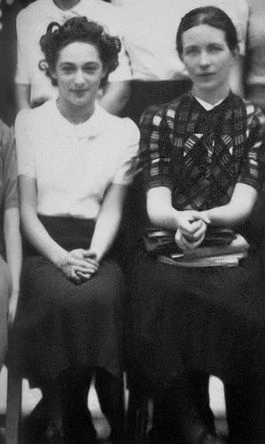
Simone de Beauvoir at university (right)
By then, Simone’s character was firmly established, defined above all by an uncompromising fierce independence. Embracing her rebellious streak, her views on love were surprisingly idealistic: she believed physical intimacy was inseparable from spiritual connection, and that one should commit to a partner only once in a lifetime.
By the time she finished high school, her family had gone broke, and her parents rightly stressed that a good education was her only ticket to financial independence and success. Determined to make her own way, the young rebel enrolled at the Catholic Institute of Paris to study mathematics, before earning a literature degree from the Institut Sainte-Marie de Neuilly.
Beauvoir and Sartre
In 1927, Simone de Beauvoir graduated from the Sorbonne after completing her thesis on Leibniz, becoming only the ninth woman to earn a degree there. Just a year later, in 1928, she earned her Bachelor of Arts. It was during her literature studies that she met Jean-Paul Sartre.
The two bonded instantly over their remarkably similar worldviews. One professor famously noted that while Beauvoir was the sharper philosopher, Sartre possessed a sheer intellectual brilliance that set him apart. Together, they were happy, unbothered by their own shifting internal dynamics. 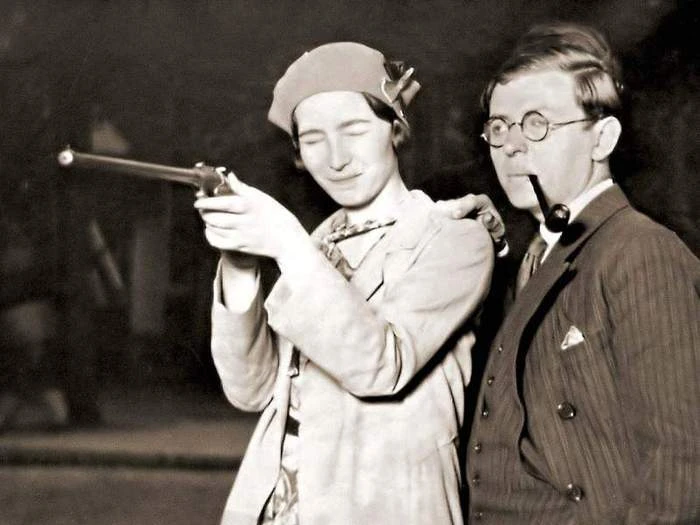
Sartre and Beauvoir
Simone’s mood fluctuated wildly: she could be a detached intellectual one day and a moody, capricious youth the next. Sartre was no different, seamlessly shifting from an ethereal thinker above worldly matters to a nagging grumbler. Neither held it against the other, accepting that mood dictated everything.
Nor did they restrict each other’s side affairs. Choosing not to live together, Sartre and Beauvoir still met every single day. They loved visiting each other, spending hours in cafés, and socializing with friends, all while scrupulously respecting one another's personal freedom.
Three’s a Crowd
This idyll lasted until Olga Kosakiewicz entered their lives—a young noblewoman from an émigré family. Both fell madly in love with her, and she embraced the passion whole-heartedly. Olga lived life to the extreme; at parties, she was known to dance until she literally passed out.
When Sartre proposed marriage to Olga, it caught many by surprise. She turned him down, preferring the unconventional dynamics of her relationship with the couple. Meanwhile, dark clouds were gathering over Europe that would soon shatter the trio’s romantic bliss. 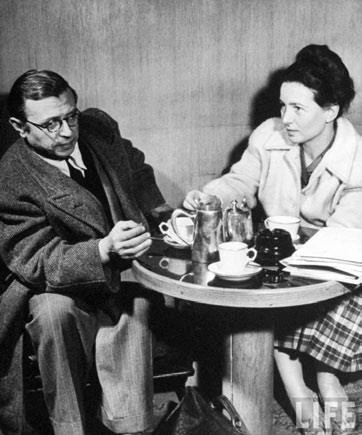
The Nazis had seized power in Germany, while Fascists were firmly in control of Italy. Soon, World War II broke out, and Sartre was sent to the front, where he was eventually captured. During this agonizing period, Simone de Beauvoir wrote her debut novel,
She Came to Stay
, widely seen as a reflection of her terrifying anxiety over Sartre's fate.
To a casual reader, the novel might seem like a simple domestic drama about a young guest tearing a couple apart. But to a philosopher, the plot was a direct exploration of humanistic existentialism, the ideology Beauvoir and Sartre had championed for years. Initially, the novel went unpublished and sat in a drawer, along with a previously written collection of short stories. Convinced she lacked talent as a writer, Beauvoir temporarily put down her pen. 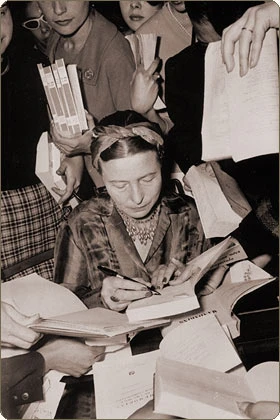
But upon returning from captivity, Sartre was thrilled by her literary experiments. He helped land
She Came to Stay
with a reputable publisher and urged her to keep writing. Encouraged by the man she loved, Beauvoir transformed from an obscure philosophy teacher into an accomplished author.
Soon, she began producing major philosophical works on the nature of womanhood. Her most celebrated writings explored how women are conditioned into traditional femininity, compromising their individuality to fit into rigid societal molds.
Her rigorous analysis sent shockwaves through French society. Where previous discussions had been vague and scattered across piecemeal essays, Beauvoir delivered the first comprehensive, highly original, and logically tight framework on the subject.
A Free Spirit
As she poured herself into her work, Beauvoir gradually drifted from Sartre, though he remained central to her heart. Sartre left France for the United States, where he struck up a romance with an actress named Ehrenreich. A decade later, he met a young Algerian girl, whom he eventually adopted so they could stay together without sparking scandal.
Simone’s own life was evolving. Having long considered Sartre the only man for her—while seeking physical intimacy primarily with women—she found the separation unbearable and followed him across the Atlantic. There, unexpectedly, she fell head over heels for a man. 
Nelson Algren
Naturally, he was an extraordinary figure—the philosopher had no time for the mundane. His name was Nelson Algren, a writer. Following a brief but intense passion, Algren made her an offer: move to Chicago, marry him, and start a family.
Beauvoir rejected all three proposals, though that didn't stop her from calling Nelson her "beloved husband" in her letters. She constantly tormented him with her refusal to settle down, her elusive nature, and her shifting moods. She would vanish to the far corners of the earth, only to shower him with affectionate letters from afar.
Algren, like any man in love, would have traded a mountain of correspondence for a simple embrace. Yet he endured it, cherishing all 300 letters Simone wrote him over their remarkable 14-year affair. During this era, Beauvoir penned two landmark works:
The Second Sex
and
The Mandarins
.
While
The Second Sex
scandalized even staunch freethinkers and cost Beauvoir many friends,
The Mandarins
dealt a heavy blow to her relationship with Algren. Furious that she had laid bare their intimate affairs in the novel without his consent, he felt deeply betrayed. 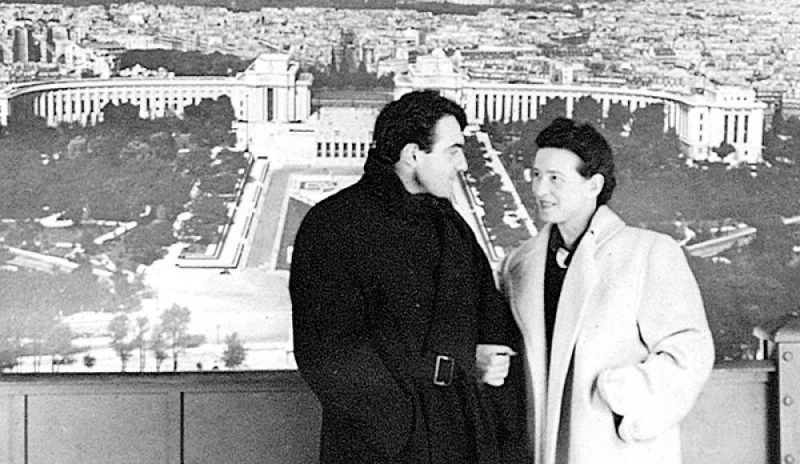
Simone de Beauvoir and Claude Lanzmann
It was during this period that the third key man entered her life: 27-year-old journalist Claude Lanzmann. Seventeen years her junior, Lanzmann was a colleague at the same publication. When he invited her to move in together, Beauvoir—to the utter shock of everyone who knew her—agreed. What followed was a peaceful, happy seven-year cohabitation.
In 1958, Beauvoir split with Lanzmann, and by 1961, her relationship with Algren had ended as well. Through it all, Jean-Paul Sartre retained his place in her heart; their bond transcended distance and time. The two spent considerable time together, even traveling to the Soviet Union in the 1960s on an invitation from the Writers' Union—a trip credited with helping warm diplomatic relations between France and the USSR. 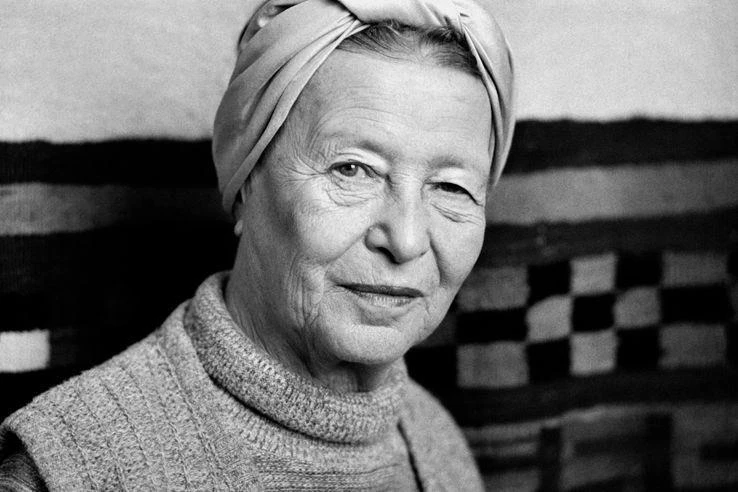
By 1970, Sartre's health took a turn for the worse, and he remained chronically ill for the rest of his days. Simone de Beauvoir spent a decade nursing him, proving once more that he was the true love of her life. Sartre's death broke her spirit; unable to find the energy to live or write without her lifelong companion, she passed away just six years later.
Regrettably, modern feminism has increasingly drifted from the intellectual foundations laid by Simone de Beauvoir, often morphing into distorted and trivialized forms.