Why melting the polar ice caps of Mars is a bad idea (3 photos)
One very famous "engineer" who loves to tell tales of the imminent colonization of Mars has repeatedly proposed detonating nuclear explosions over the poles of the Red Planet to quickly evaporate frozen matter, saturate the atmosphere with gases, and make it denser. 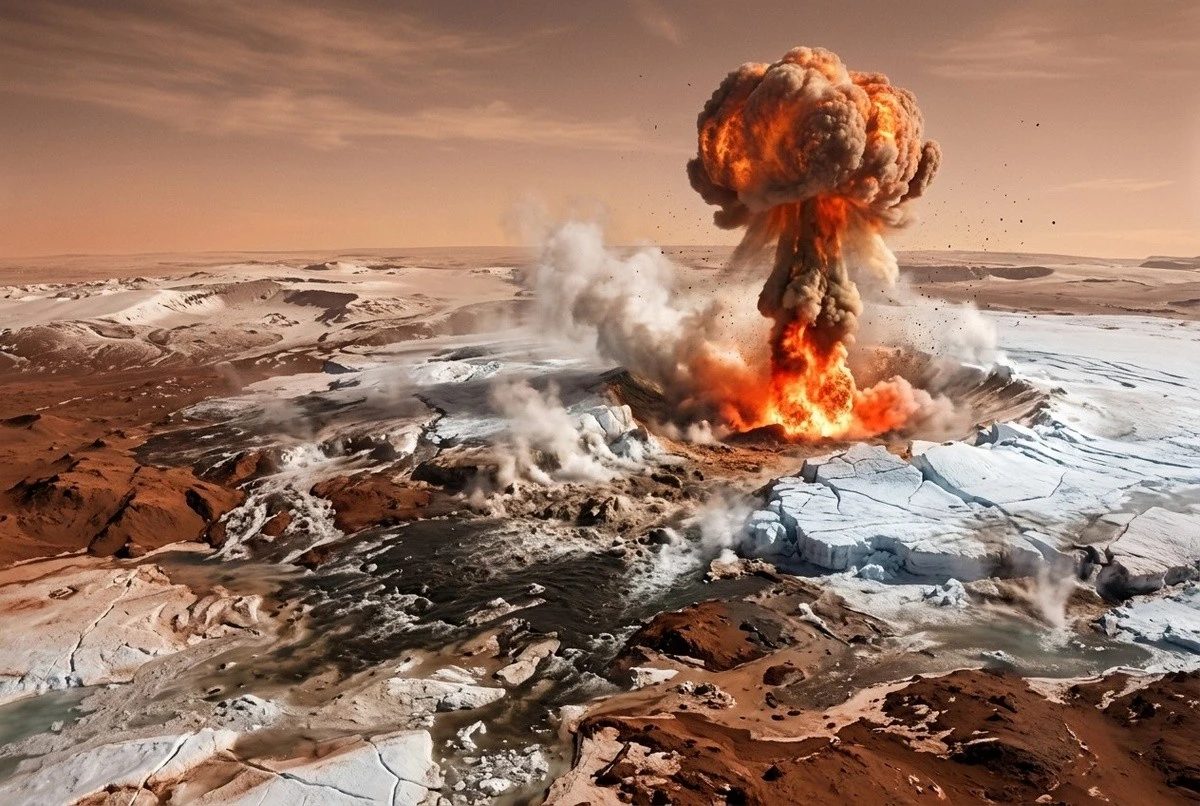
In the popular imagination, this idea seems like an extremely effective step toward terraforming: bam! And the frozen desert begins to transform into a new home for humanity.
All it takes is determination, and you're in the bag! Or is it?
With Mars, things are, of course, much more complicated than such fantasies suggest.
The main problem is that the polar caps of Mars are not magical atmospheric reservoirs. Yes, they contain frozen carbon dioxide and water ice. Yes, if the lion's share of these reserves were released and converted into gas, the atmospheric pressure would indeed increase. But this raises a reasonable question: will this be enough to cause significant changes on the planet?
And the answer ruins all the romance.
The current atmosphere of Mars is very thin. The surface pressure is less than 1% of Earth's. Therefore, liquid water cannot exist stably there: it either quickly evaporates or freezes. For Mars to once again become a planet with rivers, lakes, seas, and a mild climate, it would need not just a little more gas, but a massive atmosphere.
Melting or vaporizing the polar caps would only slightly thicken this meager gas layer. Researchers estimate that releasing carbon dioxide from the polar deposits would increase the pressure to less than 15 mbar. For comparison, Earth's pressure is about 1,000 mbar.
Therefore, "nuclear manipulation" of the polar caps would not only fail to turn Mars into a warm world, but would also pollute it. 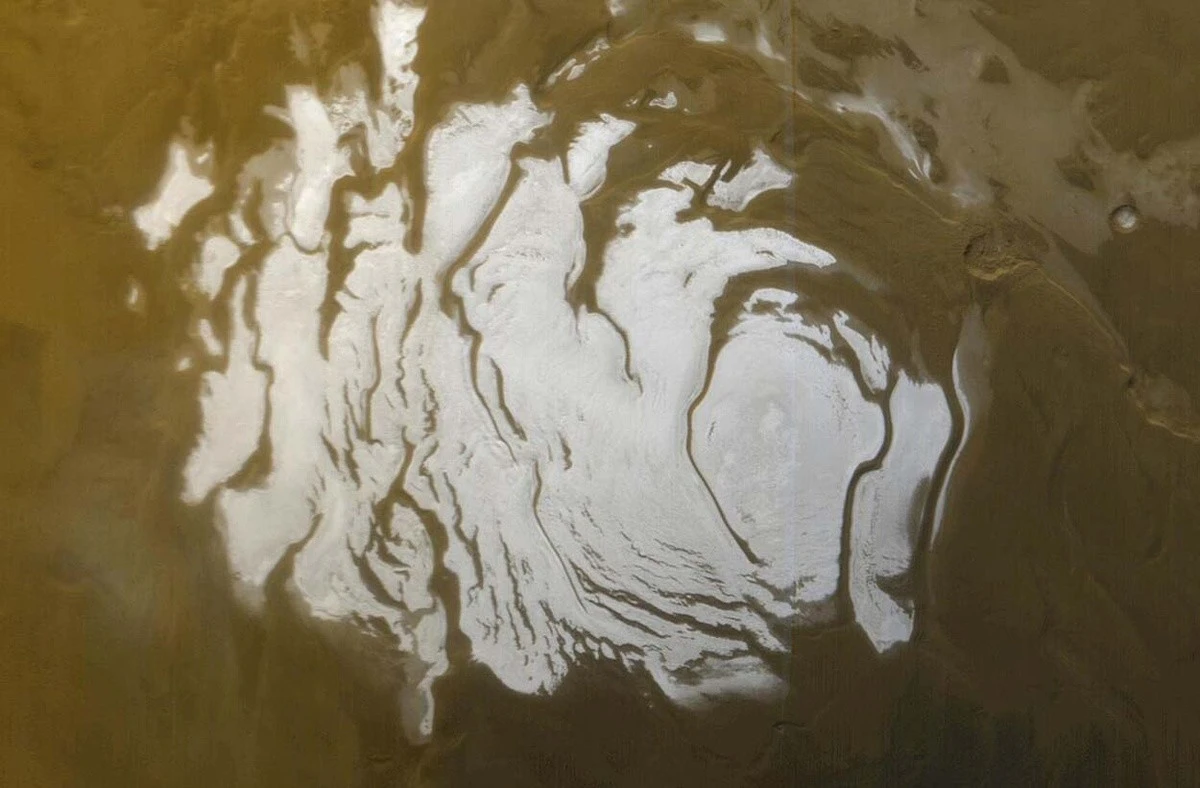
The southern polar cap of Mars in summer, captured by the Mars Global Surveyor orbiter on April 17, 2000
There's a second problem: water. Even if we imagine the polar caps melting, the atmosphere "recovering" slightly, and streams of water pouring across the surface, this effect would be short-lived. Mars is too cold, and the pressure would still be extremely low, so water would evaporate, freeze, and escape into the ground through cracks and pores. Water vapor would be transported to cold traps, that is, permanently shaded areas, where it would precipitate as frost and ice.
The third problem is carbon dioxide itself. In theory, it could become the main greenhouse gas, warming Mars. But its available reserves on the planet are insufficient. Part of the ancient atmosphere has escaped into space. Some carbon has bonded with carbonate minerals, while some is trapped in the soil and locked in icy clathrates—structures where gas molecules are trapped within a crystal lattice of water ice. Simply put, Mars lacks a convenient reservoir of greenhouse gas just waiting to be heated and released back into the atmosphere. Furthermore, it's impossible to replace the gas that simply escaped the planet.
Mars doesn't just lack heat. It lacks the substance to create a new atmosphere.
Now let's add another problem—the icing on the cake. Even if we somehow miraculously create a thick atmosphere, it would have to be contained somehow. Earth has a powerful magnetic field that protects its upper atmosphere from the constant assault of the solar wind. Mars, however, lacks a global magnetic field. Therefore, solar wind and radiation would destroy and carry its new atmosphere into space. 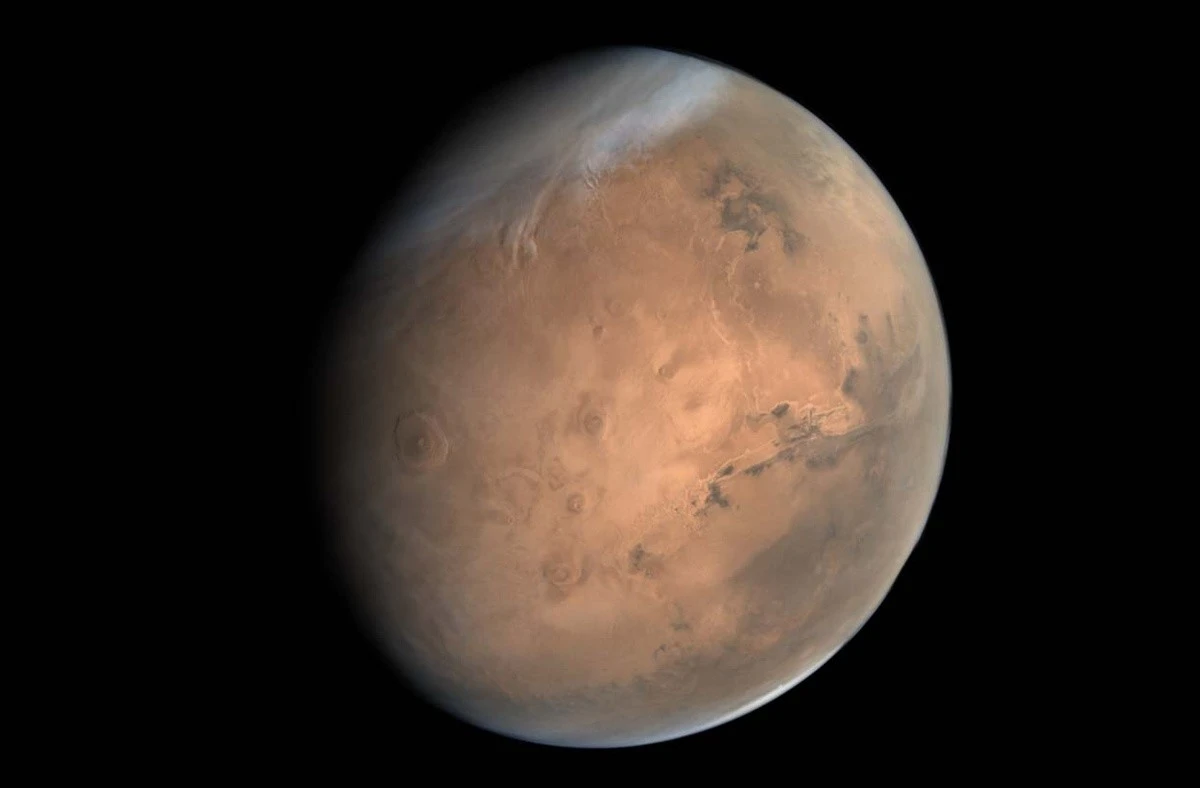
Natural-color image of Mars, taken by India's Mangalyaan spacecraft on October 10, 2014, from a distance of approximately 76,000 kilometers.
This has happened before. Based on available data, early Mars was a wetter and warmer world, meaning its atmosphere was much denser. But it failed to retain it. The gas envelope thinned, liquid water disappeared from the surface, and the Red Planet turned into the cold, dry desert we see today.
So why should the new atmosphere behave differently?
Of course, it wouldn't disappear instantly. The solar wind doesn't act like a hurricane, capable of blowing away the entire atmosphere in a couple of days. It's a slow process. But terraforming is a task that takes thousands or even millions of years. Therefore, the planet must not just acquire an atmosphere for a few decades, but maintain it stably.
Mars isn't capable of this.