Top 10 Strange Military Inventions That Were Never Destined to Be Used (11 Photos)
The easiest way to attract investment into a military project is to claim that the new weapon will make the army invincible. However, as experience shows, designers are full of eccentrics. There's no guarantee that the latest innovation won't turn out to be a colossal waste of resources.
You'll be surprised by some projects that almost made it into service. It was only thanks to common sense that the military didn't end up with a drum-based rocket launcher or nuclear mines containing chickens. We present ten truly strange inventions that never made it past field testing. 
Pukle Gun
The invention belongs to British lawyer James Puckle, who was the first in the world to patent a repeating weapon back in 1718. A shooter armed with a Puckle gun gained a distinct advantage in the form of a threefold rate of fire. It's worth noting that at the time, armies were armed with antediluvian muskets and flintlock rifles.
The Puckle gun was comparable to standard counterparts in accuracy and range. Remarkably, the new weapon could fire unusual square-shaped bullets. The inventor believed that square bullets had greater killing power and pain. He was far ahead of his time. If even one major army adopted the Puckle gun, history would have unfolded quite differently. 
The complexity of the design and operation of this innovative new product turned against it. The gun proved too expensive and complex. Its design consisted of numerous intricate parts, making mass production difficult. Furthermore, its operational requirements were poorly suited to the military tactics of the time.
The advantages of the Puckle gun were its small size and high rate of fire. However, its disadvantages were far greater. To fire, it required a permanent installation. The shooter had to assemble the gun and install the weapon. Once assembled, the gun could not be moved to a new position. As we know, losing time can be critical in any battle. Perhaps that's why this new development wasn't seen in service with any large army.
Pigeon-Guided Missiles
Today, a pigeon-guided missile seems out of the ordinary. In fact, the "Pigeon" project did exist. During World War II, engineers puzzled over the accuracy of hits. A pigeon innovation could solve this problem. The inventors modified the conical part of the missile, which would house three pigeons.
The birds were trained to peck at a target on a screen. The target image was transmitted to the screen through lenses. The missile changed course depending on the sector of the screen where the pigeon pecked. Pecks on the center of the screen caused the missile to fly straight. If the missile deviated from the target, the image moved to the edge of the screen. Pecks on this area allowed the missile to be directed on the correct course. Paradoxically, the pigeon rocket was unusually reliable. 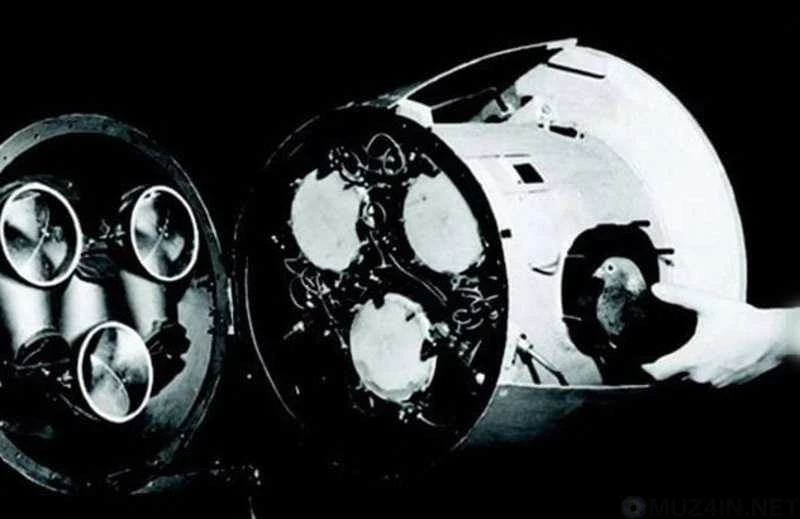
Harvard University psychology professor B.F. Skinner was a key figure on the development team. He gained fame for his studies of rats and pigeons. He believed that pigeons were significantly smarter and more trainable than rats. Later, he completely abandoned experiments with rats. Project Pigeon proved him right.
Despite the successful testing of the pigeon rocket, it never reached the battlefield. B.F. Skinner accused the generals of bias. In fact, his idea lost out to another project that was developing a radar-guided missile system.
Mouse Bomb
You don't have to be a military man or a designer to invent a weapon. The invention of Pennsylvania dentist Little S. Adams is a prime example. He decided to avenge Pearl Harbor on Japan with thousands of fires ignited by his mouse bombs. These tiny incendiary devices were so named because they were to be carried to their destination by bats.
The American dentist was an amateur caver. His brilliant idea struck him while studying the bats living in Carlsbad Caverns. Adams imagined thousands of the feathered rodents flying toward Japan carrying miniature incendiary bombs. He outlined his crazy plan to Eleanor Roosevelt, with whom he was close. 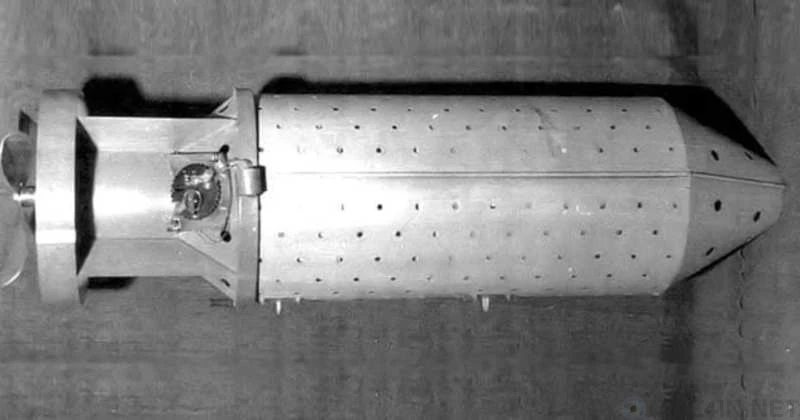
Thanks to his friendship with the president's wife, his idea became known at a high level. Oddly enough, the National Defense Committee approved the idea, allocating over two million dollars to Project X-Ray. The main costs were related to the issue of delivering the bats to the shores of Japan.
It's possible that the bat bombs would have been adopted by the American military. But the project was canceled, with funds and specialists diverted to the development of an atomic bomb. Nuclear weapons were a higher priority than the strange bat bombs.
"The Great Panjandrum"
The invention was a rather strange structure, unusual in every way. The "Great Panjandrum" looked like a huge drum packed with explosives. The device moved under its own power using two three-meter-long wheels. Small rockets attached to the rims made the wheels turn. The "Great Panjandrum" was designed to blow up concrete barriers, bunkers, and other obstacles in the path of the American army.
In practice, the device proved unpredictable. The "Great Panjandrum" was extremely difficult to steer. Engineers attempted to equip the design with a steering wheel, which resulted in the explosive drum acting like a tricycle. Furthermore, when the explosive device accelerated to 60 miles per hour (97 kilometers per hour), the rockets fell off the wheels. 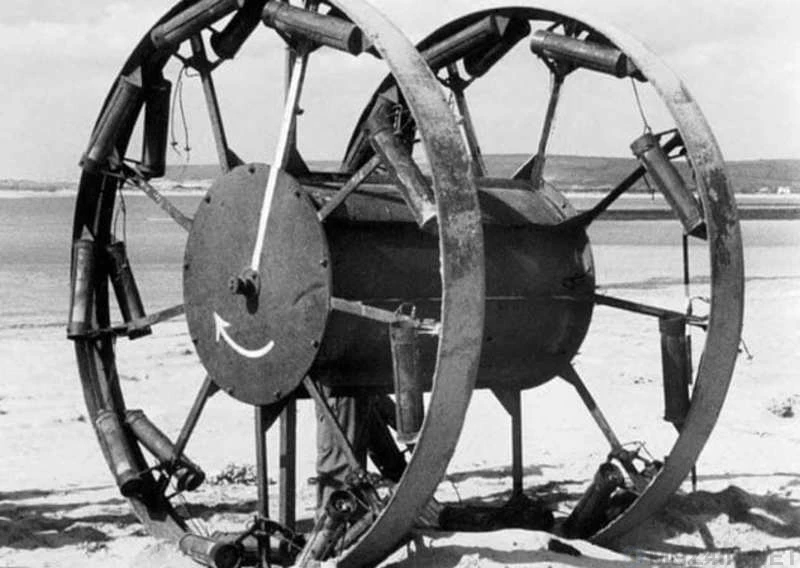
Despite all the difficulties, the "Great Panjandrum" was presented to senior military command in January 1944. Initial tests showed no signs of trouble. The device gradually gained speed and moved in a straight line. At some point, the rockets began to separate from their wheels, flying in all directions. The launcher instantly transformed into a huge fiery wheel, moving in a chaotic trajectory. As Panjandrum turned into a pile of flaming rubble, it became clear that the concrete barriers would have to be blown up by another method.
"Khajil"
Another invention by the brilliant team that was attempting to realize the "Great Panjandrum" project. The only thing they were good at was giving their projects epic names. "Khajil" gave Panjandrum a run for its money in terms of hopelessness and utter ineffectiveness. "Khajil" was developed during the era of rocket production.
Scientists were trying to find a use for jet propulsion. As is well known, rockets can not only accelerate but also decelerate movement. For example, when delivering cargo by air. Ideally, the rockets would have been able to do more than just slow the falling speed of the loaded platform and correct its descent trajectory. In reality, things turned out somewhat differently. 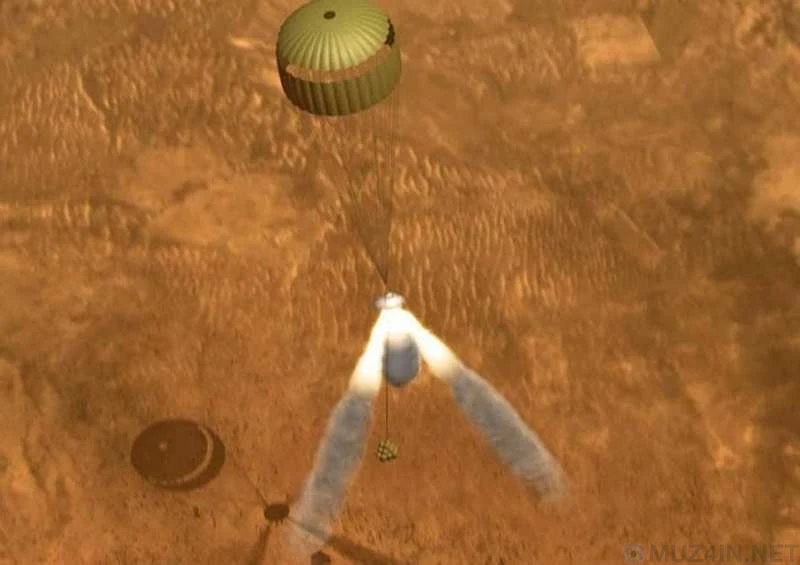
The project was named after the prophet Elijah spelled backwards. In the first tests, the transport dropped a platform loaded with concrete blocks. As it approached the ground, the rockets were activated to soften the landing. In practice, each test ended in disaster. Initially, the rockets failed to slow the concrete blocks' fall. Then, excess fuel caused the rockets to fire again, sending the cargo back up.
"Hajil" underwent extensive testing. Until, through trial and error, they arrived at the desired result. It was decided to switch to a more fragile payload. The US Navy donated two jeeps for this purpose. One crashed safely, landing at almost 50 kilometers per hour. The second jeep survived, but landed upside down. Due to the end of World War II, the project was shelved.
"Nellie"
The "Nellie," more commonly known as the "White Rabbit," was one of those projects doomed to failure from the start. The invention didn't address the army's pressing needs. It was an armored earthmoving vehicle that diligently dug trenches, helping infantry get as close to the enemy as possible. The "White Rabbit" project owes its longevity to Winston Churchill. 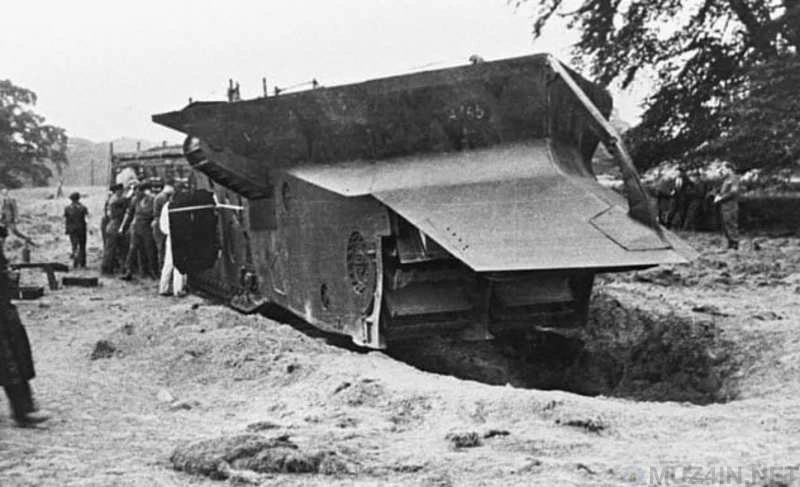
"Nellie" was very cumbersome, slow, and unwieldy. With a turning radius of one and a half kilometers, it could easily be called a stationary earthmoving machine. It could find application in the mining industry, but certainly not in the army, where artillery was crucial. The project was canceled only in 1943, because Winston Churchill had a soft spot for the armored earthmover. He later admitted that the "Nellie" should have been mothballed much earlier.
"Maus"
A rather odd name ("Mouse") for a 200-ton tank with 23-centimeter armor. The supertank was developed on the orders of Adolf Hitler during World War II. Not all generals shared the Fuhrer's enthusiasm. The army needed fast tanks with powerful on-board armament. The "Maus" was different from the start. 
Ferdinand Porsche was tasked with designing the supertank, and he had to resolve conflicting issues. The driveshaft proved to be a weak point. Despite being equipped with a powerful aircraft engine, the tank's top speed was limited to 19 kilometers per hour. The Maus had no machine guns, making it completely useless in close combat.
Adolf Hitler planned to arm the army with 150 indestructible tanks. But the designers failed to resolve the technical problems. As a result, only two prototypes were built.
"Beetle"
A strange design with a ring-shaped wing—an aircraft that was supposed to not only take off and land vertically but also reach supersonic speeds. However, from the very beginning, the Coleoptere ("Beetle") had numerous shortcomings. For example, pilot Auguste Morel noted difficulties in determining altitude. Quite often, the only indication of altitude change was the engine's sound. The aircraft also failed to overcome a highly undesirable tendency to rotate vertically. 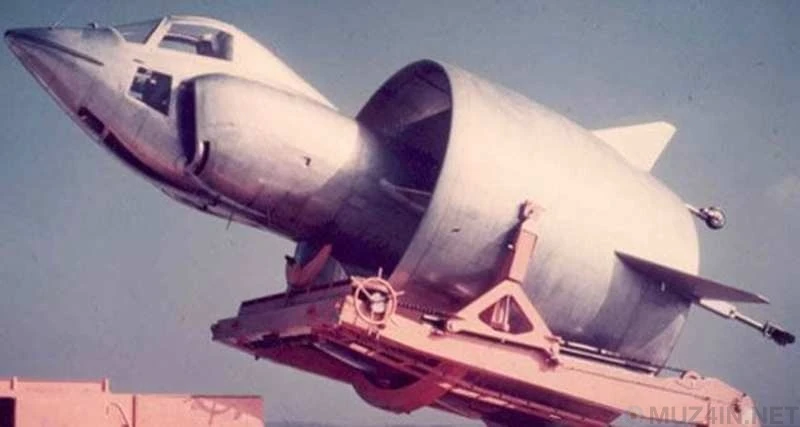
Only once did the Beetle achieve horizontal flight, and that was by accident. During the ninth takeoff, the pilot lost control. The aircraft briefly entered horizontal flight. The pilot was forced to eject due to a loss of altitude. The Coleoptere crashed and was destroyed. The ensuing fire destroyed the remains of the structure. The project was safely abandoned.
"Blue Peacock"
The invention was entirely consistent with the Cold War era. The "Blue Peacock" was a huge nuclear mine, intended to be buried in West Germany. It was believed that this would prevent or disrupt a hypothetical Soviet invasion. The deadly device had a significant flaw. The detonator refused to detonate at the low temperatures that were inevitable underground. 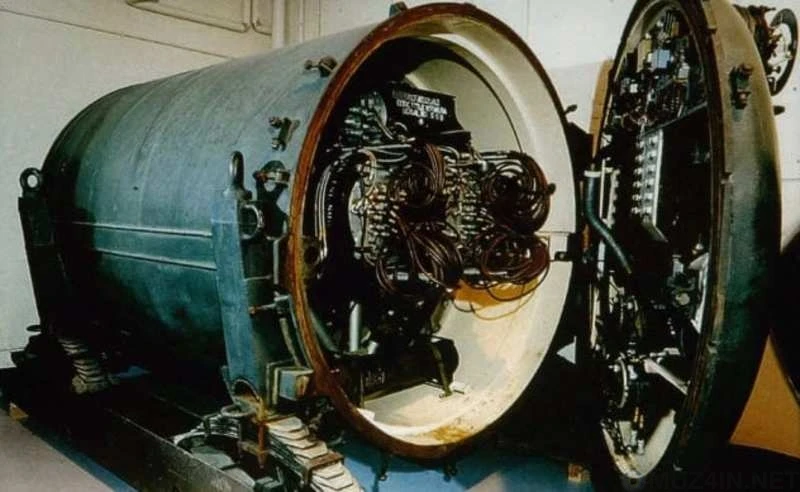
Brilliant minds came up with a remarkably original solution. The developers decided that chickens would save the day. All they had to do was launch the birds into the bomb's casing and provide them with sufficient food. The funniest thing is, the project wasn't abandoned because of the chickens. The British had the foresight to calculate the potential consequences of detonating a nuclear mine in central Europe.
Gay Bomb
It's hard to believe, but the idea of a gay bomb originated not in the rampant homophobic 1950s, but in the more recent and democratic year of 1994. An American military laboratory requested nearly eight million dollars to develop a chemical aphrodisiac. This supposed weapon of mass destruction was not subject to any international ban. This chemical aphrodisiac did not threaten the life or health of the enemy, but affected only sexual orientation. 
Upon closer examination, the idea proved to be a complete failure. First of all, science doesn't know how a chemical substance could instantly change a person's sexual orientation. Moreover, even when combined, all known aphrodisiacs cannot have a significant effect on the human body. And the very concept seemed dubious. Science knows of no evidence of the demoralizing effects of riotous orgies. However, there are many homosexual military personnel who have had successful careers.