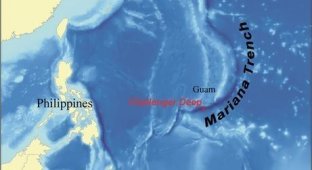
At the bottom of the western Pacific Ocean, southeast of the Mariana Islands, lies a trench nearly 11 kilometers deep. This is the Mariana Trench—the deepest place on Earth. If Mount Everest were submerged there, there would still be more than two kilometers of water above the summit. 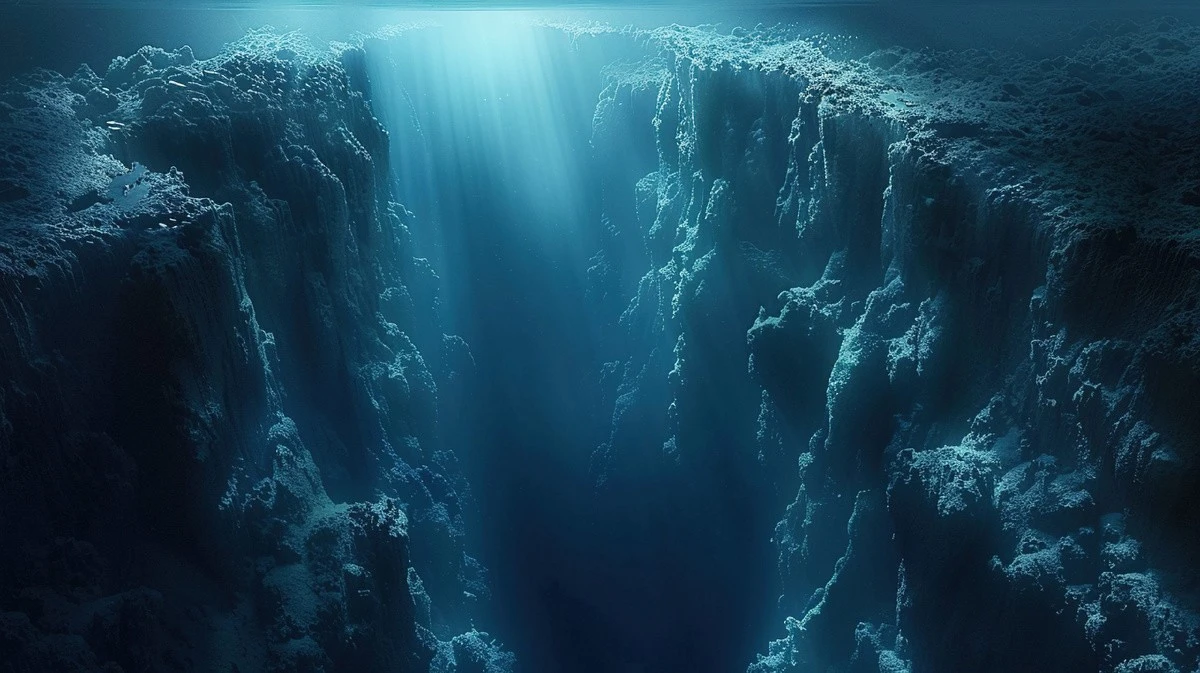
The pressure at the bottom is such that any submarine would collapse like a tin can under pressure: the metal would bend, the seams would split, and water would rush in within seconds.
But how did this abyss come to be? Why here and not in the Atlantic or Indian Ocean?
Collision of Giants
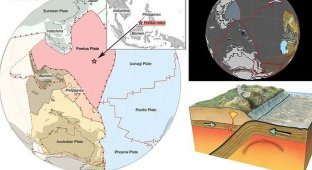
The Earth's crust is not a monolithic structure. It consists of giant plates that float on the hot mantle, like chunks of ice on water. As they slowly move, the plates occasionally collide, move apart, and overlap. Where they meet head-on, mountains form. Where they move apart, oceans appear. And where one plate dives under another, deep-sea trenches form.
The Mariana Trench is the result of precisely this process. The heavy Pacific Plate collided with the lighter Philippine Plate and began to sink beneath it, deep into the planet. Geologists call this mechanism subduction.
Why is one plate diving?
The Pacific Plate is ancient, approximately 170-180 million years old. During this time, it cooled, compacted, and became heavier. The Philippine Plate is much younger—approximately 40-50 million years old. It is lighter, warmer, and more buoyant.
When these two plates met, the older, heavier Pacific Plate was unable to maintain its position on the surface and began to subduct beneath the younger Philippine Plate. Where the plate flexed, the Mariana Trench formed, whose depth, incidentally, is continuously increasing by 3-4 centimeters per year. 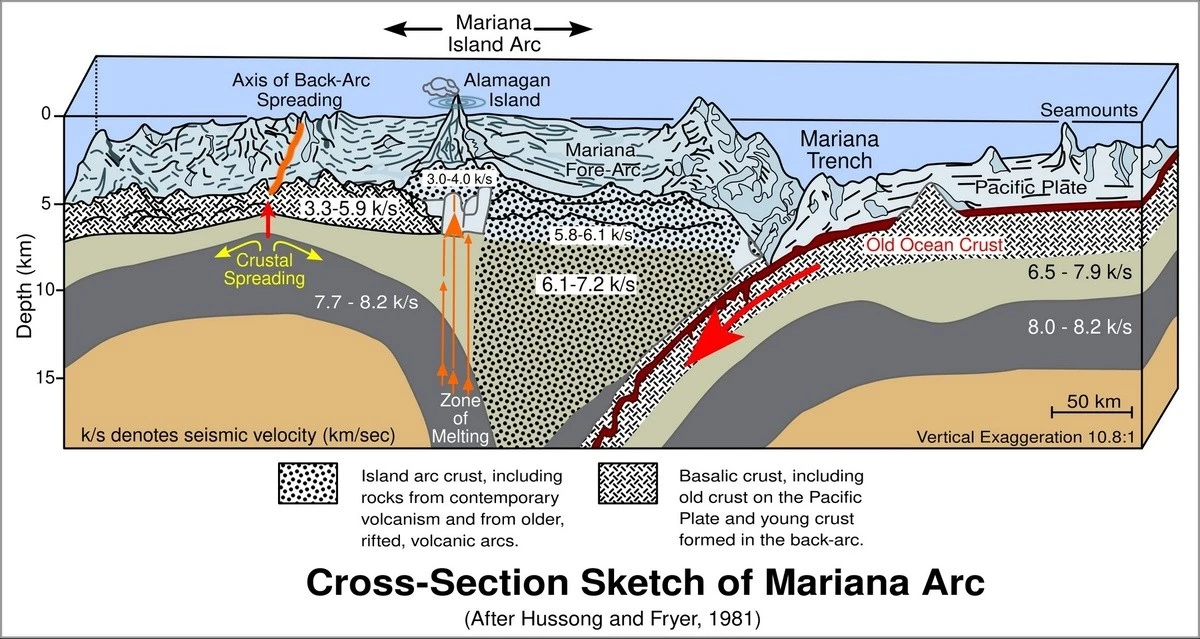
Remarkably, the plate itself had already subducted hundreds of kilometers. There, in the hot mantle, it gradually melts, is recycled, and becomes part of the Earth's interior. This is one of the mechanisms for the continuous self-renewal of our planet's crust.
Side Effects
The intense friction that accompanies the subduction of one plate beneath another generates powerful earthquakes. For this reason, the Mariana zone is one of the most seismically active on the planet.
The subducting plate also draws ocean water through cracks. The water enters the hot mantle and chemically alters the surrounding rocks, causing them to melt at a lower temperature*.
*When water enters the mantle under enormous pressure, it becomes embedded in the crystal lattice of minerals. This changes their chemical composition—the rocks become hydrated (saturated with water). Such rocks melt at a lower temperature than dry ones.
This is how magma forms, which rises and then erupts to the surface in the form of volcanoes. 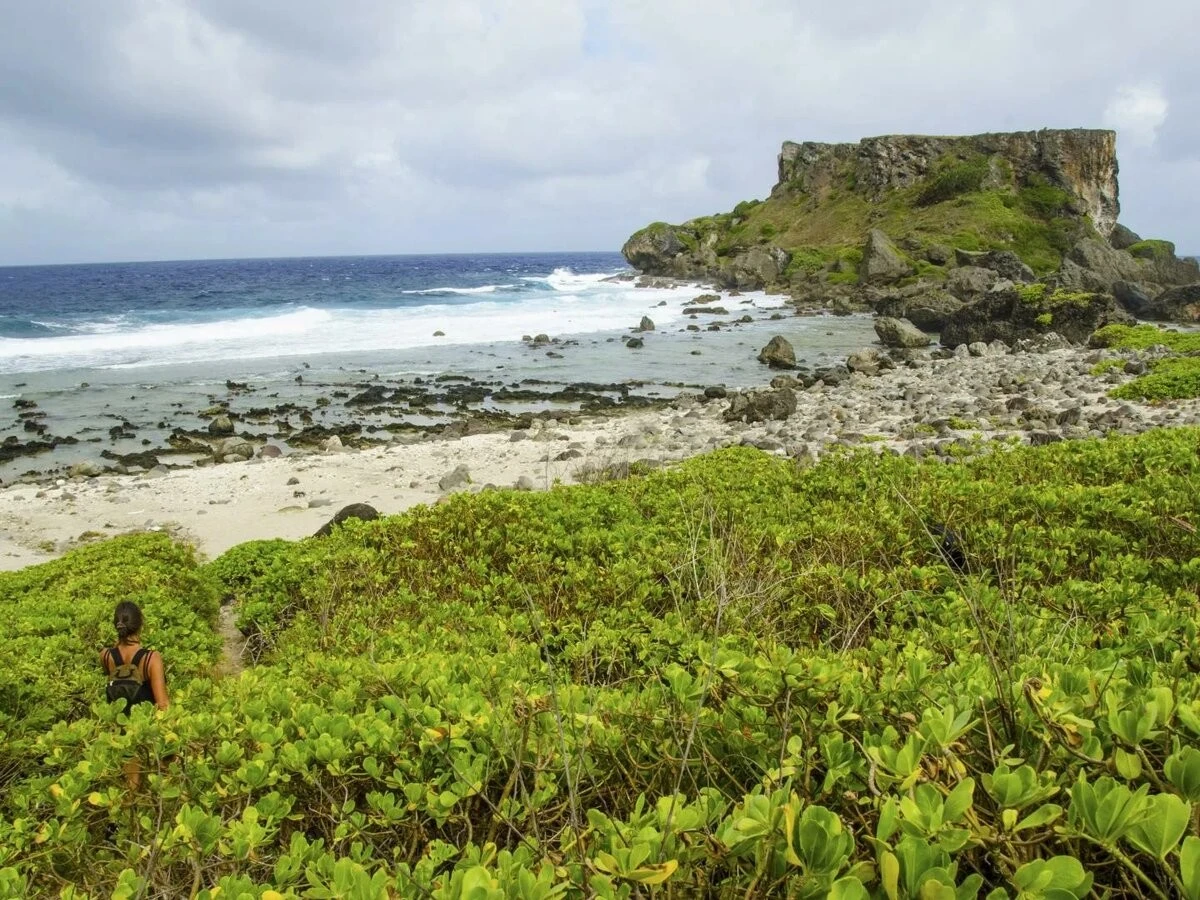
One of the northern Mariana Islands. All this beauty is the result of a destructive process occurring deep underwater.
That's why the Mariana Islands, a chain of volcanic islands, are located near the trench. Each island is the tip of an underwater volcano, a byproduct of the formation of the Mariana Trench.
Add your comment
You might be interested in:












Persistence in achieving a goal

A biker prevented a hit-and-run driver from escaping

Not everyone is having fun on the amusement ride

17 Photos That Will Stop You in Your Tracks (18 Photos)

The cutest lunch delivery ever

Young women, Dancing and George Michael: nothing superfluous

An apology delivered with a running start

A steam locomotive for "big boys"
Stunning Views of the Martian Horizon from 400 Kilometers
