Today we'll talk about the design created by Adolf Furrer in 1919 (and at the same time, we'll continue our story about the weapons developed by this prolific and original designer). 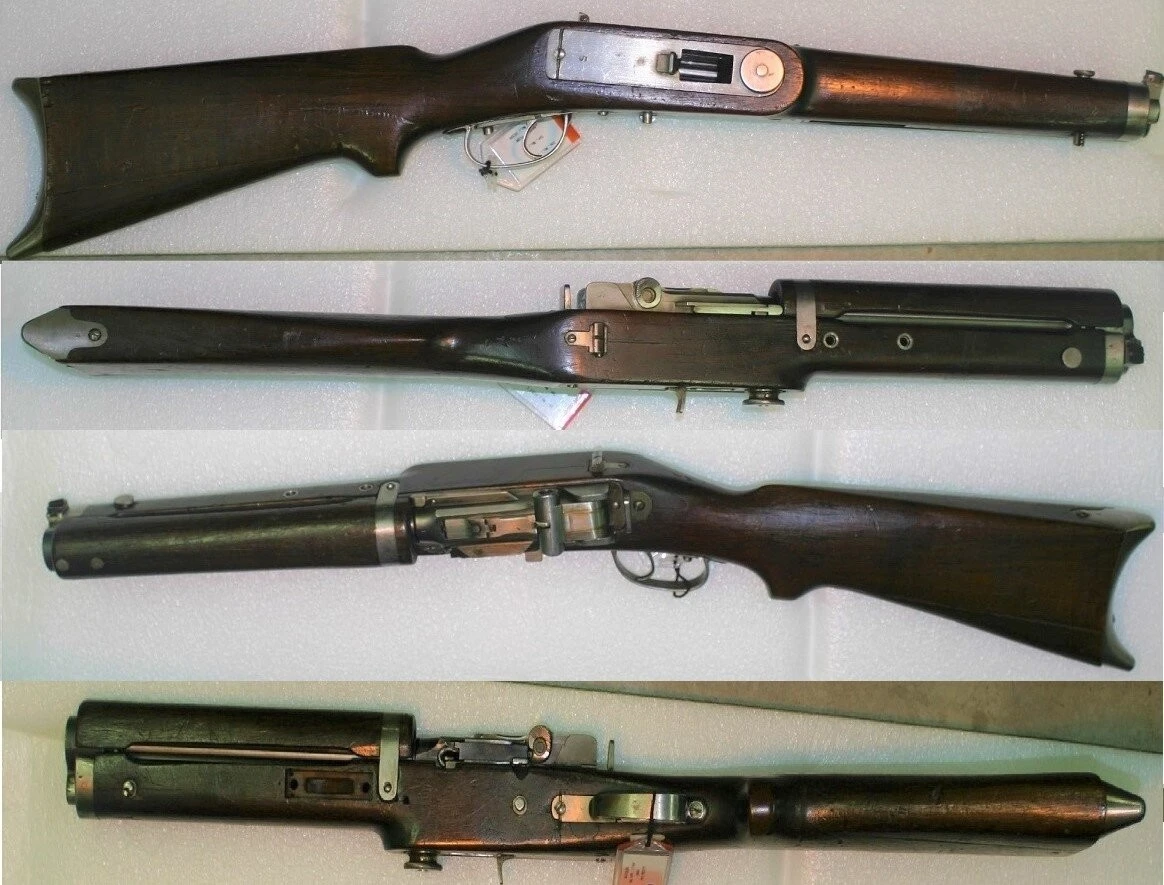
Furrer submachine gun, model 1919. From top to bottom: right side view, top view, left side view, bottom view.
A Brief Introduction
As is well known, by the middle of World War I, the deeply entrenched warring parties realized that only automatic weapons could help them in these conditions, and they began developing them, to the best of their technical and design abilities. Some (like Louis Schmeisser in Germany) developed a submachine gun, others (like Vladimir Fedorov) created an assault rifle, and still others (like anonymous Austrian and Hungarian designers) simply attempted to combine two self-loading pistols into a single submachine gun (the Steyr pistol model 1912 and the Frommer pistol model 1912, respectively).
In 1919, Adolf Furrer, a gunsmith working for the Swiss company Waffenfabrik Bern (aka W+F Bern), decided to participate in this process, offering the Swiss military a submachine gun of his own highly original design:
Design Features
Adolf Furrer based his system on Georg Luger's immortal creation: the Swiss creation's action operated with a short barrel recoil, and the locking system was a lever. Furrer also didn't bother with the cartridge, believing that the 7.65x21mm Luger cartridge would be quite sufficient (when fired from the pistol, a 6g bullet accelerated to 365 m/s with an energy of 400 J).
But then came the nuances.
First, Adolf Furrer installed his own lever system. Although it functioned identically to Georg Luger's, it had an additional lever connecting the other two levers to the receiver and positioned perpendicular to them (this system was patented and used by Furrer on other, later designs).
Second, Adolf Furrer rotated this system 90 degrees, so that the folding levers folded to the left instead of upward.
This was done for one simple reason: the curved box magazine Furrer designed to feed his system held 40 rounds and was simply too large to fit underneath, so it was attached to the right side (and, of course, feed reliability must be taken into account).
Spent cartridges were ejected to the left through a hole that opened when the bolt was folded. 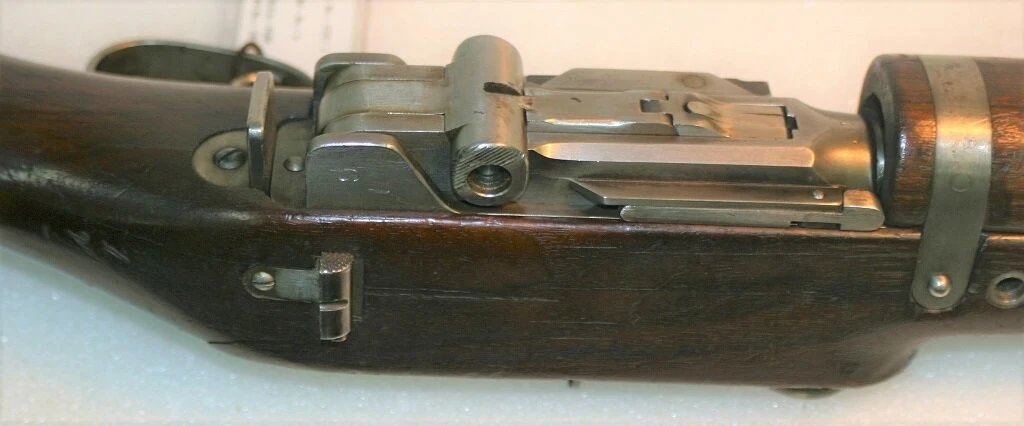
The bolt of the Furrer submachine gun.
Thirdly, Adolf Furrer decided to improve the reliability of the automatic system by "supporting" it with a gas booster with a massive muzzle and a power transmission system located parallel to the left barrel. This system accelerated the barrel's recoil (the barrel was lengthened and, consequently, heavier).
Fourthly, the submachine gun had a flag-type fire mode selector (self-loading and automatic), which the designer placed on top, in front of the rear sight.
The sights consisted of a front and rear sight.
The final nuance of the Furrer submachine gun was that the sights were offset to the right, as the barrel and stock were offset to the right (relative to the gun's central axis). The left side of the submachine gun was occupied by the lever mechanism and gas booster. 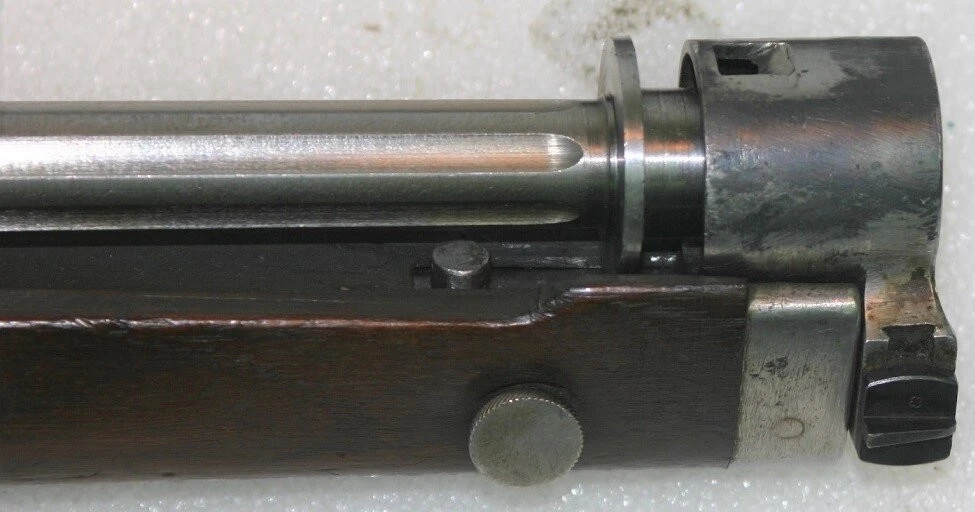
The gas booster of the submachine gun without the overlay. Note the muzzle and the front sight, offset to the right.
All of this came with a rifle-style wooden stock, wooden handguards concealing the barrel and gas booster, and a bipod with a wooden grip.
This last detail was absolutely essential: the weapon didn't weigh much, 4.8 kg (unloaded), but its balance was a complete disaster. So, it was most likely intended to be mounted on some self-propelled vehicle (like an airplane).
Specifications
Overall length: 790 mm
Weight: 4.8 kg
Cartridge: 7.65x21 Luger
Range: up to 150 m
Rate of fire: up to 1,200 rpm
Magazine capacity: 40 rounds 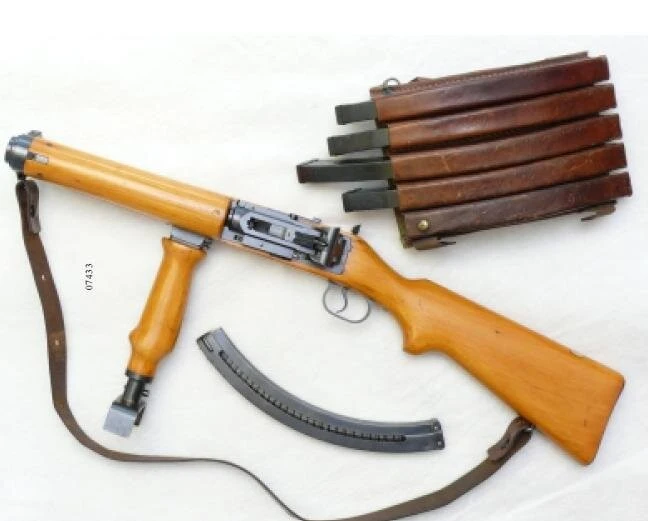
Furrer submachine gun, model 1919
The Fate of the Weapon
The Furrer submachine gun was presented to the Swiss military and sent for military testing (approximately no more than 100 units).
It performed well, but the Swiss military wisely rejected it, believing that the Louis Schmeisser submachine gun model 1918 (MP-18) was better looking, simpler in design, and cheaper.
The weapon remained in storage until 1962, when it was declared obsolete. 69 units were destroyed. A few survived, quite by chance (one (number 1) is kept in Leeds, England (top photos), and another (last photo) is in the Morges Castle Museum in Lausanne). A curious detail: the "English" submachine gun (number 1) lacks a fire mode selector.
Add your comment
You might be interested in:










20 Personal Photos of Celebrities That Ooze Vintage

Protective film Removing it with a power screwdriver
Global Sex Symbol: Rare Photos of Monica Bellucci (26

Animal Paws and Claws: 50 Photos That Will Surprise Even

America's Cheese Caves: How and Why the US Government

Fascinating Facts to Blow Your Mind (10 Photos)

Straight Out of the '80s: Band Posters No One Would Ever

It’s Not a Renovation, Just a Deep Clean! 30 Incredible

How an Airline Pilot Was Sucked Out of the Cockpit
