Megalodon: the story of the discovery of a sea monster (6 photos)
The giant prehistoric shark Megalodon, whose fossilized teeth have captivated the human imagination for centuries, has migrated from paleontology textbooks to the big screen in the 21st century, becoming a key figure in documentaries and horror films. 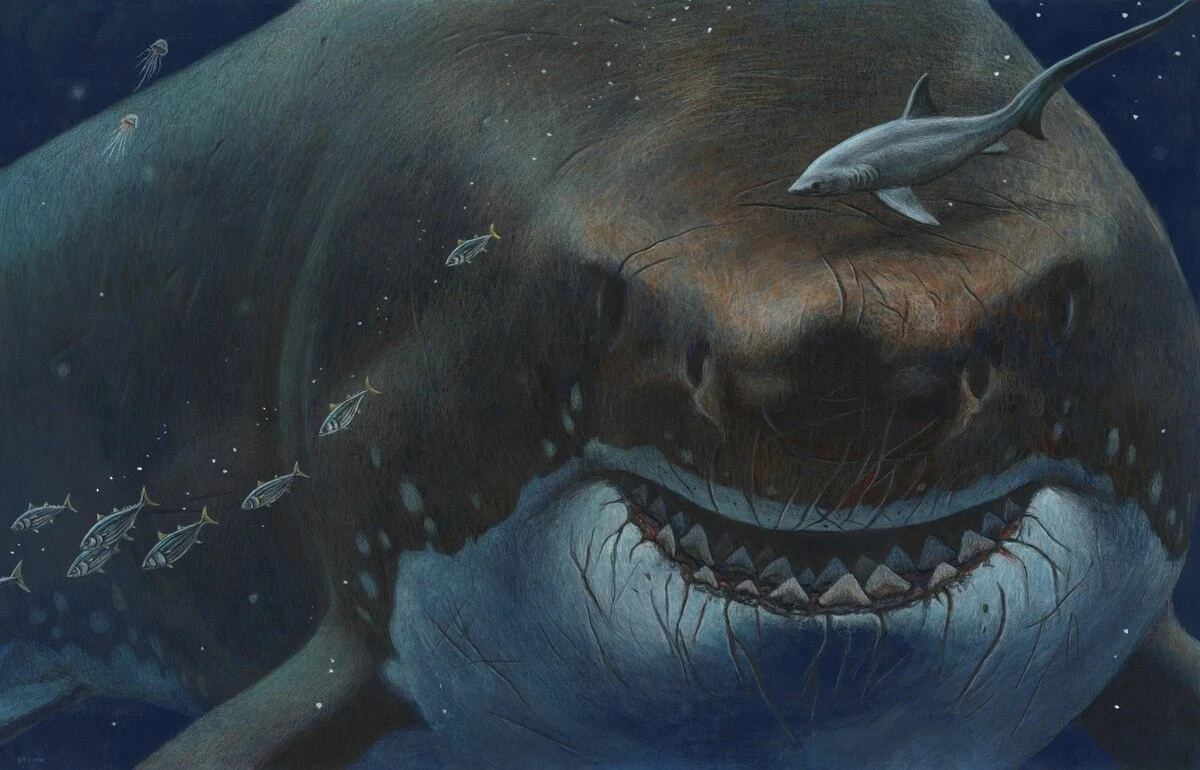
The Megalodon was a truly gigantic creature, with an average body length of 14-15 meters. Females, which are larger than males, are believed to have grown to 18-20 meters, and some estimates suggest their body length could exceed 24 meters!
But how did humanity even know about the existence of this monster, extinct approximately 3.6 million years ago?
This is the story of how, for centuries, people held in their hands evidence of the oceans' greatest predator, but did not understand the true nature of these mysterious "stone triangles," believing them to be snake tongues, dragon teeth, or mystical artifacts.
Mysterious Stones of Antiquity
Large triangular fossils with jagged edges have been found all over the world—from Europe and the Mediterranean to the coasts of America, South Africa, and New Zealand. But what they really were—no one knew. 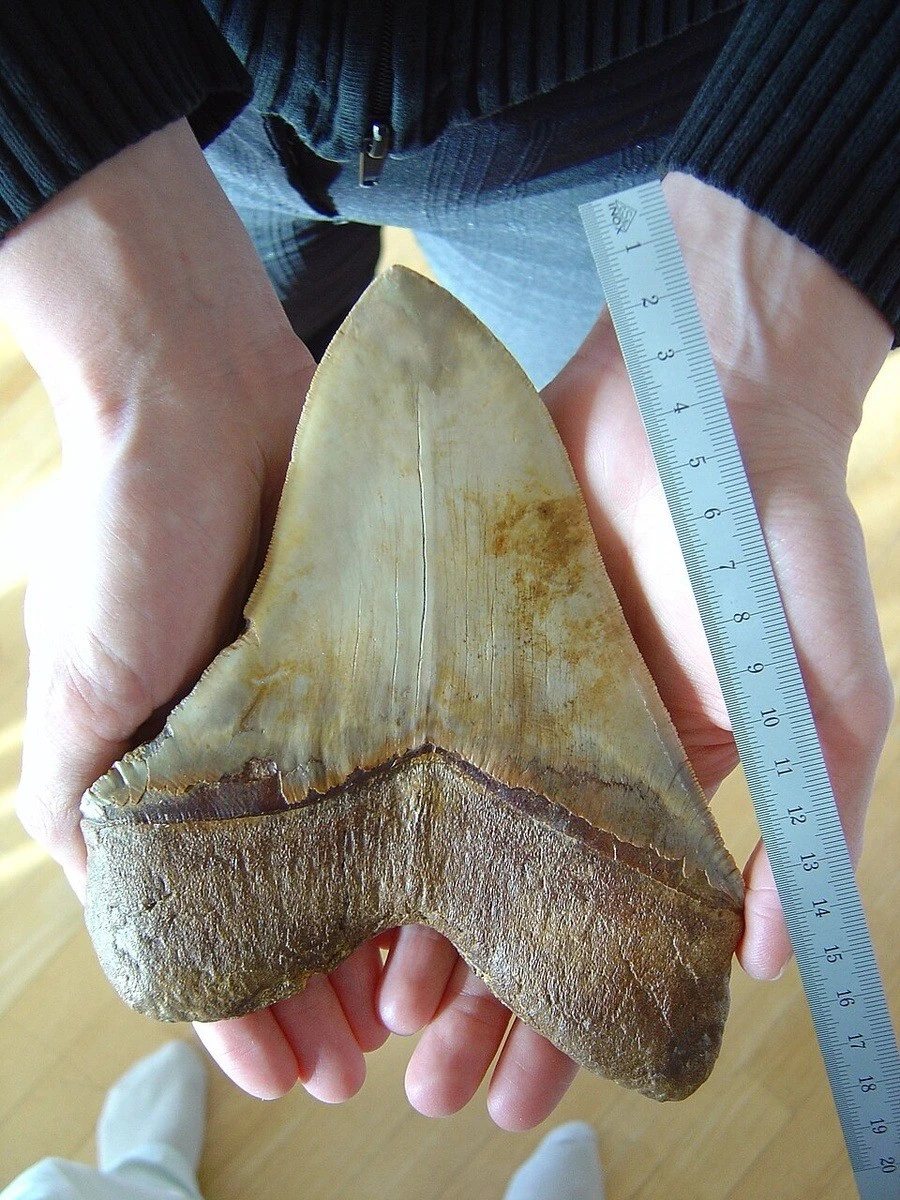
Megalodon Tooth
The ancient Romans believed that these mysterious stone triangles fell from the sky during lunar eclipses as a bad omen—a harbinger of famine, war, or the wrath of the gods. In Roman culture, lunar eclipses themselves were considered bad omens, and the discovery of such "heavenly stones" after one certainly predicted imminent disaster.
In medieval Europe, they were called "glossopetra"—the petrified tongues of snakes or dragons. In Malta, their origin was linked to the legend of the Apostle Paul, who, shipwrecked on the island, cursed the local poisonous snakes, causing their tongues to turn to stone. The legend remains silent as to why these tongues were the size of saucepans.
Enterprising individuals divided the glossopetra into pieces and sold them as sacred relics imbued with miraculous properties. This trend was picked up by apothecaries, who resold them as a universal remedy. Glossopetra were used to make amulets against the evil eye and curses, and they were also added to wine, believing that if poison was added to the drink, the stone would neutralize it. Wealthy families passed down large specimens from generation to generation as heirlooms.
But no one realized that these were the teeth of a real creature, and not some mythical creature whose nature no one had ever determined.
Steno Makes a Breakthrough
Everything changed in 1666. Fishermen off the coast of Italy caught a great white shark, and the Duke of Tuscany ordered its head delivered to the scientist Nicolaus Steno for study. 
Portrait of Nicolaus Steno
Steno, a Dane in the service of the Medici family, was an anatomist, not a paleontologist. Paleontology didn't even exist at the time. But when he opened the shark's mouth and saw rows of triangular, serrated teeth, he had a revelation.
These teeth turned out to be miniature versions of the glossopetra, which still enjoyed a mystical popularity at the time.
In 1667, Steno published a paper in which he proposed that the mysterious triangular stones were the fossilized teeth of ancient giant sharks. The idea seemed insane: how could the teeth of marine predators end up inside rocks, many of which were found far from the coastline?
Steno went further. He hypothesized that the places where glossopetra are found were once the seabed. This was a revolutionary insight, laying the foundations of two sciences at once – paleontology and geology.
The Giant Gets a Name
After Steno, researchers began systematically studying fossilized shark teeth. But another century and a half passed before scientists realized the true scale of the discovery.
In 1835, the Swiss naturalist Louis Agassiz undertook a monumental task—a description of all known fossil fish. Among the specimens were teeth (the very same glossopetra) that were astounding: some exceeded 18 centimeters in diagonal length. 
Portrait of Louis Agassiz
Agassiz compared them to the teeth of a great white shark: if its teeth are 5-6 centimeters long and its body is 5-6 meters long, then a monster with 18-centimeter teeth should reach... Agassiz couldn't believe his calculations.
He named the unknown creature Carcharodon megalodon—"a large shark with enormous teeth"—and placed it in the same genus as the great white shark, its gigantic ancestor. Today, taxonomy has changed, and megalodon is more often classified in its own genus, Otodus, but the name remains.
Teeth—the Key Clue
A shark's skeleton is composed of cartilage, not bone. Since cartilage is soft and quickly decomposes after the animal's death, only hard minerals remain. 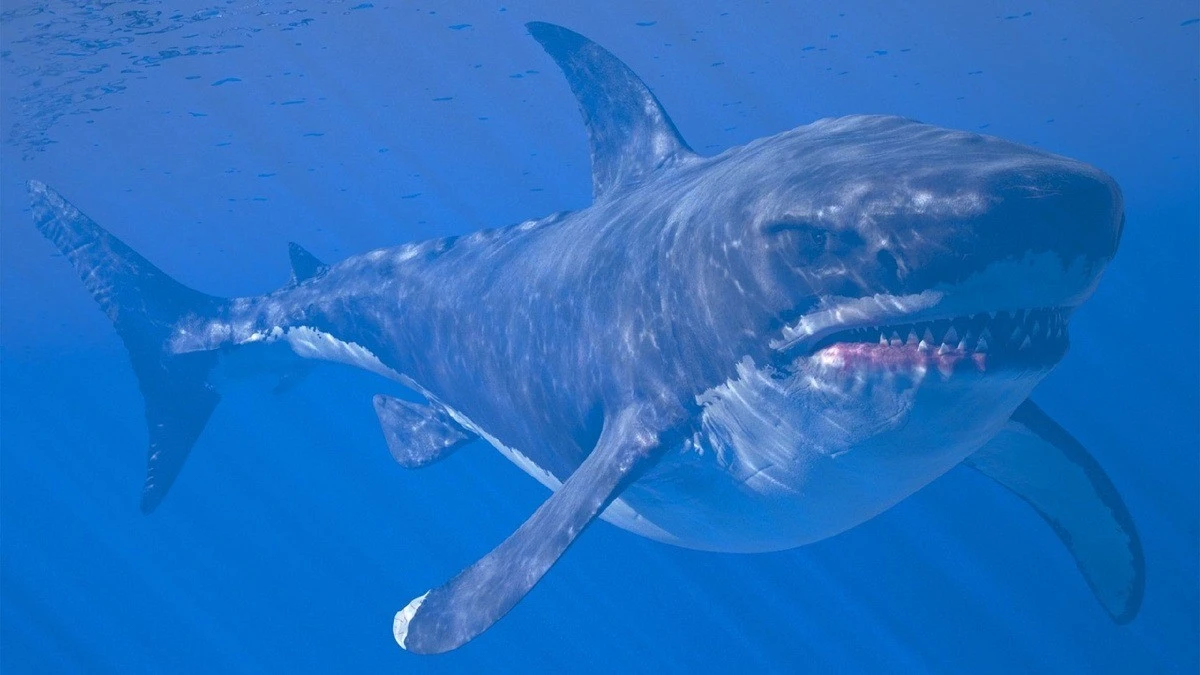
Teeth are ideal candidates for fossilization. They are covered in enamel—the hardest tissue in the body—and permeated with durable dentin, ensuring their preservation for millions of years. Most importantly, sharks lose them by the thousands: a single individual sheds 20,000-30,000 teeth in its lifetime. Each lost tooth is a potential fossil.
Megalodon existed for approximately 20 million years. Billions of individuals, each with thousands of teeth—it's no surprise that they have been found all over the world: from California to Japan, from Morocco to Australia.
Interestingly, megalodon vertebrae have also been found, which, under extremely rare circumstances, are also capable of mineralizing. Using a very modest set of 19 such 25-centimeter vertebrae, scientists reconstructed the outline of approximately 200 vertebrae, and subsequently the appearance of this monster.
It's important to note that no complete skeleton exists in nature—the megalodon puzzle will forever remain incomplete.
Recreating the Monster
How were scientists able to recreate the megalodon's appearance? By analogy with modern sharks and precise mathematical calculations.
The tooth-to-body-length ratio is fairly consistent in sharks. Based on this, it was calculated that the average megalodon body length was 14-15 meters, and its weight was 50-70 tons. Individual specimens could grow to over 20 meters and weigh around 100 tons. For comparison, the average great white shark is 5-6 meters long and weighs 2-3 tons. 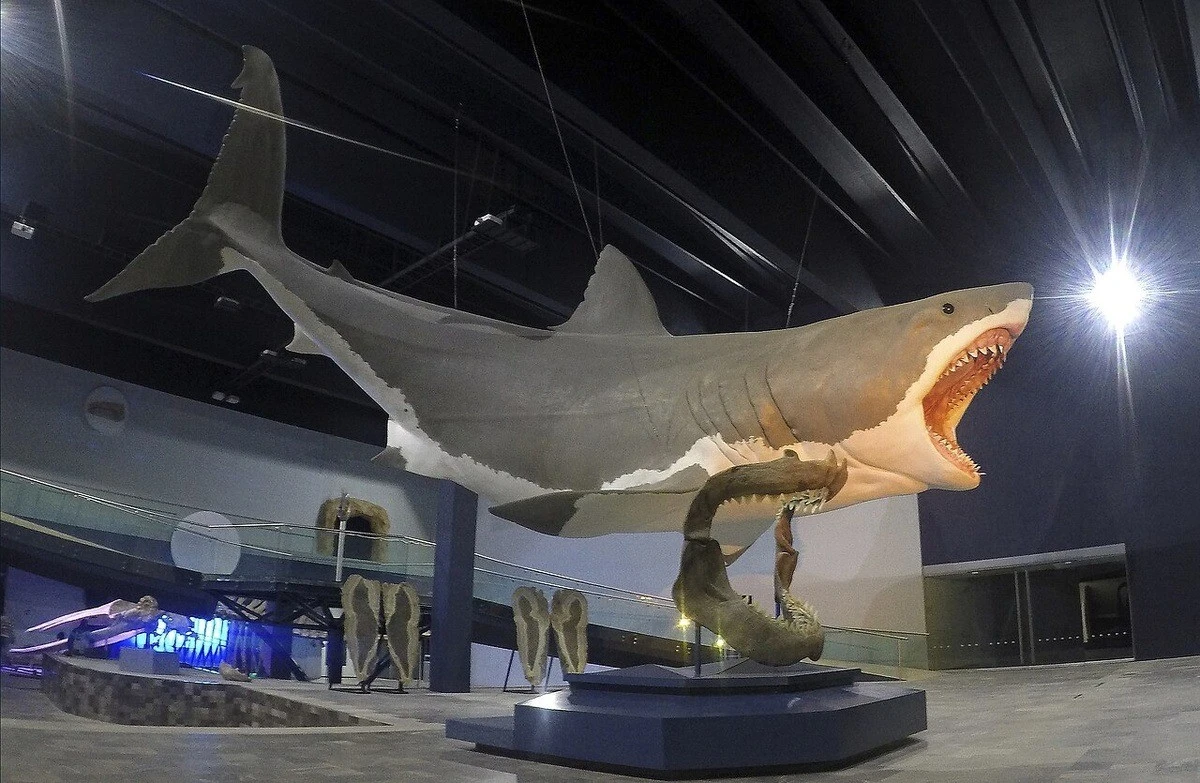
Megalodon sculpture at the Museum of Evolution in Puebla, Mexico
The shape of its teeth was used to determine its diet: wide, thick triangles with powerful serrations—an ideal weapon against large prey. Megalodon specialized in whales—characteristic grooves and puncture marks from its giant teeth have been found on the ribs and vertebrae of fossilized whales.
The range of Megalodon has been reconstructed based on its find sites. Megalodon lived in warm seas worldwide. Juveniles may have stayed close to the coast, while adults preferred the open ocean.
Extinction
The megalodon became extinct approximately 3.6 million years ago at the end of the Pliocene. A combination of factors was responsible:
Global cooling of the oceans formed glaciers and lowered sea levels, destroying the shallow waters where megalodons reproduced and raised their young;
About four million years ago, the Isthmus of Panama closed (rising land blocked the ancient strait between the Pacific and Atlantic oceans), leading to a restructuring of global currents: warm water flowed into the Gulf Stream, the Atlantic became saltier and warmer, and migrating whales (their main prey) disappeared from tropical zones;
The giant megalodon, which needed enormous amounts of food, faced a severe shortage.
Competitors like great white sharks and killer whales adapted better to the new conditions and survived to this day.
Our ancestors never saw this predator alive. But thanks to fossilized teeth—those same "dragon tongues" worn as amulets for centuries—we know it existed. The greatest predator ever to swim the Earth's oceans.