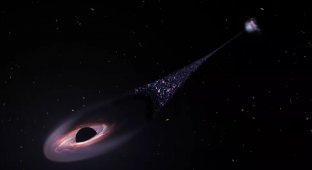
What's Inside Black Holes: An Unexpected Assumption (3 photos)
Until now, it was generally believed that they contain a singularity—a state in which the laws of physics no longer apply. Now, scientists are proposing an alternative theory. 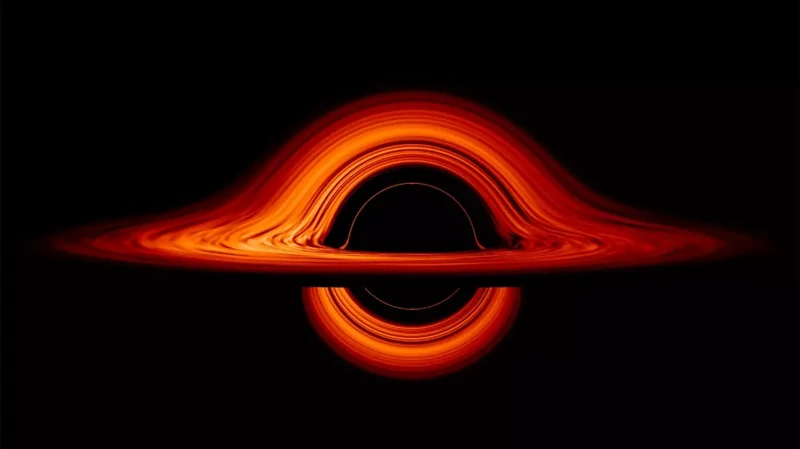
Perhaps black holes don't contain a singularity at all, astrophysicists write in the Journal of Cosmology and Astroparticle Physics. They believe that the state of matter and spacetime itself beyond the event horizon can be explained by quantum effects.
As a reminder, a black hole forms when gravity compresses matter to such an extent that it "falls" into some state as yet unknown to science. When the core of a "dying" very massive star collapses, the structure of its atoms first collapses, creating a cluster of neutrons and protons, which then "split" into their component parts—quarks, or quantum particles. Ultimately, a "gap"—a black hole—is formed.
However, it is unclear what happens to space and time there.
The event horizon is the notional "surface" of a black hole, the boundary beyond which our understanding is hidden: no information comes from within. 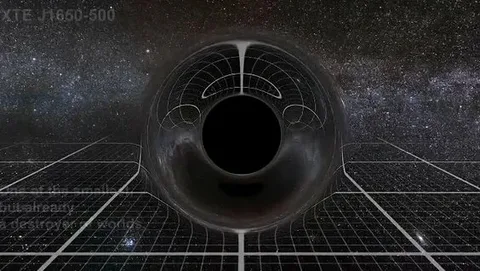
Albert Einstein realized that gravity is a curvature of spacetime: any particle with mass creates a sphere of this deformation in the fabric of the universe around itself. Accordingly, the more massive the object, the more impressive the "vortex," and objects falling at its edge are drawn into it.
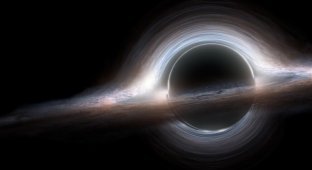
The curvature of spacetime by mass is clearly visible in the astonishing effect of gravitational lensing in space: if another object appears directly behind a black hole or an entire galaxy, the light from the "backward" object is forced to bend around the "frontward" object, resulting in the magnificent spectacle of a gigantic cosmic lens.
At the same time, gravity also alters the flow of time: the closer to its source, the slower time passes. Calculations show that the gravity of a black hole creates such a "vortex" that time should stop completely within it. In fact, it seems as if the laws of physics no longer apply within it. This is what's called a singularity. 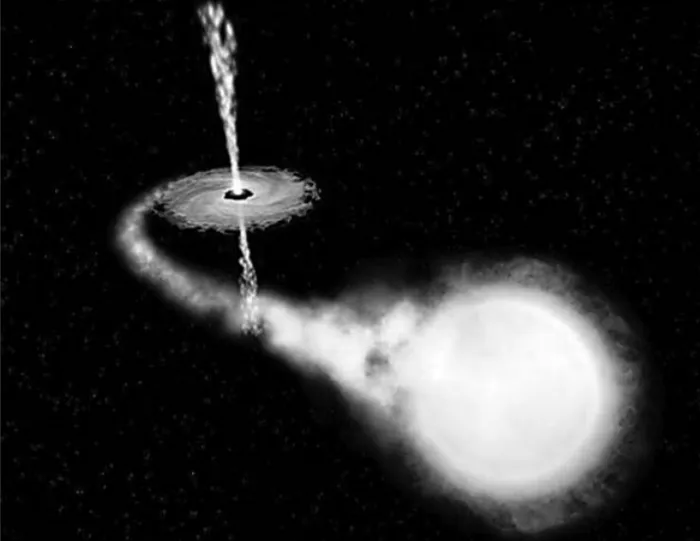
Nevertheless, scientists cannot accept the fact that Einstein's profound and all-pervasive General Theory of Relativity might not work even under such extreme conditions. They are searching for ways to abandon the singularity paradigm and find a more understandable explanation for what happens in black holes.
And in their recent article, the researchers proposed considering possible quantum effects that we simply don't yet understand well. As a reminder, quantum mechanics studies the world of particles, which seemingly make up everything that exists. The universe is permeated with them. Even in a seemingly complete vacuum, quantum particles constantly appear and disappear. Subatomic particles—protons and neutrons—are made of them. An electron is a quantum particle. And a massless photon, which therefore doesn't bend anything and rushes unimpeded through space, is also a quantum. A quantum of light.
The abilities of quantum particles are truly "supernatural": they can pass through obstacles, exist in several different states simultaneously, and exist in an incomprehensible relationship called quantum entanglement, that is, they instantly react to each other's behavior at any distance.
That's why physicists ponder what might happen to them inside a black hole. For example, there's the concept of so-called quantum bounce: it suggests that in a black hole, the curvature of spacetime doesn't actually become infinite, but stops, and gravity turns into its complete opposite—a repulsive force. However, it doesn't push everything back toward us; instead, it creates a new region of spacetime inaccessible to us. Essentially, this means a wormhole and a transition to another universe. In this concept, the Big Bang is called the "Big Bounce."