How did scientists know there was once water on Mars? (8 photos)
Today, the Red Planet greets robotic visitors from Earth with a lifeless desert shrouded in rusty dust. Temperatures here rarely rise above freezing, and the atmosphere is so thin that liquid water cannot exist in a stable state on the surface. However, scientists almost unanimously agree that billions of years ago, Mars was very different – with raging rivers, deep lakes, and perhaps even vast oceans. 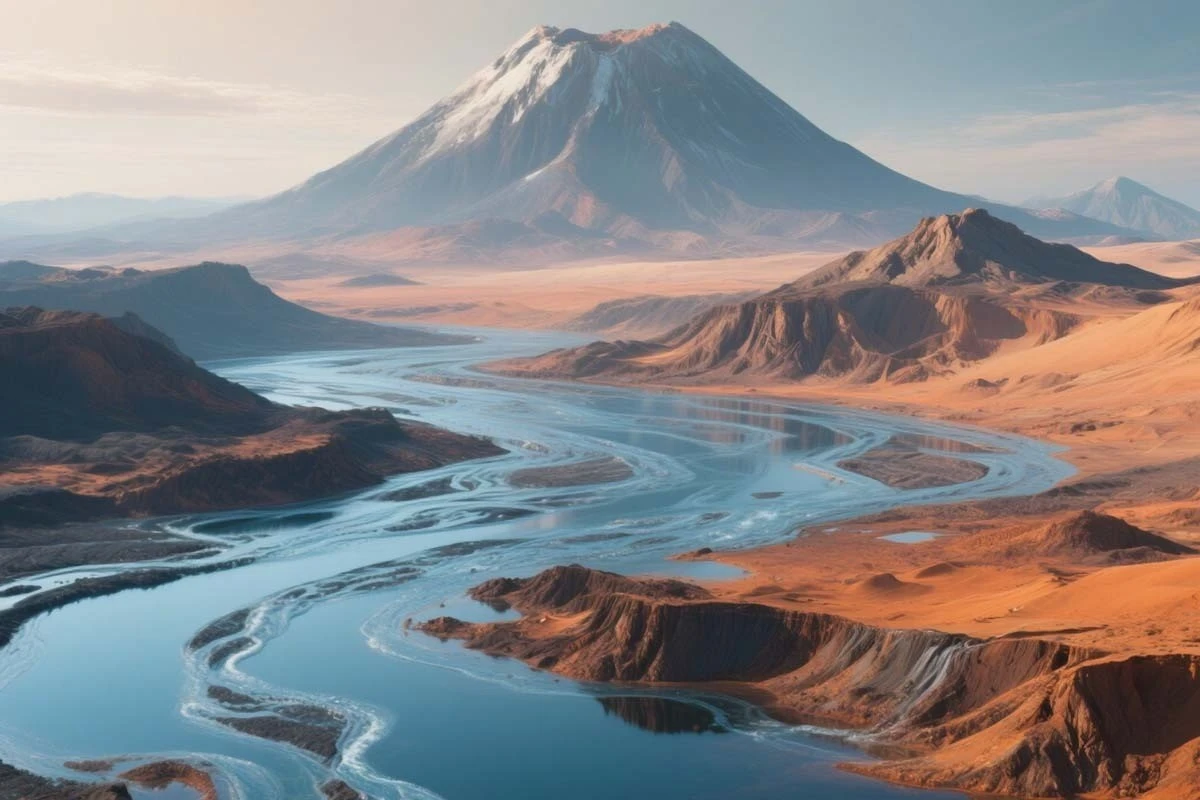
How did researchers reach such a surprising conclusion? Let's take a fascinating journey into Mars's past.
Ancient Riverbeds – The First Striking Evidence
It all began in 1971, when NASA's Mariner 9 spacecraft transmitted images of the Martian surface to Earth. Scientists were stunned: the planet was crisscrossed with winding channels, strikingly reminiscent of dry riverbeds on Earth.
A particularly striking example was the Nanedi Valley (Latin: Nanedi Valles), a network of winding channels with tributaries and meanders that on Earth are formed only by constant water flow. Such structures could not have formed as a result of short-term ice melt or occasional floods – they indicated the long-term existence of stable water flows. 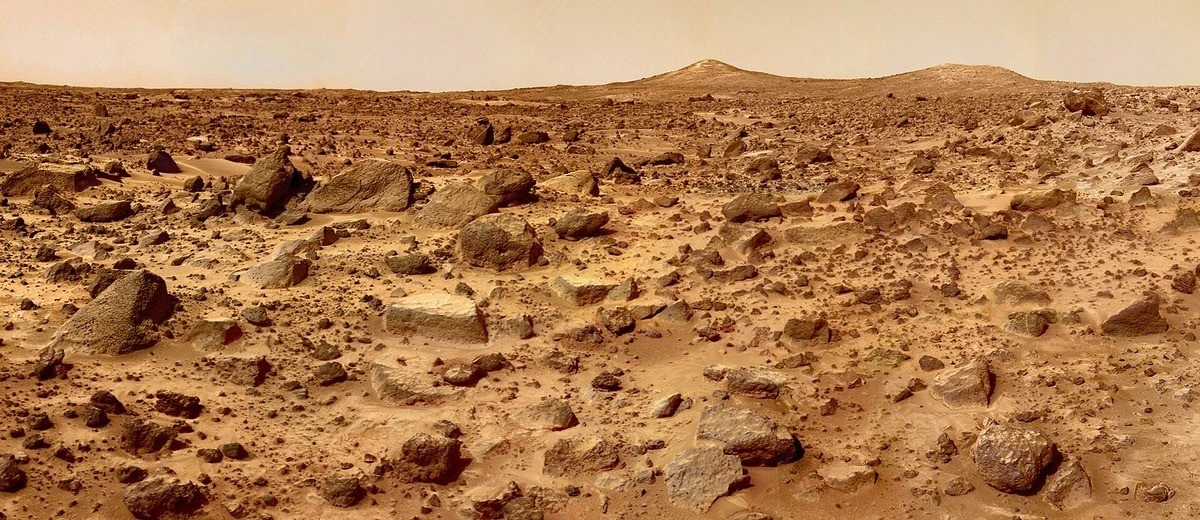
Panorama of the Ares Vallis region, near the edge of Chryse Planitia. The image was stitched together from images transmitted by the Mars Pathfinder lander on July 4, 1997.
Even more intriguing were the giant outflow channels, such as Ares Vallis. Their colossal size (up to 100 kilometers wide) indicates catastrophic floods of unimaginable magnitude, when enormous volumes of water suddenly erupted to the surface, sweeping away everything in their path. Mars likely experienced apocalyptic floods in the past.
Clay minerals – traces of ancient lakes
Rovers, which were able to study the local soil up close, finally dispelled these doubts. For example, NASA's Curiosity rover, exploring Gale Crater, discovered layered deposits of clay minerals – a sure sign that it was once filled with water. In other words, in the distant past, Gale Crater was a deep-sea lake. 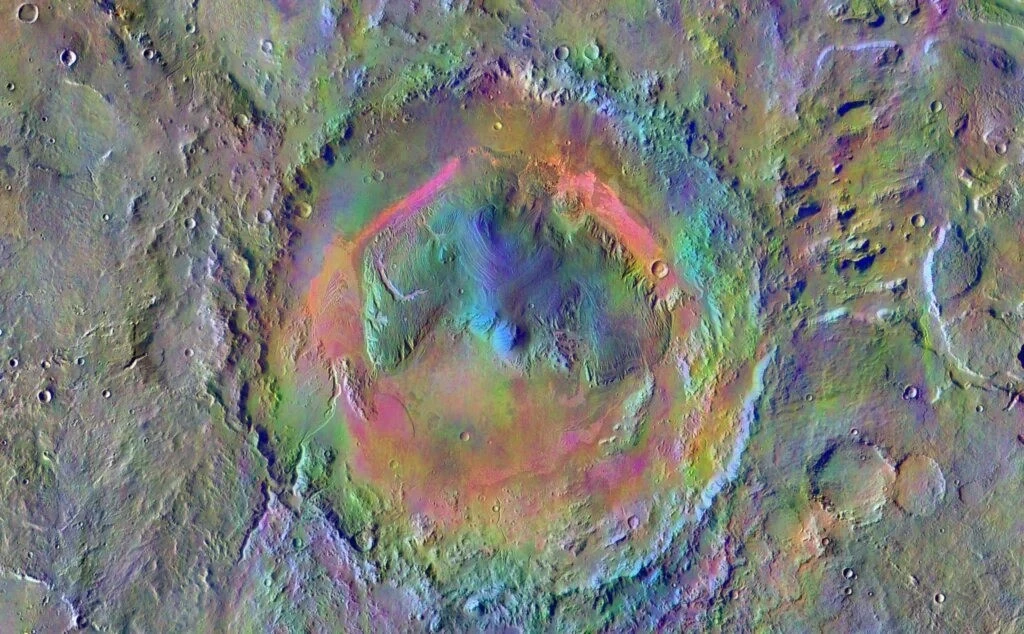
Gale Crater
Clay on Earth only forms when rocks are in prolonged contact with water. Its presence in Gale Crater means that water existed there for quite a long time – perhaps millions of years (enough time for the surrounding rocks to undergo chemical transformation).
Especially important, these clay minerals indicate a neutral environment in which they formed – not too acidic and not too alkaline. These are precisely the conditions favorable for the origin of life as we know it, based on our experience on Earth.
"Blueberries" and Other Hydrous Minerals on Mars
NASA's Opportunity rover made another surprising discovery – tiny spherical formations, jokingly nicknamed "blueberries" for their shape and size. Analysis revealed that they are hematite, an iron oxide that on Earth typically forms in aqueous environments, such as hot springs. 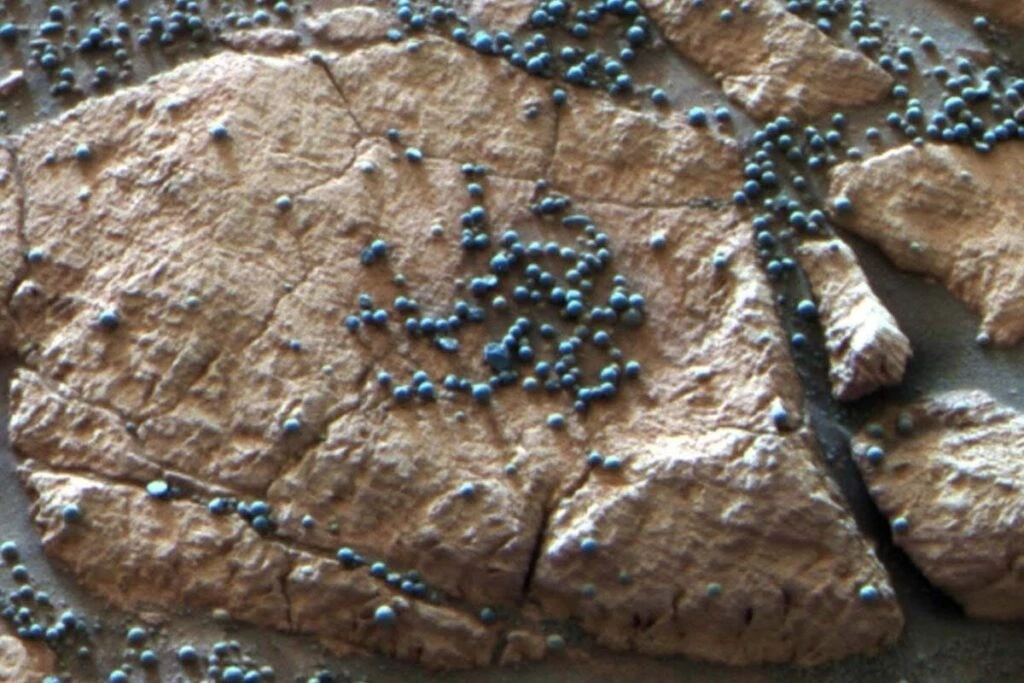
"Blueberries" of Mars
Besides "blueberries," other water-indicating minerals have been found on Mars: gypsum, jarosite, and various sulfates. All of these minerals form on our planet only in the presence of water—from fresh to salty, from neutral to acidic. By studying the distribution of these minerals, scientists can reconstruct the history of Martian aquatic history—from the vast freshwater bodies of the early era to the salt lakes of the later period.
River Deltas – Natural Archives
In Jezero Crater, where NASA's Perseverance rover is currently operating, a perfectly preserved ancient river delta has been discovered, which is why the site was chosen as a landing site. The images clearly show fan-shaped sediment deposits – exactly like those found in terrestrial rivers flowing into lakes or seas. 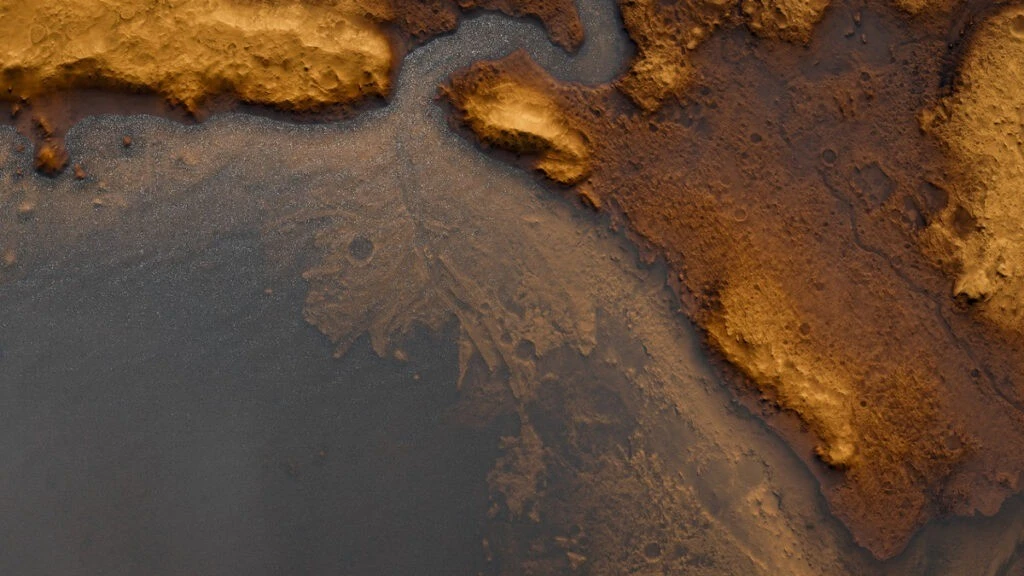
Part of Jezero Crater
Deltas are especially important for research because they not only provide evidence of the past existence of water but also serve as natural "traps" for organic matter. On Earth, such sites often harbor fossils, which is why NASA chose Jezero to search for possible traces of ancient Martian life.
Martian meteorites tell their own story
Surprisingly, some evidence of Mars's aquatic past has arrived! Among meteorites found in Antarctica, scientists have identified fragments of the Red Planet, ejected from its surface by asteroid impacts. 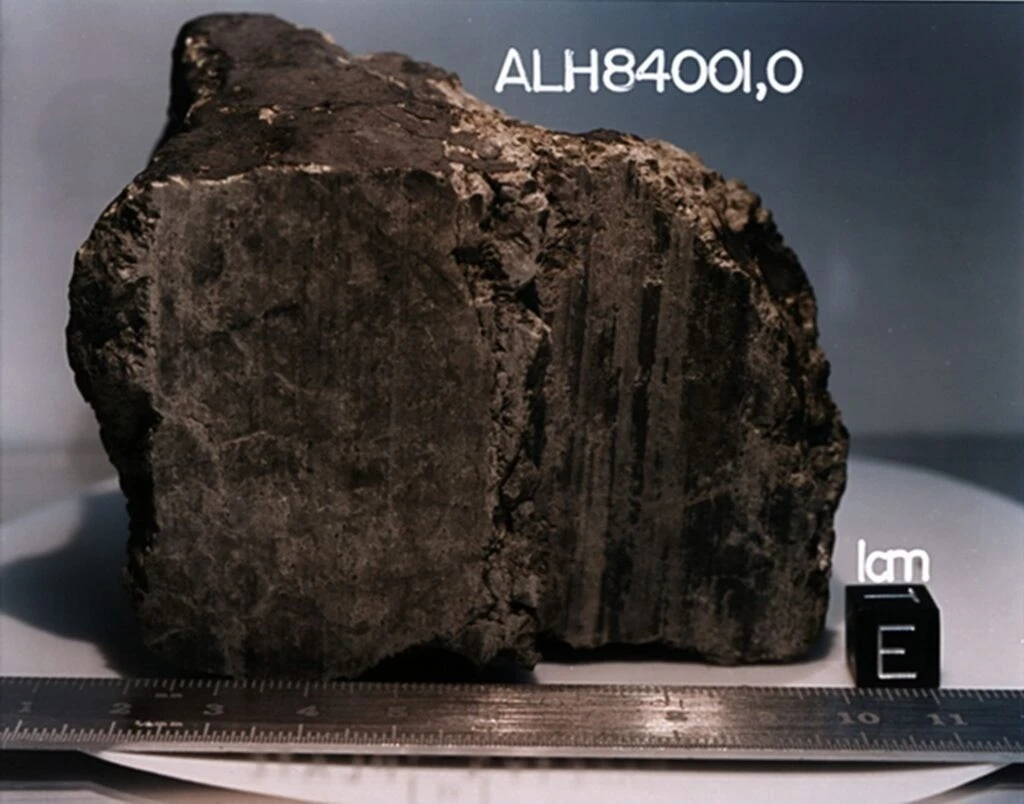
Martian Meteorite ALH 84001
One such meteorite, ALH 84001, caused a sensation in 1996 when researchers announced they had discovered possible traces of Martian life within it. Although the biological nature of the structures discovered remains controversial, the meteorite contains carbonate minerals, which on Earth only form in aquatic environments. ALH 84001 has proven that liquid water existed on Mars as early as four billion years ago. This is despite the Red Planet's estimated age being approximately 4.6 billion years.
Modern ice reserves are a legacy of a watery past
Today, water on Mars exists primarily in a frozen state. The giant polar caps, containing both water ice and frozen carbon dioxide (dry ice), sparkle so brightly that they are visible even with an amateur telescope. Furthermore, vast ice masses lurk beneath the surface—like natural reservoirs that protect Mars's water reserves from evaporating into space. 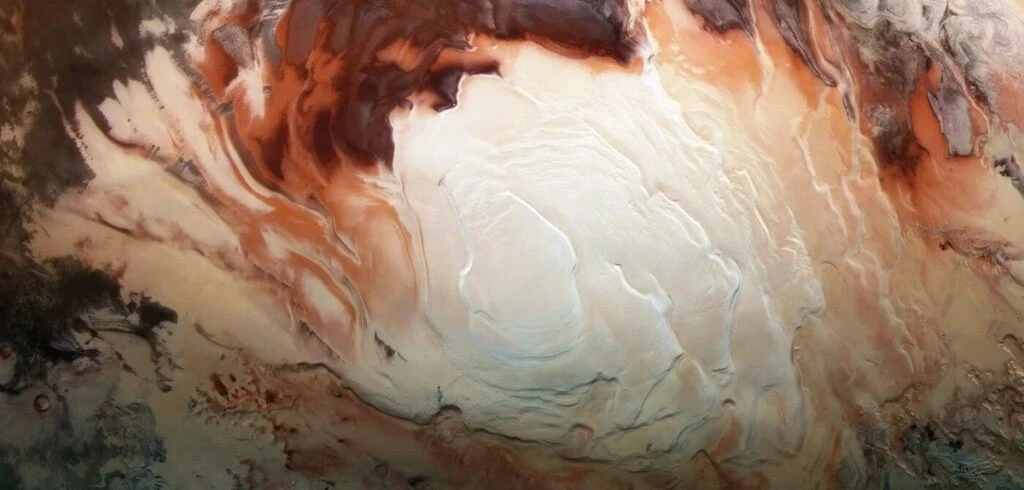
The European Space Agency's Mars Express orbiter is observing the south pole of Mars.
Radar data obtained by orbiters hint at the existence of a salt lake beneath the southern cap, which remains liquid due to the extreme concentration of salts and the pressure of a kilometer-thick ice sheet.
Mars's water-rich past is also evidenced by the chemical composition of its modern atmosphere. It has been found to contain a disproportionately high amount of heavy isotopes of hydrogen (deuterium) and oxygen (O-18) compared to their lighter counterparts. The fact is that light isotopes more easily escape the planet's atmosphere, escaping into space, while heavy ones remain. Such an isotopic ratio is only possible if Mars once held vast volumes of water (seas and oceans) that gradually evaporated into space, leaving behind this isotopic trace.
What happened to the Martian water?
By piecing together all the evidence, scientists were able to reconstruct the astonishing and at the same time dramatic history of Mars. It was once a wet world, similar to early Earth, but then a climate collapse occurred, and the planet gradually turned into a frozen desert. 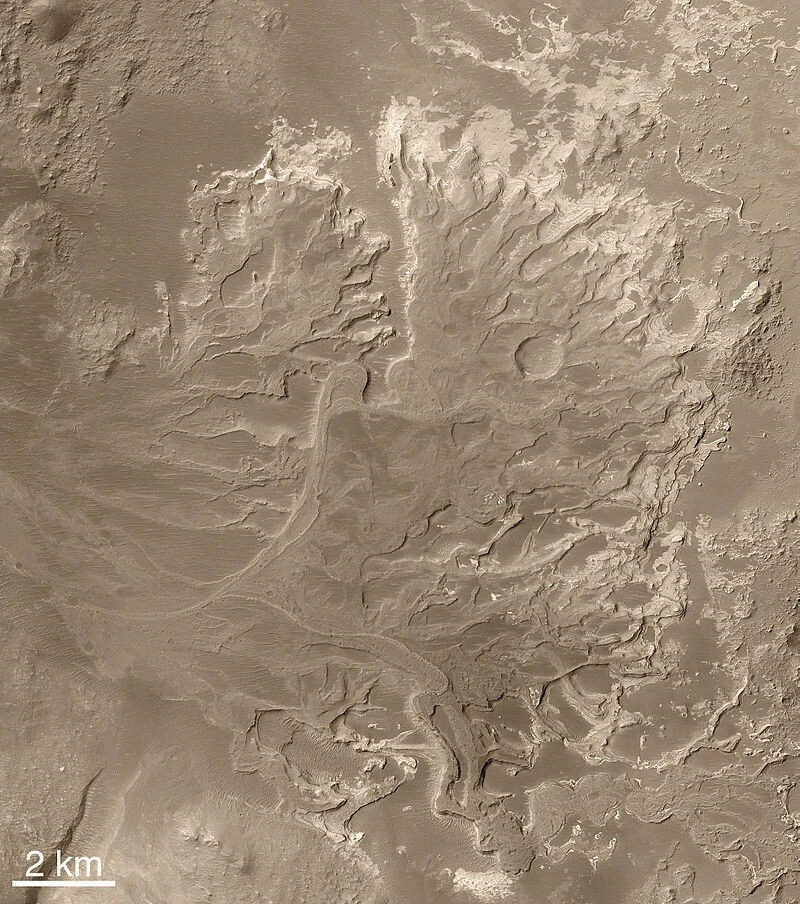
Image of a dry river delta in the northwestern part of the Eberswalde crater
Two mutually reinforcing factors played a key role in this transformation. First, the planet's small mass—only 10% of Earth's—meant weak gravity, insufficient to retain light gases. Second, Mars lost its global magnetic field (or at least its initial weakness), which on Earth acts as a shield deflecting the solar wind. Without this protection, charged particles from the Sun bombarded the upper atmosphere unimpeded, literally "blowing" them into space atom by atom. These two processes triggered an irreversible chain reaction: thinning atmosphere → falling pressure → evaporation of water into space → further desiccation of the planet.
Each new mission to Mars adds invaluable details to this amazing story. Rovers and orbiters, equipped with increasingly sophisticated instruments, continue to gather evidence that the Red Planet was once blue – with full-flowing rivers, deep lakes, and possibly vast oceans.