Killer whale: killers of blue whales and white sharks (13 photos)
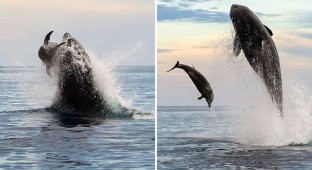
There are many animals on the planet that obtain food through their great strength. Many more survive through cunning, intelligence, or resourcefulness. But only one animal on the planet has equally successfully elevated all of these qualities to some transcendental level. Immense strength and astonishing ingenuity. 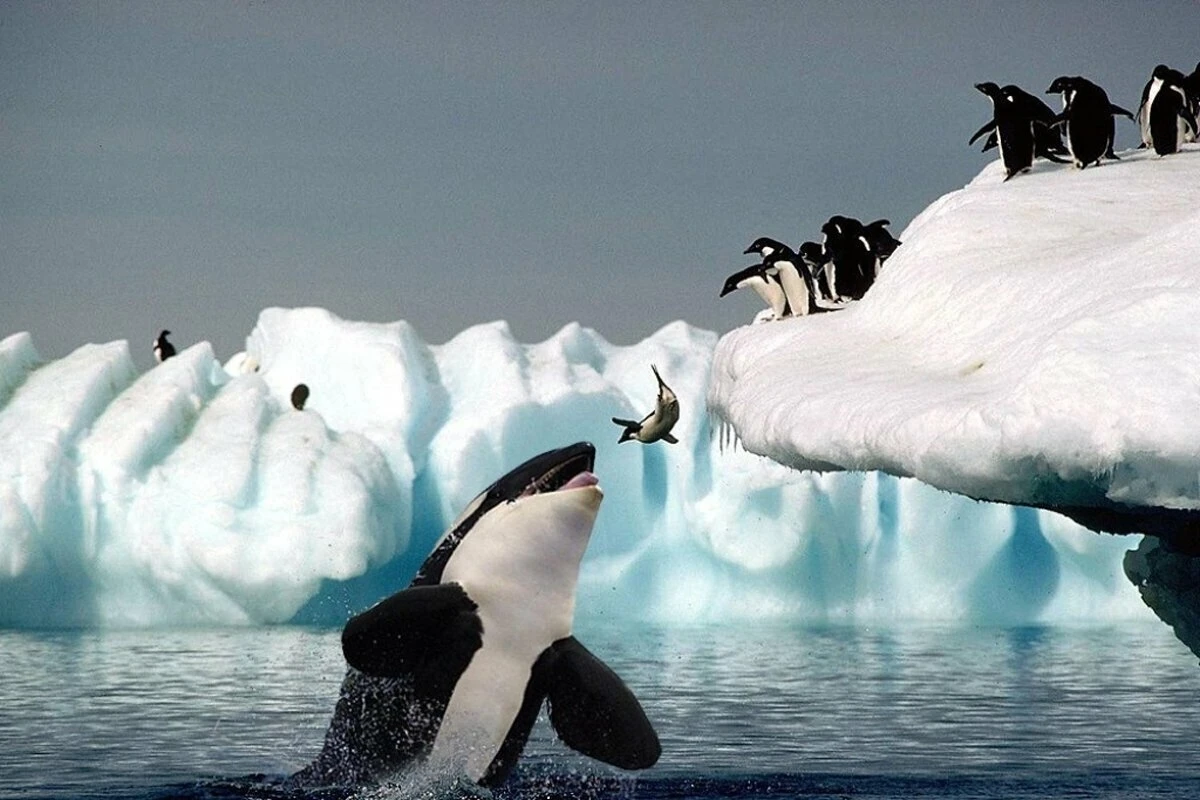
Surprise!
The very fact that I live on the same planet with a predator of such size terrifies me a little. Can you imagine a monster weighing 8-10 tons and 8-10 meters long? Personally, no, my brain simply can't comprehend those numbers. But it's their size (and their huge, sharp teeth) that make them big-game hunters. 
By the way, it might give the false impression that killer whales don't have eyes. 
They do have eyes, of course, but they're really small and in an odd place—right in line with their large mouth.
Even a lone killer whale can take down a porpoise, a bottlenose dolphin, or, with a little luck, even a narwhal. And that's on par with the great white shark, the most dangerous predatory fish on the planet. But there's one caveat: killer whales, unlike sharks, are almost never alone. 
Come join us, the water is simply amazing!
Killer whales are gregarious animals with a very complex social structure. The pod is always led by a matriarch—the most experienced female—whose children, grandchildren, and great-grandchildren obey her. They are all bound by close family ties and decades of experience living together, so they know how to hunt as a team. And this team can do a lot. For example, they can hunt whales. 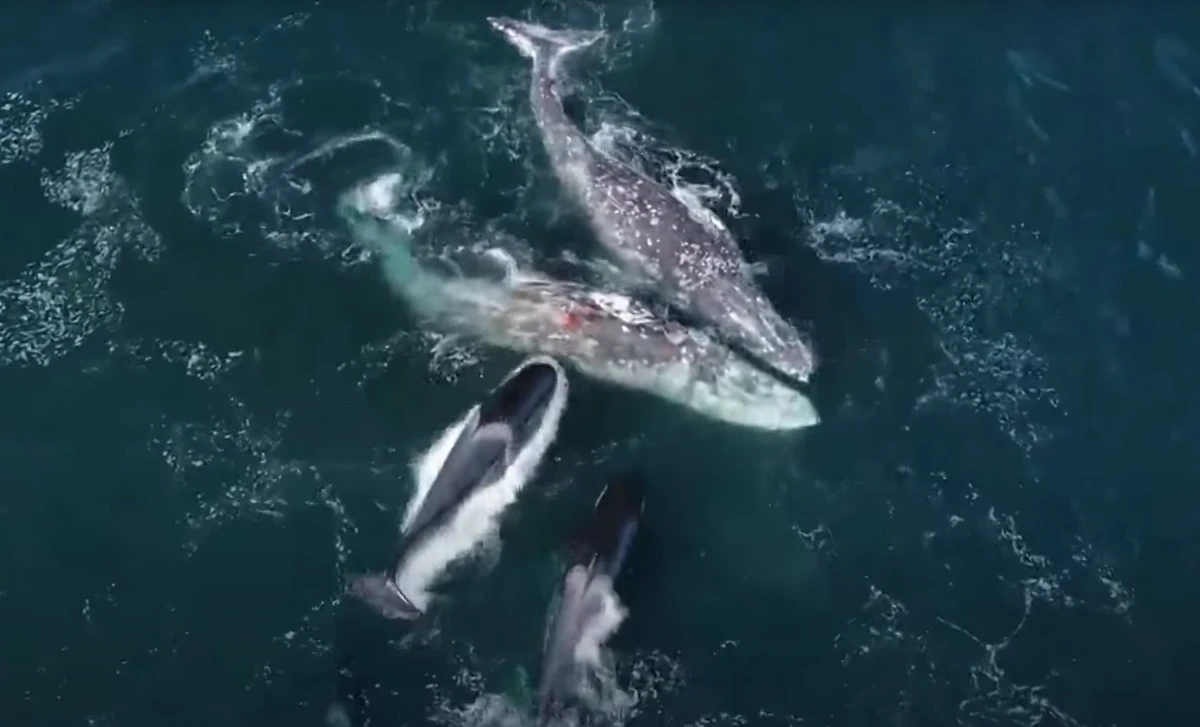
A pod of killer whales chases two gray whales. 
Interesting shot: You'd think the killer whale was rubbing itself against a rock. In reality, it's an attack right in the whale's face.
We're not talking about minke whales, which weigh up to 15 tons. And not even about sperm whales—the largest modern predators. A well-coordinated team of killer whales can defeat a blue whale—the largest animal that has ever lived! First, the pod stalks the titan for several hours, sapping its strength with constant feints, and then launches a coordinated attack on several fronts, inflicting wounds. Any mistake can result in a fatal blow from their enormous tail. But killer whales are infallible. 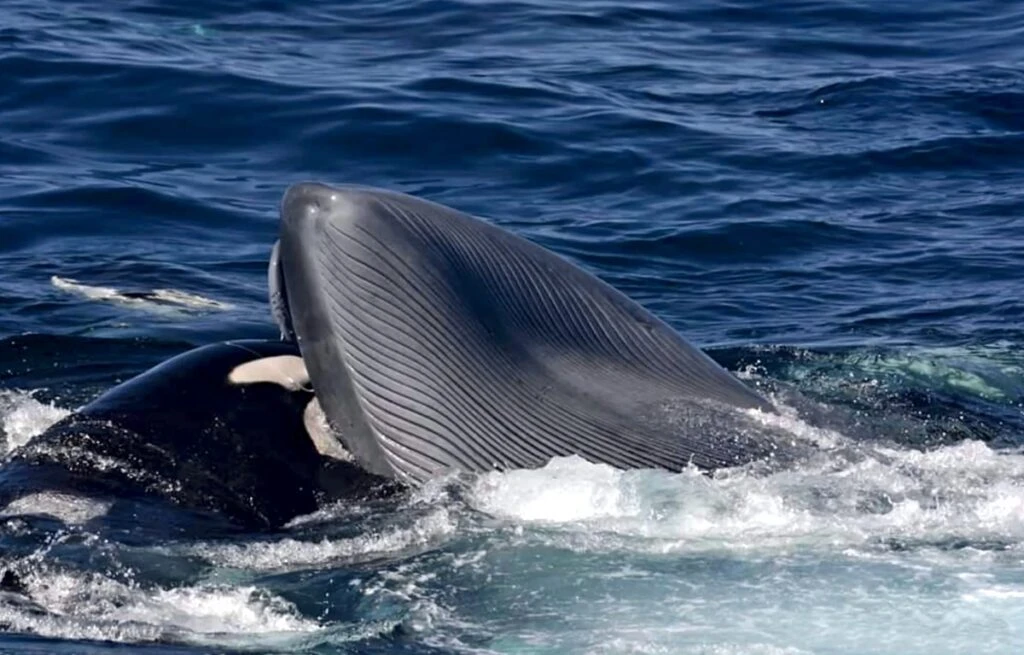
A killer whale climbs into the mouth of a wounded whale.
As you've probably already guessed, such feats require more than just physical strength. A sharp, insightful mind, the ability to communicate with one another, and, surprisingly, a fair amount of imagination are required. It would be strange to expect them to devote such a talent set solely to whaling—the scale is too small. 
Yes, they also attack great white sharks.
Killer whales are simply devilishly inventive when it comes to hunting. Animals from northern populations, for example, are able to drive belugas into ice traps, restricting the animals' mobility. Those from southern populations flip sharks belly-up to confuse them and cause temporary confusion. And captive killer whales lure birds to fish so they can eat them. No, they're not starving; they do this purely for sport. 
Friends, free fish! 
The artist has drawn nonsense, you might say. But I'll tell you that moose in coastal areas can dive for seaweed and sometimes become prey to killer whales. Scientists know of at least one such case.
But their ingenuity is at its best when the animals work in groups. The same pod that defeated a whale can, within a few weeks, engage in driven hunts for small fish. Having spotted a school of herring, the pod circles around, forcing the fish to cluster together, after which one of them dives into the center with its mouth wide open. The hunt continues until everyone has eaten, or the fish are gone. 
But it's practically impossible to pull off such a feat alone.
Wave hunting deserves special mention, as during it, the predators demonstrate perfect synchronicity and a mastery of basic physics. Having spotted an ice floe where several penguins or seals are resting, killer whales may attempt to flush them out. They simultaneously accelerate and pass just beneath the surface of the water, creating a powerful wave. If the ice floe is small, the poor creatures are simply washed into the ocean! 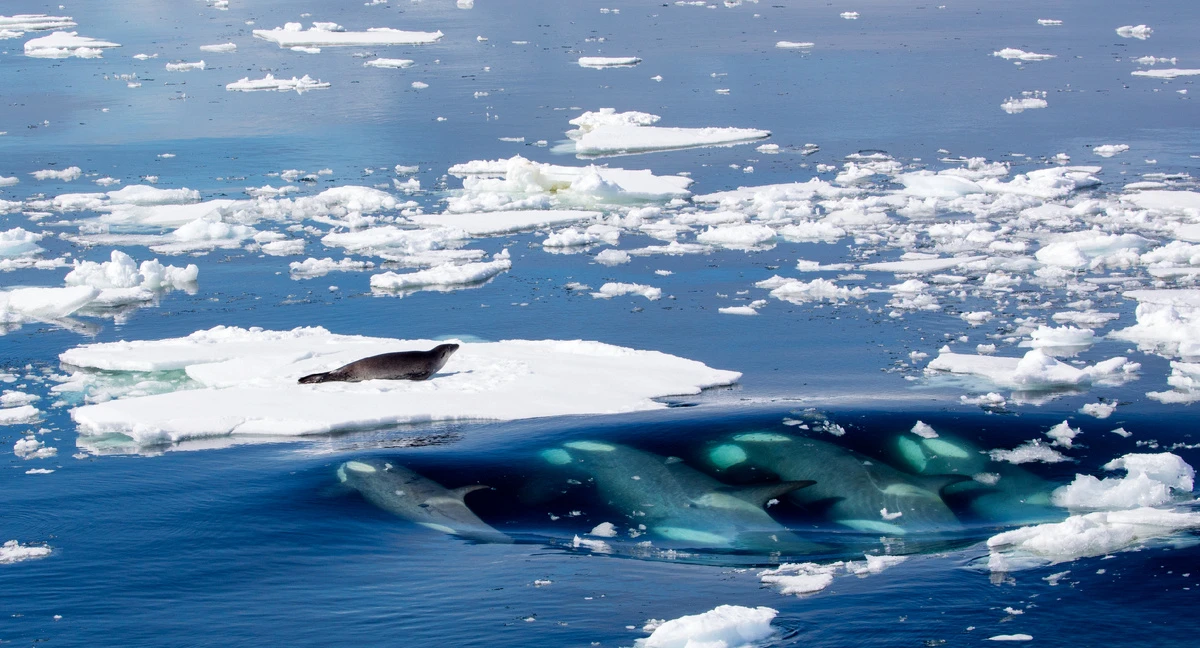
This is what creating these waves looks like.
The list of killer whale hunting techniques is endless; these predators have at least 50 of them. But what's important is that no single population masters all of them. Some groups specialize in large prey, others in smaller ones, while others eat everything but don't possess any particularly sophisticated skills. At first glance, this doesn't seem to favor killer whales, but only at first glance. After all, if you dig deeper, you'll realize that each group of predators has its own distinctive hunting culture—a set of knowledge and skills that are preserved and carefully passed down from generation to generation. Just like humans. 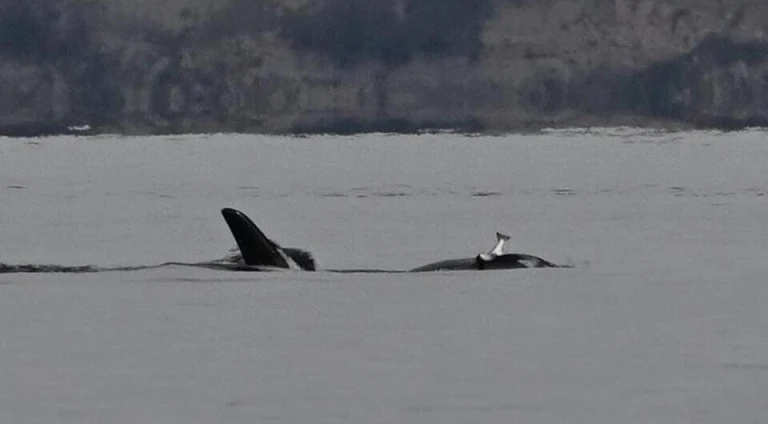
Other strange characteristics also support the existence of killer whale culture. For example, their desire to wear salmon on their heads like hats.