Why the US Uses 110 Volts and We Use 220—and Why America Has Stuck with a "Weak" Outlet for a Century and a Half (8 Photos)
A European electric kettle will usually boil a liter of water about a minute faster than an American one. The reason is simple: it can draw more power from the wall. 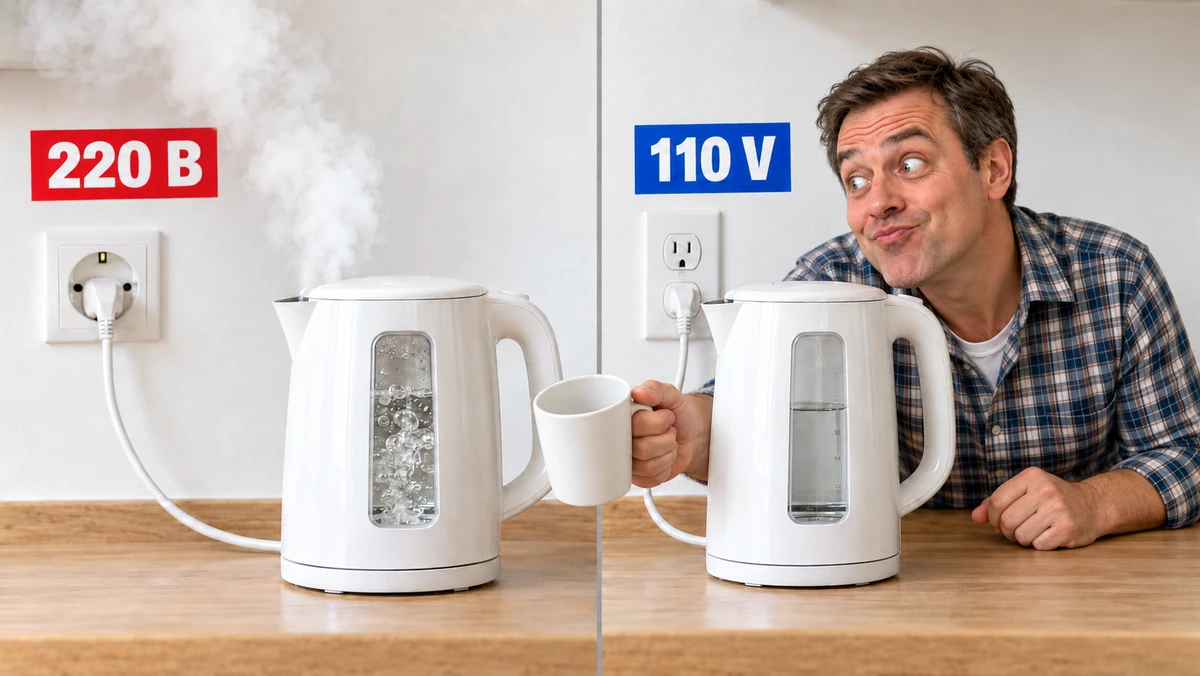
Granted, those familiar numbers are long out of date. Standard outlets in the US supply 120 volts, while ours are nominally 230, though out of habit we still refer to them as "110" and "220." But here is the most interesting part: American homes actually receive a full 240 volts. Half of that voltage is simply directed to lights, TVs, and kettles.
How did this happen, and why stick with a system designed back in Edison’s day?
It All Started with the Light Bulb
In 1882, Thomas Edison launched the Pearl Street power station in New York City. Naturally, it didn't power refrigerators, air conditioners, or microwaves—its primary customer was the electric light bulb. 
Thomas Edison, illustration
Edison’s early grids operated on roughly 100–110 volts of direct current (DC). The carbon filament in his light bulbs was fragile: too high a voltage shortened its lifespan, while too low required higher current and thicker copper wires. According to the Smithsonian Institution, the system was specifically tailored to bulbs operating at around this voltage.
Alternating current (AC) eventually won out, revolutionizing power grids, but American homes weren't rewired overnight. Light bulbs, switches, and other hardware were already being mass-produced for lower voltage. Over time, the standard rose to today's 120 volts, but "110" stuck around in everyday speech.
Even Edison himself quickly realized that transmitting all electricity at such a low voltage would require far too much copper.
Why Higher Voltage Saves Wire
Basic high school physics explains it best. Power equals voltage multiplied by current. To deliver the same power at twice the voltage, you only need half the current. 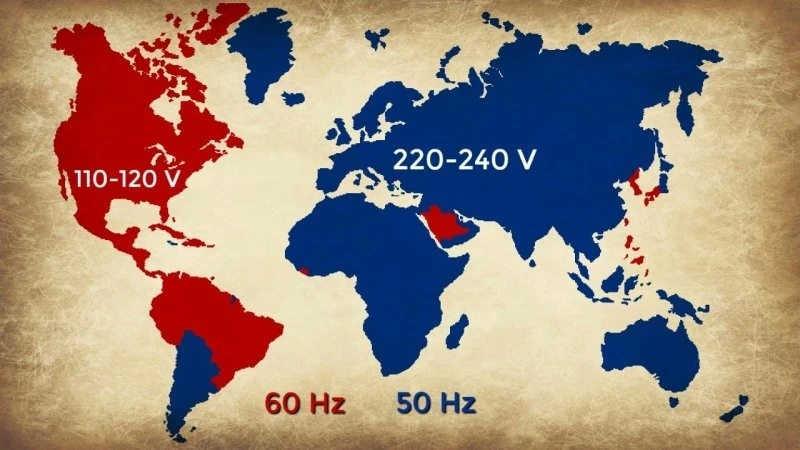
For wiring, that makes a massive difference. Heat loss increases with the square of the current: cutting the current in half reduces heat losses by roughly a factor of four at the same resistance.
In 1883, Edison patented a three-wire system: two sets of lamps operated at roughly 110 volts, while the potential across the outer wires reached around 220 volts. This made it possible to deliver more power while saving on expensive copper.
More than 140 years later, a remarkably similar concept sits inside every American circuit breaker panel.
Where the 240 Volts in an American Home Come From 
A utility transformer typically delivers three wires to a home: two hot wires and a neutral connected to the center tap of the secondary winding. Voltage between the neutral and either hot wire is 120 volts, while voltage between the two hot wires is 240 volts. This configuration is known as split-phase power.
Standard outlets draw 120 volts. Meanwhile, high-draw appliances—like electric stoves, clothes dryers, central air units, water heaters, or EV chargers—get dedicated 240-volt circuits.
So the claim that "America runs on 110 volts" is only half true. For heavy-duty appliances, the US has long used essentially the same voltage as Europe.
Which is one major reason Americans see no need to overhaul their entire electrical system.
Why Europe Chose 220–240 Volts 
Electrification across Europe was less standardized early on, with different cities and utility companies installing grids at varying voltages. Where systems were built later or redesigned, higher residential voltage offered obvious savings on wiring.
Over time, most of Europe settled on 220–240 volts, eventually standardizing to a nominal 230/400 V.
In the Soviet Union, another standard lasted for decades—127 volts—a figure today remembered mainly from antique tube radios and TVs.
Where Soviet 127 Volts Came From
In older three-phase grids, line-to-line voltage was 220 volts, while line-to-neutral was roughly 127. This wasn't a random figure: 220 divided by √3 equals approximately 127. 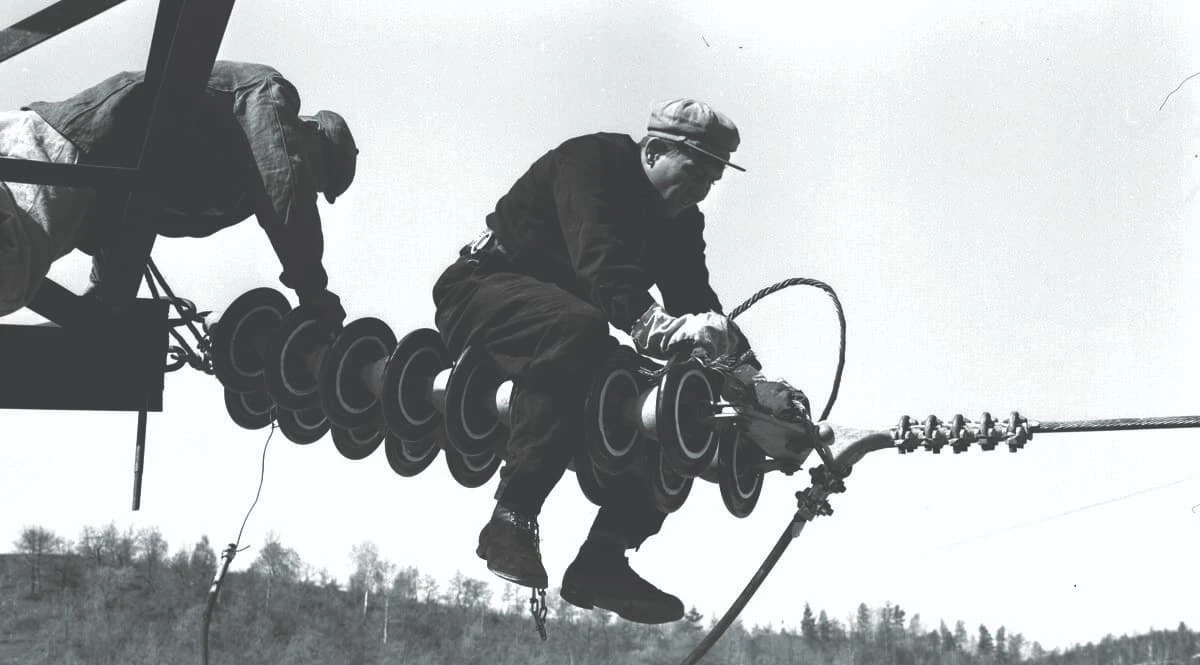
As households filled with refrigerators, irons, washing machines, and other power-hungry appliances, the lower voltage became impractical. Delivering the same wattage required higher current, meaning thicker cabling and greater strain on the grid.
As a result, cities were gradually converted from 127/220 V to 220/380 V. The transition dragged on for years, leaving a legacy of 127/220 V selector switches on the back of old Soviet appliances. Set it wrong after moving, and the smell of hot insulation would alert you to your mistake before you even realized it.
Today, the official standard is set at 230/400 V. Yet "220" is so deeply ingrained in everyday language that it shows no sign of disappearing.
Why American Electric Kettles Are Slower
This is where voltage differences stop being historical trivia and turn into a practical quirk of everyday life.
A typical American 120-volt, 15-amp outlet caps device power at around 1.8 kW, which is why US electric kettles are usually rated at 1.5 kW. In Europe, 2 to 2.2 kW models are standard.
Boiling one liter of water from 20 to 100 °C requires roughly 335 kilojoules of energy. In ideal conditions, a 2.2 kW kettle takes about two and a half minutes, while a 1.5 kW model takes nearly four. In reality, heat loss slows both down, but that roughly one-minute gap remains.
Could you run a high-powered 240-volt kettle in the US? Sure. But nobody is going to run a dedicated 240 V line to the kitchen just for a kettle, when high voltage is reserved for stoves and dryers.
What Happens to a European Hairdryer in the US?
Before traveling, check the label on your device rather than the plug. 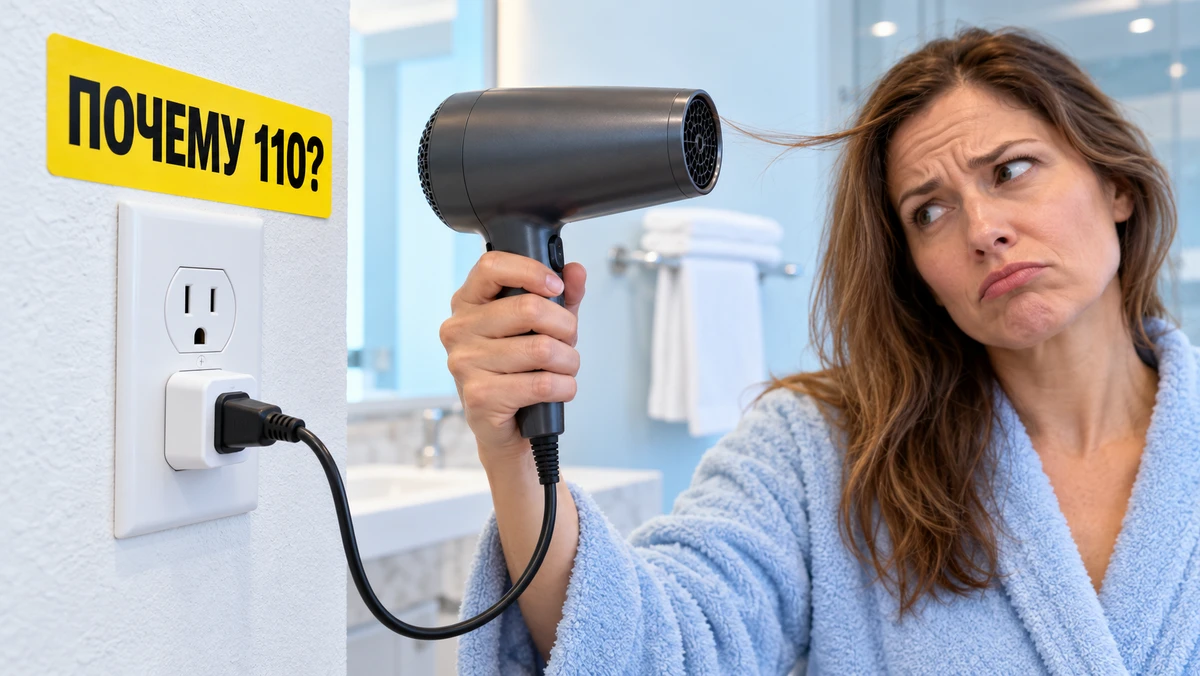
If a charger reads 100–240 V, 50/60 Hz, it will work just as well in the US as in Europe. All you need is a plug adapter. Keep in mind that a simple adapter doesn't convert voltage—it only changes the plug shape.
A hairdryer is a trickier story. If it is rated strictly for 220–240 V, plugging a simple model into an American 120 V outlet will cause the heating element to output only about a quarter of its usual power. It will barely blow warm air, and how the motor and electronics react depends on the specific model's design.
The reverse mistake is far worse: plugging a 120 V-only device directly into a 230 V outlet. For a basic resistive heater, power output quadruples almost instantly—and the experiment will come to a very sudden, smoky end.
That's why seeing "100–240 V" on a label is far more reassuring than having a drawer full of travel adapters.
So Why Doesn't the US Change Its System?
Because in day-to-day life, there's little reason to change. Smaller appliances run perfectly fine on 120 V, while high-draw equipment gets 240 V. Millions of homes and countless appliances are already built around this setup.
Overhauling everything just to get a punchier wall outlet would be astronomical in cost with very little upside. A kettle might boil faster, but stoves, dryers, and AC units are already drawing 240 volts anyway. 
There is another common myth: that 120 volts in the US is virtually harmless. That is simply false. An electric shock from household mains can be fatal under either standard.
Ultimately, the famous "110 vs. 220" debate isn't about which country chose the "right" grid. They are simply two systems that evolved at different points in history, with decades of infrastructure built around those early decisions.
And American 240-volt power hasn't gone anywhere. It's been there all along—just not in the plug you use to boil water.