Lightning-fast Fred Spiksley: British football’s first legend (9 photos)
Fred Spiksley was a football star before the sport became globally popular. He's known for scoring numerous goals, but his biography also boasts many other remarkable moments. Spiksley played in the same theater with Charlie Chaplin, managed to work as a coach on three continents, and cleverly escaped Germany just before World War I. This athlete's life story is worth knowing. 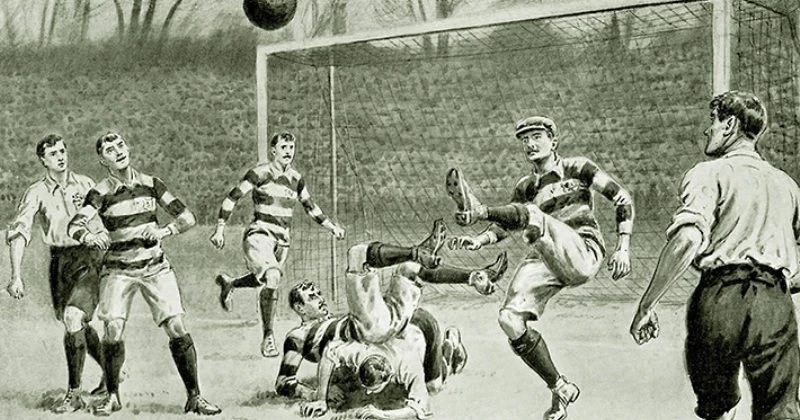
Fred Spiksley was born in 1870 in Gainsborough, Lincolnshire, northern England. His family was unremarkable, certainly not connected to sport. The elder Spiksley worked in a boiler room, and the boy's mother was a housewife. 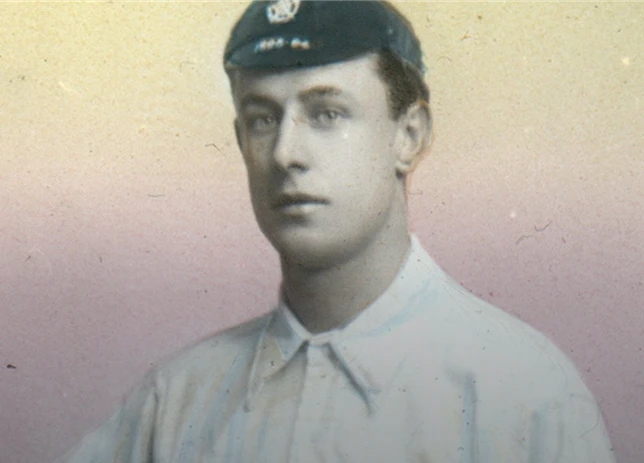
Fred Spiksley
No one could have imagined that the skinny, big-eyed boy would eventually make a name for himself in British football and coach teams in Europe, the USA, Peru, and Mexico. Fred's career began routinely, at a little-known city club, Gainsborough Trinity, whose owners never regretted taking the young player in. His second team was the equally run-down Sheffield Wednesday. It was through Spiksley's efforts that this little-known club gained popularity and achieved national prominence. 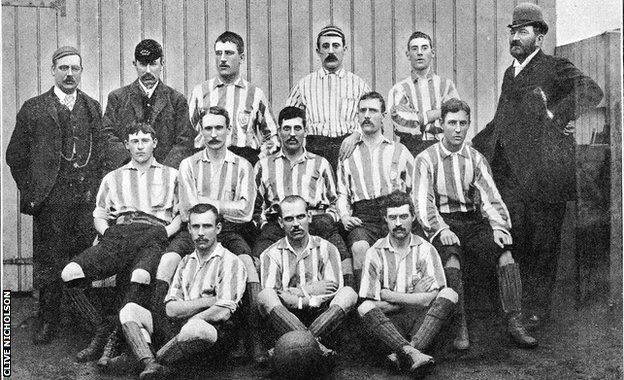
The Wednesday team (Spixley is on the far right in the second row), 1891
Spiksley was incredibly agile in the game. Ernst Needham, captain of the English national team and considered by many to be the best player of the turn of the 20th century, described his style of play:
Our captain told me to move from the left half of the field to the right to stop a break down the left side. I might as well have tried to stop the wind... Fred was incomparable in those days!
Bill Bassett, another famous clubmate of Spiksley's, also described him as "the most lightning-quick player in English football." Fred was an incomparable dribbler, a skill he honed back in the days when, as a boy, he kicked a heavy rubber ball around the cobbles of his native Gainsborough. 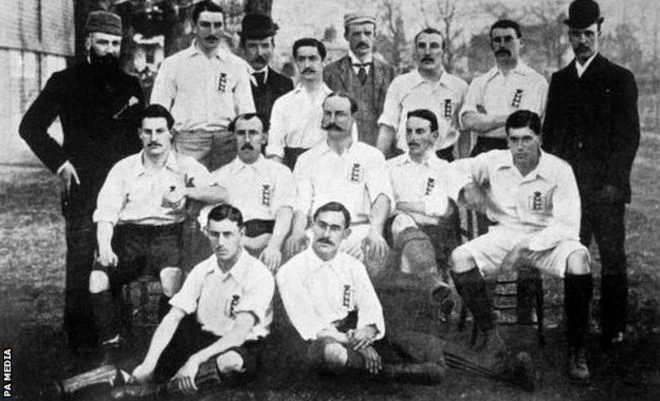
England national team (Spiksley bottom left, 1893)
Spiksley's signature move of curling the ball with the outside of his foot drove opponents to distraction, as they were powerless to counter his style of play. Mark Metcalf, one of the authors of the biography of Fred Spiksley, "One Flew Over the Olive Grove," said of him:
There is reason to consider Spiksley the greatest striker of that period. He was superb in important matches. Read the reports from 1902-1903—he was fast and unstoppable.
Spiksley came to Sheffield Wednesday in 1891, during the club's most difficult period, when it was struggling to break into any British league. Spiksley, who had previously scored 131 goals in 126 matches for Gainsborough Trinity, was a real find for a previously unpromising team. 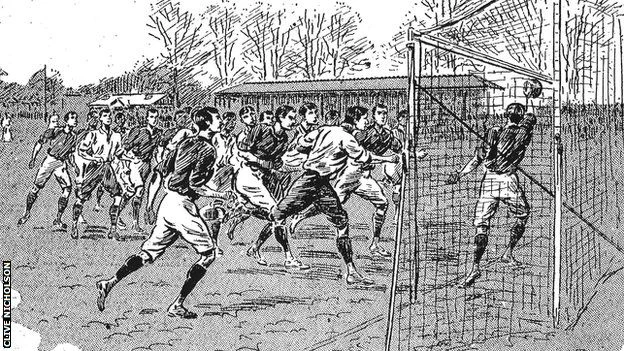
Spiksley scores against Scotland
When Fred left Wednesday, 10 years later, the club was already the reigning League One champions and had already won its first FA Cup. During his career at the club, Spiksley scored over a hundred goals and was a truly happy man. The team's mascot.
After this, Spiksley played for the England national team, where his career was full of ups and downs. Despite this, Fred had no reason to complain – he became famous and earned a good living. After that, he played for Leeds, Watford, and Southern United, but he was unable to fully realize his potential there due to a serious knee injury. Little did Spiksley know how his ailment would come in handy 10 years later, when World War I broke out in Europe.
Unable to play due to health reasons, Fred didn't sit idly by. He joined the circus, where he was immediately noticed by theatrical impresario Fred Karno. He cast him in a sketch called "The Football Match," which was a hit with audiences. To taste. 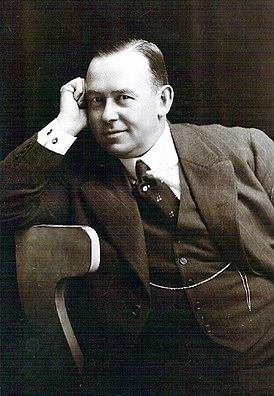
Fred Karno
The sketch described the dramatic, yet no less amusing, story of a rivalry between two football teams. Spiksley wasn't the only athlete in this performance—Karno invited several other ball virtuosos, skilled in performing various spectacular tricks.
Another participant in the sketch was a young Charlie Chaplin. Impresario Fred Karno described the future great actor as "a gloomy, pale, and extremely expressionless man." Karno believed Chaplin would be unable to perform in the theater due to his almost painful shyness. Now we know exactly how wrong the experienced impresario was.
Soon, Chaplin and Spiksley's paths diverged: the great actor went on to conquer Hollywood, while the great footballer left England to promote football around the world. Many sports historians believe that the athlete left his homeland because he was unable to find a coaching position with any major team. 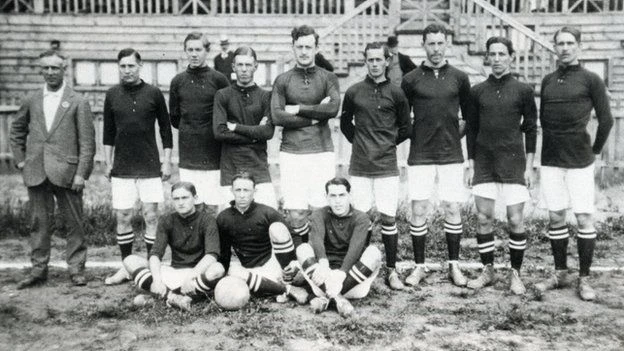
Fred Spiksley (left) with the Swedish national team
He missed out on chances to join Tottenham and QPR, and Watford rejected him due to his gambling addiction. This was no accident – horse racing could be considered Spiksley's second passion after sport. Despite his failures in his native kingdom, the footballer seized his opportunity and became one of the most sought-after football coaches of the early 20th century.
Fred Spiksley taught football in Sweden, Germany, France, Switzerland, Belgium, Spain, the USA, Peru, and Mexico. It was only thanks to his efforts that the Swedish national team reached the international level, and AIK Stockholm became champions. Seventeen years later, another club where Spiksley coached, Germany's FC Nürnberg, achieved success.
The only clubs that showed no interest in Spiksley as a coach were English clubs. At the end of his career, the footballer managed to work for a couple of years at Fulham, but this affected the team's performance. Meanwhile, Spiksley was an undisputed authority worldwide, and his lightning-fast passing and rapid movements attracted a huge following. 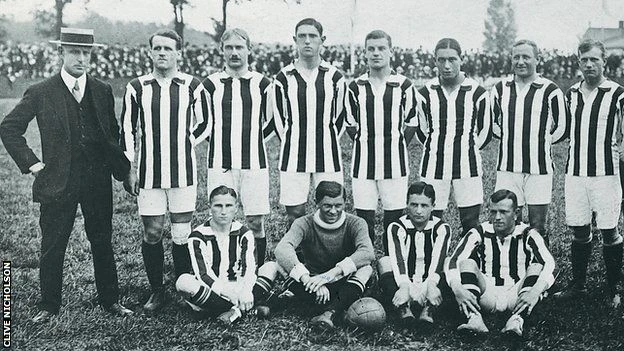
Fred Spiksley (left) and his players from FC Nuremberg
In 1914, before the outbreak of World War I, Fred Spiksley coached the German team FC Nuremberg. When Germany ordered the arrest of all foreigners between the ages of 17 and 45, the 44-year-old coach and his son found themselves behind bars on meager prison rations of water and bread.
Fred's wife, Ellen, managed to secure the release of her husband and son by using his football club and the influence of the American consul. But after their release, the Spiksley family was forced to flee Germany for their homeland, England. There, the footballer faced a new challenge: universal conscription. But in this case, the knee injury that had plagued him his entire life came in handy: a medical commission declared him unfit for military service.
But the war still entered Spiksley's life. To help his country, he worked throughout the war years as a production inspector at a munitions factory in Sheffield. After the war, Fred remained in the city and took his final coaching job at Edward VII School. In 1933–1934, the school team was incredibly successful—the boys won all 20 matches and scored a total of 181 goals. 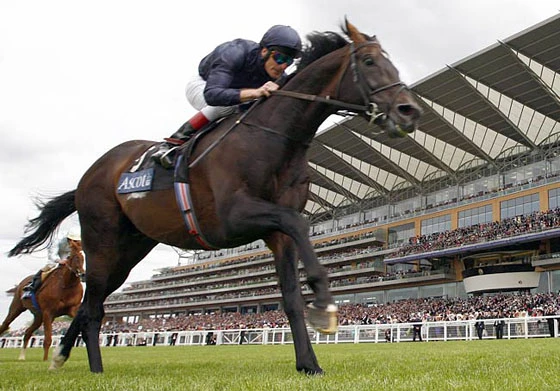
Goodwood Racecourse (present day)
Spiksley could have become England's greatest manager, but he didn't for one simple reason: he suffered from a severe gambling addiction. After football, horse racing was everything to Fred. Sometimes he was lucky and brought home a fortune, but more often, his bets were unsuccessful, and he lost everything. In 1909, he lost so much money that he was declared bankrupt.
A professional's reputation is very important in British society, so the great footballer was viewed with prejudice. After retiring from the sport, Spiksley devoted himself entirely to betting. Even the genius of British football died of a heart attack at the Goodwood races. Eyewitnesses reported that at the moment of his death, the 78-year-old Spiksley was clutching what later turned out to be a winning ticket.