A quasar is a class of astronomical objects that are among the brightest (in absolute terms) in the visible universe. The English term "quasar" is derived from the words "quasi-stellar" or "star-like" and "radiosource," and literally means "star-like radio source."[1] (taken from Ruwiki)
And sorry if there are a lot of letters. 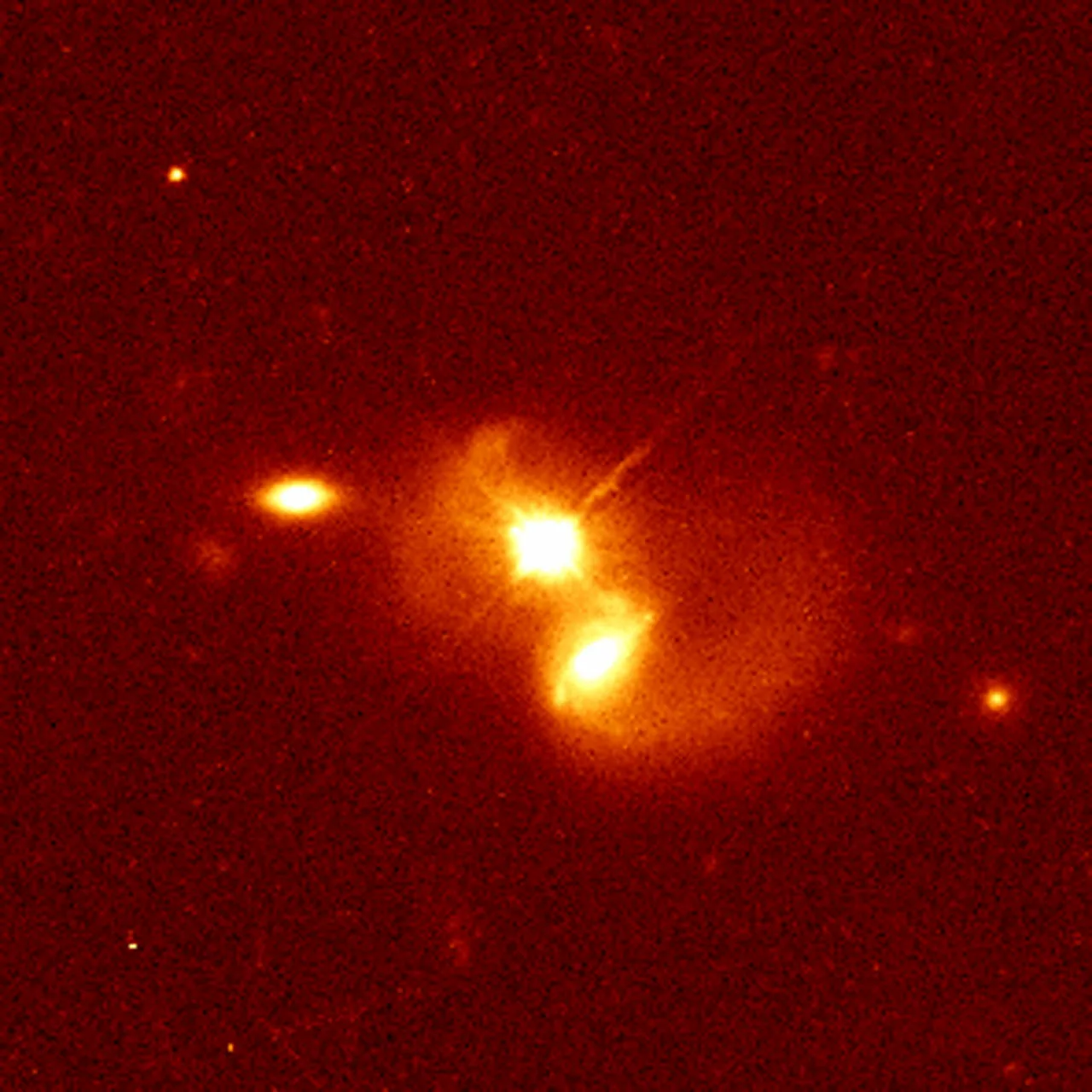
Quasar PG 1012+008
Mysterious Giants of the Cosmos: Modern Quasar Studies
What are quasars?
Quasars are bright point-like objects located at enormous distances from our planet. They belong to the class of active galactic nuclei (AGN) and are powerful emitters of the electromagnetic spectrum, including visible light, X-rays, and radio waves. The name "quasar" comes from the English term "quasi-stellar object," as the first discovered representatives of this class looked similar to stars, although they had a completely different emission pattern.
Historical Background
The Beginning of Quasar History: The Jodrell Bank Radio Observatory Program
The Jodrell Bank Radio Observatory became the launching pad for the study of the mysterious objects that later became known as quasars. This observatory launched a program aimed at determining the apparent angular sizes of radio sources. The results were sensational: the first quasar, now known as 3C 48, was discovered by Allan Sandage and Thomas Matthews in the late 1950s.
However, the real breakthrough came a little later, in 1963, when five new objects were added to the list of known quasars. Even then, it was clear that the researchers were onto something special. The objects exhibited a number of unusual characteristics that remained unexplained for a long time.
Discoveries of 1963: Beginning to Understand the Phenomenon
In the fall of 1963, the distinguished Dutch astronomer Maarten Schmidt made a revolutionary discovery: he demonstrated that the spectral lines of quasars are redshifted. Previously considered incomprehensible, the spectral lines of 3C 48 were soon successfully interpreted as hydrogen and magnesium lines, sharply shifted toward the red end of the spectrum. This redshift meant that 3C 273 was much more distant than previously thought and possessed incredible energy, exceeding the luminosity of a typical galaxy.
At the same time, Yuri Efremov and Alexander Sharov made an important observation: they recorded variability in the brightness of quasars with a periodicity of just a few days. Such dramatic changes confirmed the assumption that the regions generating such intense radiation were small.
Characteristics of the Structure and Behavior of Quasars
One of the key factors that attracted the attention of scientists was the high degree of compactness of quasars. Despite their brightness, comparable to that of entire galaxies, the regions from which most of the radiation emanated were limited to regions on the order of the size of the Solar System. This property emphasized the uniqueness and significance of these objects for science.
Today, scientists have an extensive database of quasars. The nearest and brightest representative of this type of object is 3C 273, with a redshift of z = 0.158, corresponding to a distance of approximately three billion light-years. However, much more distant quasars are also known, located at distances of over twelve billion light-years from Earth.
Determining the exact number of discovered quasars is complicated by a number of factors. Firstly, new such objects are regularly discovered. Secondly, there is no clear distinction between quasars and other types of active galaxies. Therefore, different lists of quasars vary. For example, the Hewitt and Burbridge catalog published in 1987 included 3,594 quasars, and by 2005, a group of researchers reported the existence of a database with 195,000 registered quasars.
These figures demonstrate continuous progress in understanding the nature of quasars and growing scientific interest in these unique objects in the Universe.
The Mechanism of Quasar Luminosity
The main reason for the brightness of quasars is the presence of massive black holes at the centers of their host galaxies. When matter falls toward such a black hole, an accretion disk forms—a rotating layer of hot gas and plasma around the event horizon. It is in this disk that the colossal amount of energy that we observe as a quasar is released.
Furthermore, some quasars emit relativistic jets—narrow streams of particles moving nearly at the speed of light. These jets generate powerful radio emission and are often observed outside the plane of the accretion disk.
Modern Methods for Studying Quasars
1. Studying the Properties of the Central Black Hole
By studying the behavior of photons and particles near quasars, scientists gain insight into the mass, charge, and rotational velocity of central black holes. One way to estimate the mass is by measuring the width of the spectral emission lines of hydrogen and helium, which arise in the hot regions of the accretion disk.
2. Observing Relativistic Jets
Observations in the microwave range allow us to see the formation and evolution of jets by studying the motion of individual components on a scale of fractions of an arcsecond. This provides insight into particle acceleration processes and magnetic field dynamics.
3. Analysis of Intergalactic Space
Because quasars are located far from us, their light travels vast distances through spacetime, colliding with gas clouds and dust structures along the way. Studying the absorption spectra caused by these collisions allows us to determine the chemical composition and density of the medium at different stages of the Universe's evolution.
4. Models of the Structure of Active Nuclei
Current theory suggests that an active nucleus consists of a central body (a black hole), an accretion disk, a torus (a ring-shaped cloud of dense gas and dust), a jet, and a hot corona. Accurately modeling all of these components requires complex calculations and numerical simulations, but technological advances continue to yield new results.
The Future of Quasar Research
The development of observation technology continues at a rapid pace. A new class of giant telescopes, such as the E-ELT (European Extremely Large Telescope) and the LSST (Large Synoptic Survey Telescope), will enable the observation of even fainter and more distant quasars, providing new information about the early stages of the Universe.
Further development of theoretical models should lead to the creation of realistic three-dimensional simulations of galactic core activity, allowing us to predict the physical parameters of quasars and test hypotheses about the nature of gravity and quantum physics.
Quasars play an important role in studying the large-scale structure of the Universe and its origins. Thanks to their powerful radiation sources, they serve as beacons in space, allowing us to map the distribution of dark matter and gases over billions of light-years. For example, researchers use quasars to measure the gravitational lensing effect, which occurs when light from a distant quasar is bent by a nearby mass (usually a galaxy).
Studying quasar redshift variations also helps scientists test models of the expansion of the Universe and identify possible deviations from the generally accepted concepts of dark energy and the Hubble constant.
In summary, quasars remain crucial elements of modern astrophysics. These amazing objects offer us a window into the universe's past, allowing us to glimpse the early stages of its development and deepening our understanding of the fundamental laws of nature. Research continues, and each new observation cycle brings more and more exciting discoveries, bringing humanity closer to unraveling the mysteries of our cosmic home.
Add your comment
You might be interested in:














Persistence in achieving a goal

A biker prevented a hit-and-run driver from escaping

Not everyone is having fun on the amusement ride

17 Photos That Will Stop You in Your Tracks (18 Photos)

The cutest lunch delivery ever

Stunning Views of the Martian Horizon from 400 Kilometers

A book titled "A Guide to Rebuilding

Young women, Dancing and George Michael: nothing superfluous

An apology delivered with a running start
