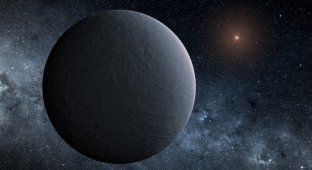
Rogue planet PSO J318.5-22: a space wanderer without a star (2 photos)
Imagine a world without sunrises or sunsets. A world without its own star, forced to drift alone in the icy interstellar void. Such a world is the exoplanet PSO J318.5-22—a cosmic outcast hurtling through the Milky Way. Its discovery took place in 2013. 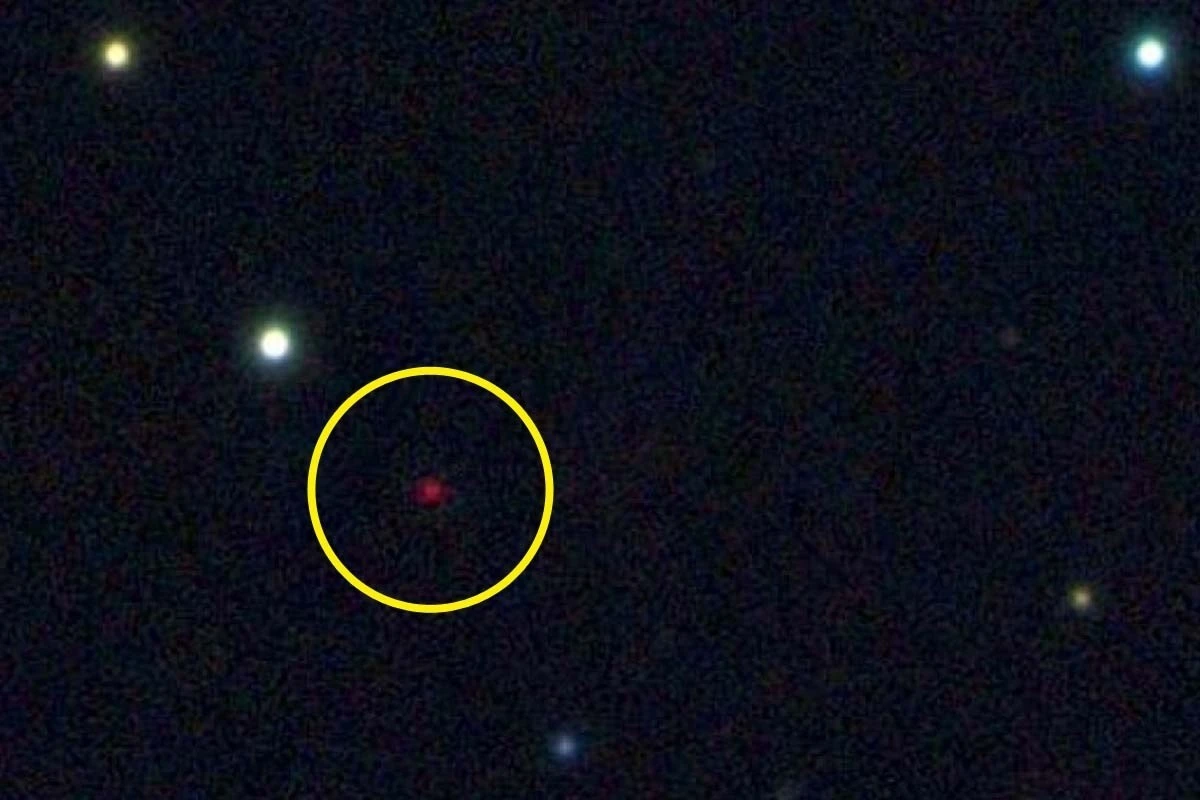
Exoplanet PSO J318.5-22, observed with the ground-based Pan-STARRS-1 telescope
A Planet Without a Home
PSO J318.5-22 is located approximately 80 light-years from Earth—in cosmic terms, almost next door. The exoplanet's mass is 8.3 ± 0.5 times that of Jupiter, and its diameter is 1.46 times that of the largest planet in the Solar System.
This object was once part of a normal planetary system, but gravitational perturbations associated with a more massive planet or companion star ejected it into interstellar space. Now, the young PSO J318.5-22, "only" 23 million years old (of which 12 million years were spent in exile), hurtles through the Galaxy at 25 kilometers per second, with no chance of returning home.
A Hot Planet in a Cold Void
Despite being devoid of the warmth of its parent star, PSO J318.5-22's surface is scorching hot, reaching 830 degrees Celsius—hot enough to melt aluminum. Where does this heat come from?
This world has two heat sources. The first is the residual energy of gravitational compression, inherited from the formation process. The second is the continuous decay of radioactive elements in the interior. PSO J318.5-22 is like a smoldering ember in the icy void of space, slowly but inexorably cooling. 
How was the planet discovered?
Detecting a planet without a star is an extremely difficult task. Astronomers detected PSO J318.5-22 thanks to its infrared glow: it literally glows from its internal heat, emitting in a range invisible to the human eye.
Modern observations suggest that rogue planets are quite common in the Universe. This means their existence is not an exception to the rule, but a common phenomenon related to the dynamics of planetary systems. Modeling suggests that the Milky Way alone could contain billions of such rogues—a gigantic, hidden population of worlds expelled from their home systems and doomed to eternal solitude in the interstellar void.