The concubine who seized China: how Cixi ruled the empire for 47 years from behind the Silk Curtain (16 photos)
She never officially sat on the throne. According to Confucian law, a woman could not govern the state or even appear before officials. But it was Cixi who, for almost half a century, controlled the world's largest empire—from behind a yellow silk curtain, in a hushed voice. History calls her a tyrant and the destroyer of the Qing Dynasty. But that same history fails to mention that it was she who banned footbinding and opened the first state schools for girls. We tell the full biography of the "Dragon Lady"—from the harem to the detective's denouement in November 1908. 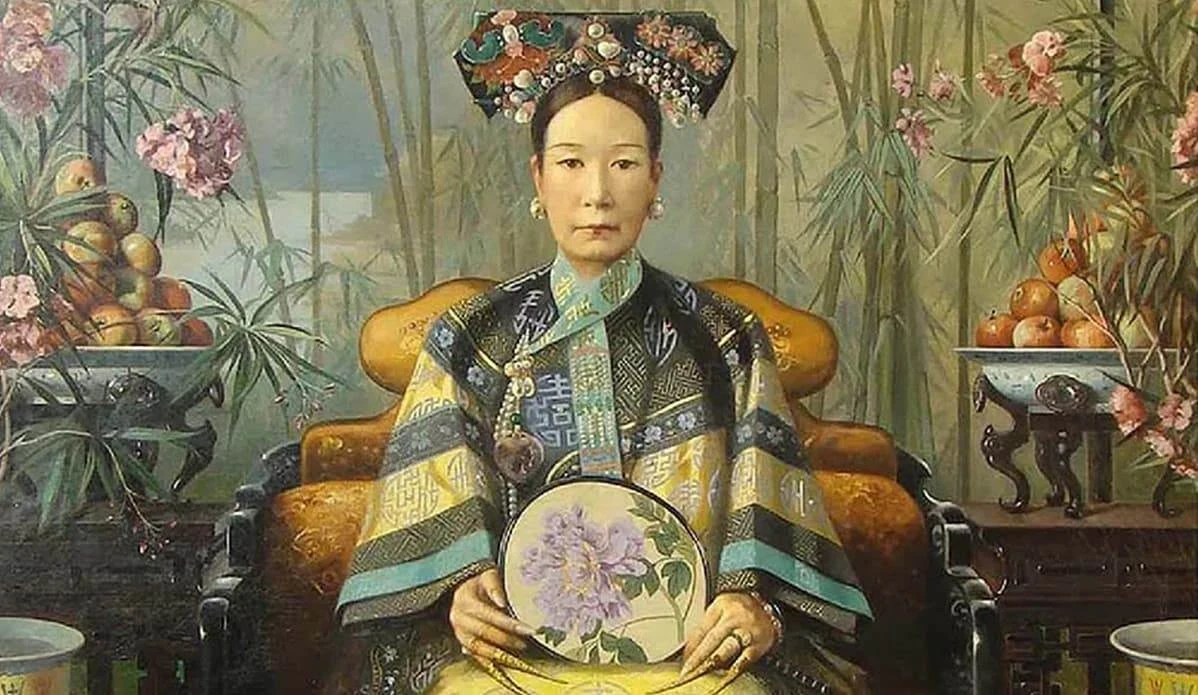
A Lucky Ticket in a Golden Cage
In June 1852, a 16-year-old Manchu aristocrat from the Yehenara clan arrived in Beijing. Her real name was Xing Zhen, which translates as "Apricot Devotion." At court, the girl was known by the simpler name Lanhua—"Little Orchid." After passing a rigorous multi-stage selection process, she entered Emperor Xianfeng's harem with one of the lowest ranks. Her title of guiren—"Precious Person"—meant complete subordination to her senior wives and eunuchs. Of the eight possible steps, she stood sixth from the bottom. 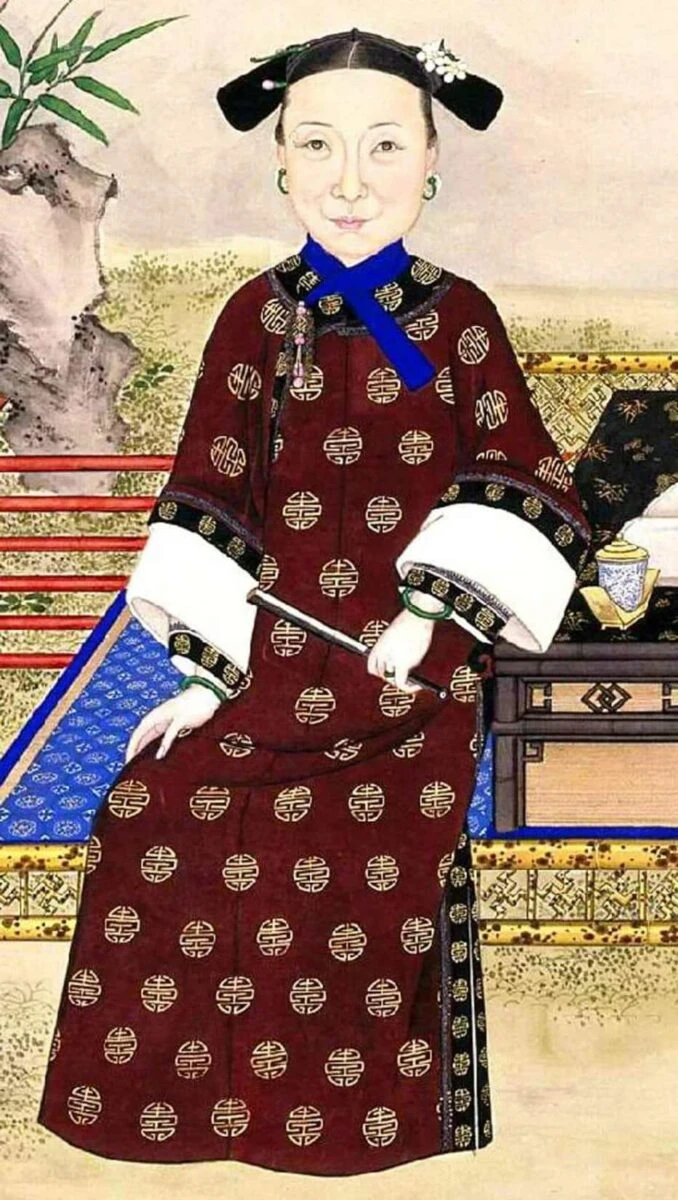
Empress Dowager Cixi. By an unknown court artist. Mid-19th century
The chances of surviving and rising in the Forbidden City were slim to none. It was rife with treachery, conspiracies, and poisoners. But Dowager Cixi had a keen mind, a captivating voice, and phenomenal intuition. A rarity for a woman of that era, she could read and write Chinese. This allowed her to understand government documents. Another trump card was his friendship with Xianfeng's official wife, Empress Ci'an. She was childless. It was she who recommended Cixi to the Emperor as a candidate for the birth of an heir.
Mother of the Heir
In 1856, Cixi gave birth to a boy, Zaichun, the future Emperor Tongzhi. He was Xianfeng's only surviving son. Rumors persisted at court: the child had been born to a servant girl who was immediately killed, and Cixi had merely faked the pregnancy. Be that as it may, the outcome spoke for itself. Her status as the heir's mother elevated her to second place in the imperial hierarchy, immediately after Empress Dowager Ci'an. 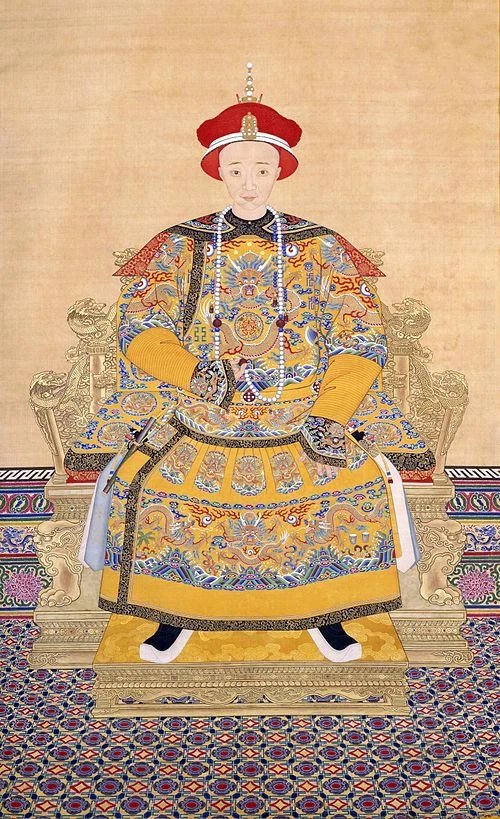
Emperor Xianfeng. By an unknown court artist. Mid-19th century
Gradually, the gravely ill Xianfeng delegated more and more authority to Cixi. In 1860, British and French troops captured and plundered his beloved residence, Yuanmingyuan, during the Second Opium War. The blow was devastating. Shaken, he sank deeper into apathy. Cixi's share of state affairs grew.
A Revolution in Mourning
On August 22, 1861, Xianfeng died. The throne passed to five-year-old Tongzhi. On his deathbed, the emperor appointed a council of eight regents, headed by Sushun. Sushun openly despised Cixi and sought her removal. According to some reports, he urged the dying emperor to force the concubine to commit suicide. She was to "serve the spirit of the deceased ruler in the afterlife." Cixi had little time left. 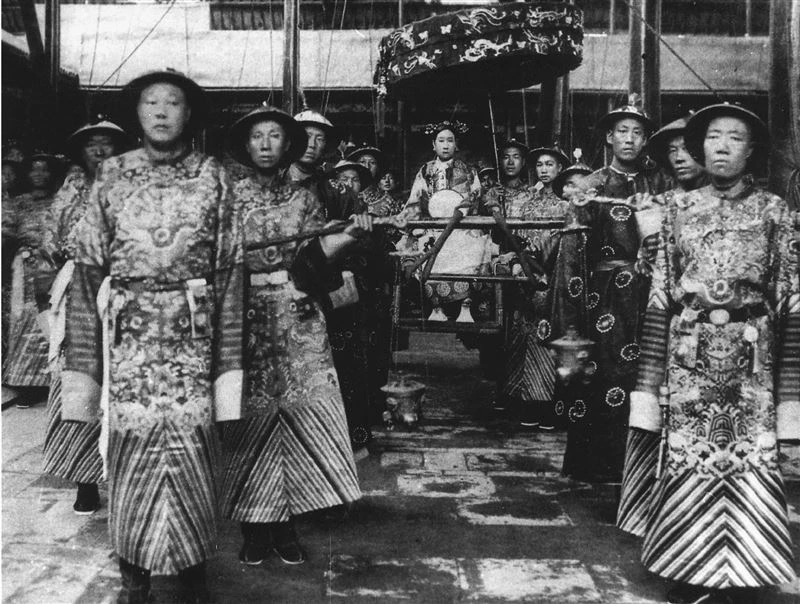
Grand Entrance of the Empress Dowager and the Heir
Cixi was ahead of the curve. Her trump card turned out to be the state seal—it somehow ended up in her hands. Without it, no decree had legal force. Cixi allied herself with Empress Dowager Ci'an and Prince Gong, who himself feared losing influence if Sushun won. Together, they orchestrated a daring coup. Several regents were executed, others forced to commit suicide. Sushun himself was arrested and publicly beheaded. The entire coup took place within weeks. 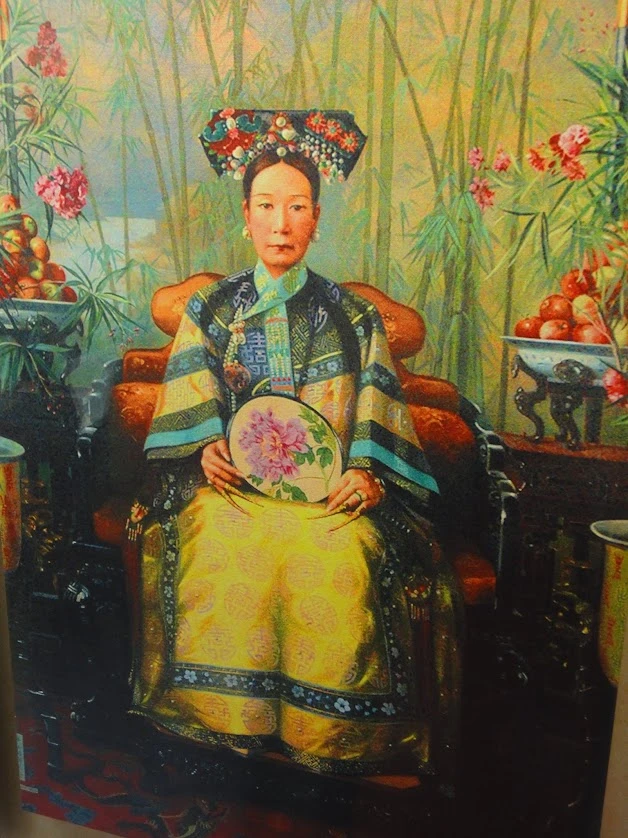
Portrait of the Empress Dowager by the Dutch artist Hubert Vos. 1905
After the coup, the concubine chose a new name for herself—Cixi. Translated as "Merciful and Blessed." From now on, China had two empress dowagers: Ci'an, senior in status but distant from politics, and Cixi, the de facto ruler.
Ruling from Behind a Silk Curtain
Strict Confucian traditions categorically forbade women from directly governing the state or interacting with officials. Cixi found a solution—one that was masterfully inventive. During receptions in the throne room, the young Tongzhi sat before the guests. Directly behind him, a thick yellow silk screen was erected. Cixi hid behind this curtain, whispering decisions to her son, who proclaimed them as the will of the divine ruler. 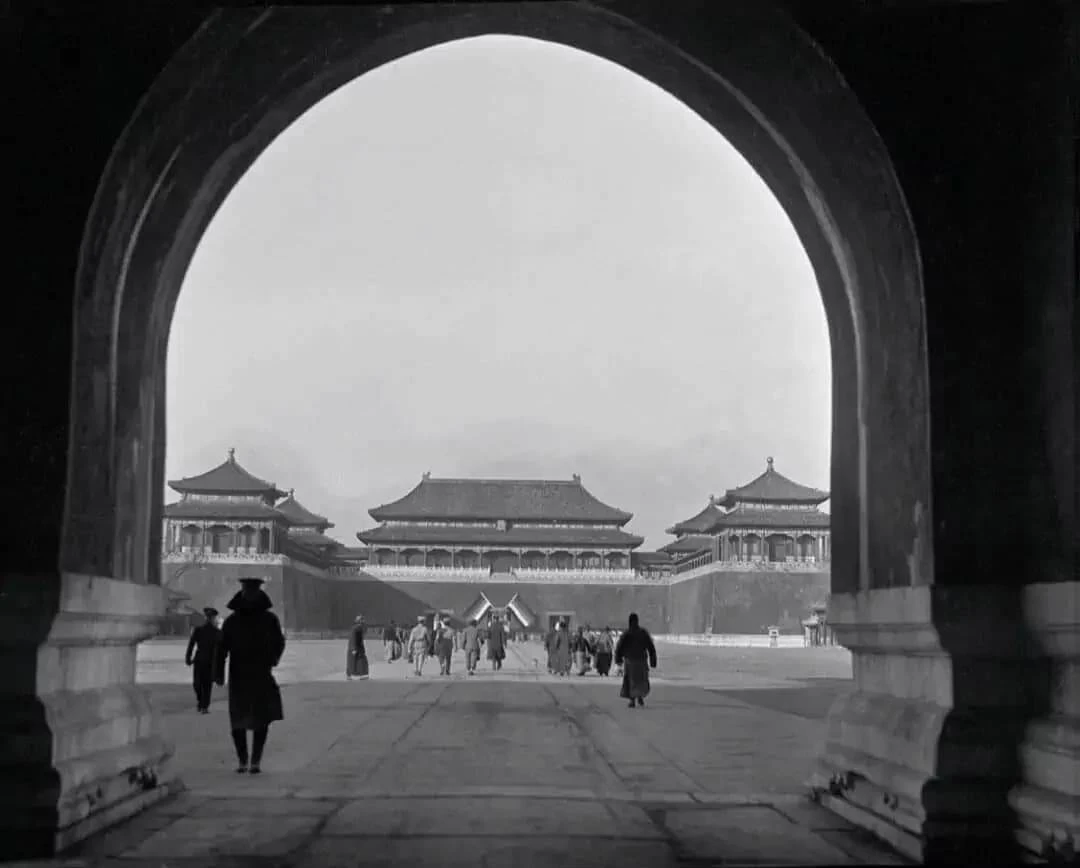
View of the Forbidden City (Gugong) through the Wumen Gate. Early 20th century
This "rule from behind a silk curtain" became a symbol of her unique political style—and lasted for nearly half a century. Formally, Cixi "retired" several times—when Tongzhi came of age in 1873, and again in 1889, when Guangxu came of age. In essence, however, power never left her hands.
A Grandmaster of Survival on the Throne
At 17, Tongzhi officially became emperor. Cixi formally renounced the regency, but in essence, nothing changed. The young ruler showed no interest in state affairs. He was drawn to alcohol, opium, gambling, and Beijing's brothels. According to some accounts, it was there that he contracted syphilis. In late 1874, the disease, combined with smallpox, took his life. Tongzhi was 18 years old. 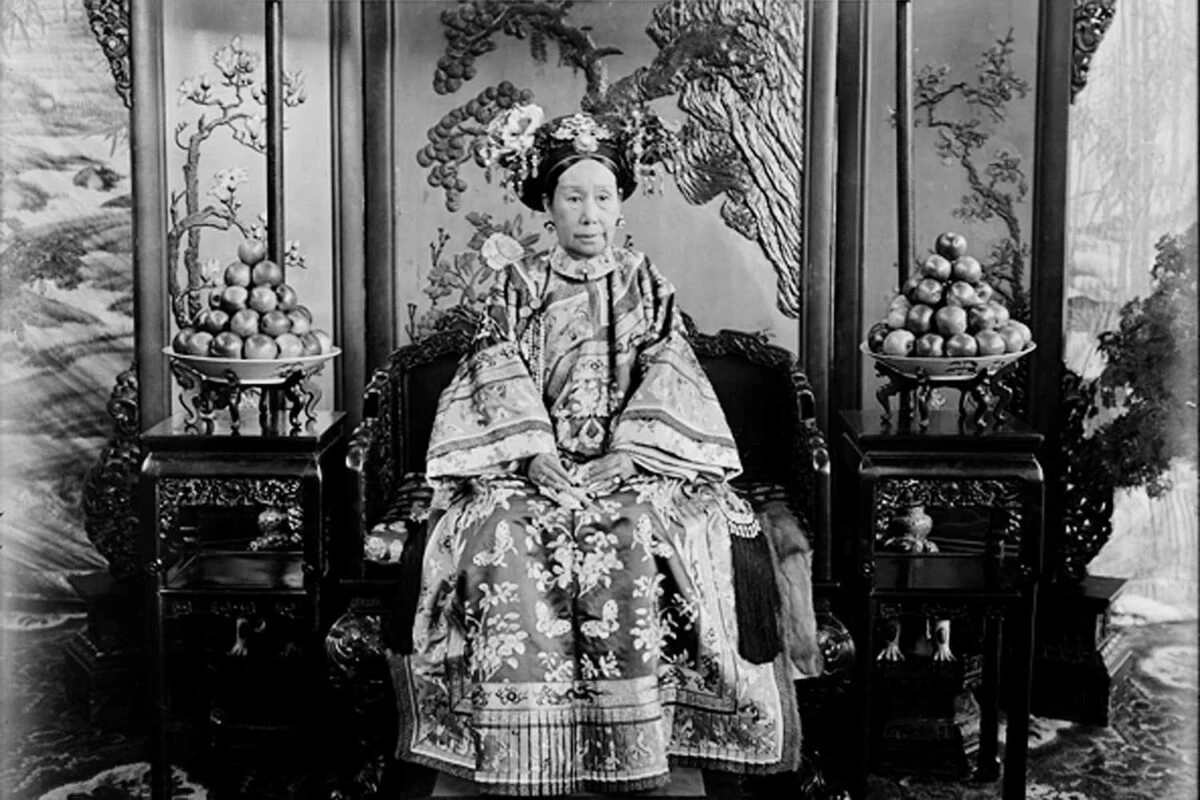
Cixi. 1880s
After the death of her son, Cixi violated centuries-old laws of succession. By tradition, the new monarch had to belong to the next generation—so that he could perform sacrifices in honor of the deceased. Cixi chose four-year-old Zaitian. He was the son of her full sister Wanzhen by Prince Chun. In one move, she both retained the regency and strengthened her lineage in the imperial line. Zaitian ascended the throne under the name Guangxu—"Glorious Succession."
Wars, Rebellions, and a Humiliating Peace
The first decades of Cixi's regency were brutal. Southern China was in flames—the Taiping Rebellion claimed between 20 and 30 million lives. Under her rule, the rebellions of the Nianjun, Chinese Muslims, and Hmong were suppressed. In 1884–1885, the Qing lost to France in the Vietnam War. In 1895, a humiliating defeat followed at the hands of Japan, a country traditionally considered a junior power in China. By the Treaty of Shimonoseki, China lost Taiwan and the Liaodong Peninsula. The indemnity was colossal. Many blamed Cixi for the failure: shortly before the war, she had spent naval funds on the reconstruction of the Summer Palace. 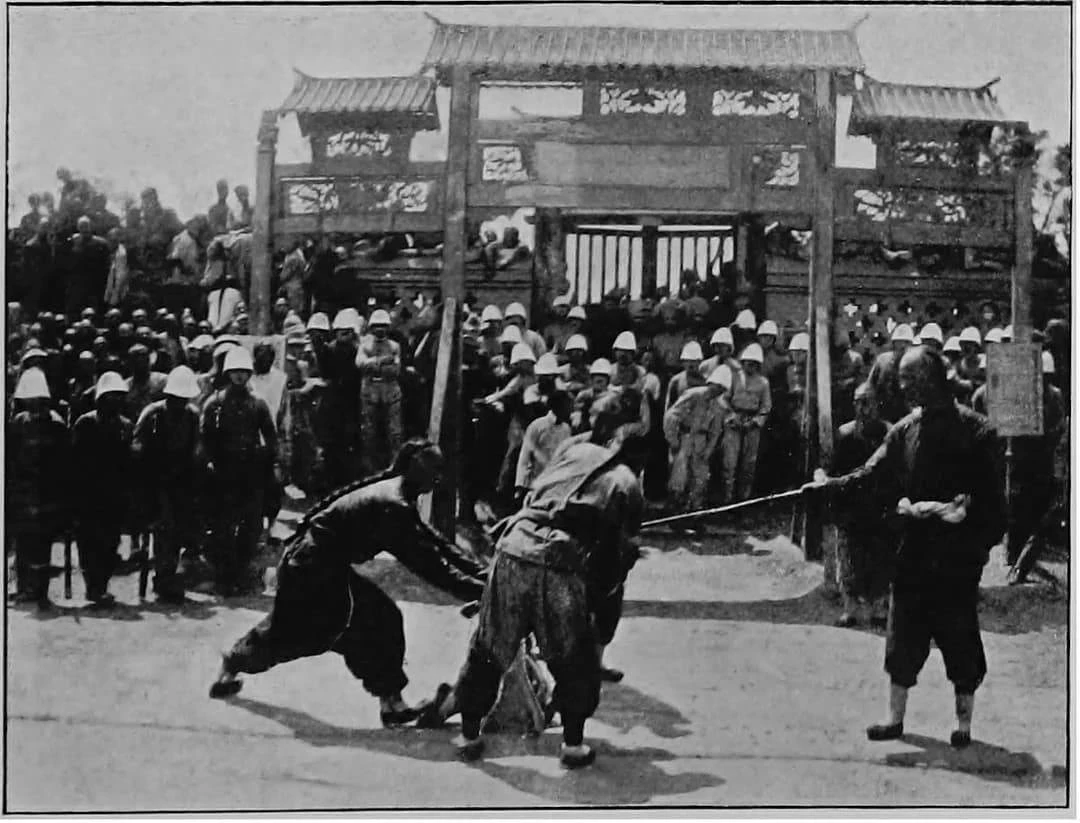
Beheading of the Boxer Rebellion after the suppression of the Boxer Rebellion
At the turn of the 19th and 20th centuries, the Boxer Rebellion broke out. The Boxer Rebellion movement was directed against foreign domination. Cixi initially supported them. In May 1900, she declared war on eight foreign powers at once. The siege of the Legation Quarter in Beijing lasted from June 20 to August 14. About nine hundred foreigners and three thousand Chinese Christians took refuge there. When coalition forces entered the capital, Cixi fled—according to some sources, disguised as a peasant. The Western press greeted her escape with venomous caricatures. 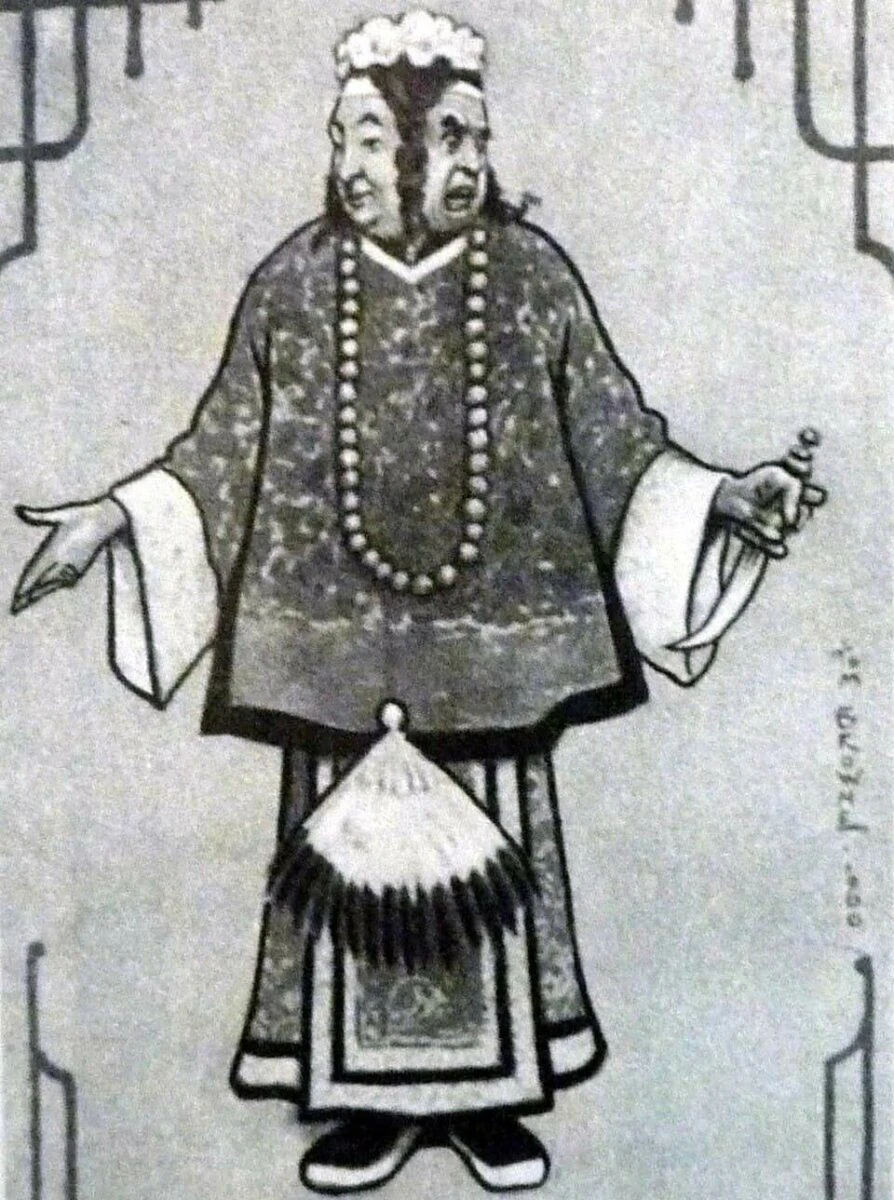
The Two-Faced Empress Cixi. Caricature from the Early 20th Century
But Cixi returned. She signed the "Protocols of the Boxer Rebellion" of 1901. The indemnity to foreign powers amounted to 450 million taels of silver—a humiliating sum. She still retained the throne.
Invisible Modernization
The West portrayed Cixi as a caricatured, archaic monster, resisting any progress. The historical reality turned out to be far more complex. It was this "ossified" ruler who initiated reforms that forever changed China's social landscape. 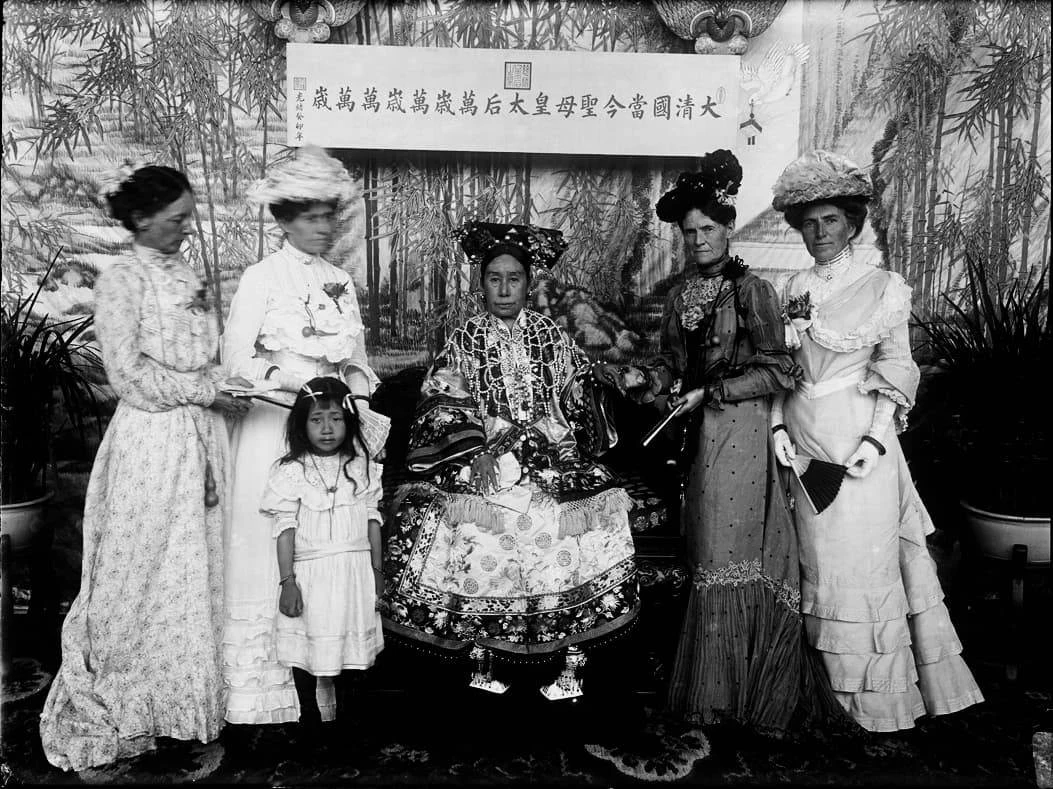
Empress Cixi with the wives of European diplomats
After the humiliation of the Boxer Rebellion, Cixi decided on reforms similar to those attempted by Guangxu several years earlier. She abolished the civil examination system, which had existed for over a thousand years, and opened modern schools based on the Western model. She sent students to study abroad. She began work on establishing a constitutional monarchy, although she did not live to see its completion.
Her role in relation to women deserves special attention. In 1902, Cixi issued an edict condemning the centuries-old custom of footbinding for girls. It's important to understand: the tradition of footbinding, which turned feet into disfigured "golden lotuses," had existed for about a thousand years by that time. The Manchu women themselves, to which Cixi belonged, never did this, so the edict was primarily a political gesture. The first state schools for girls were opened at court. 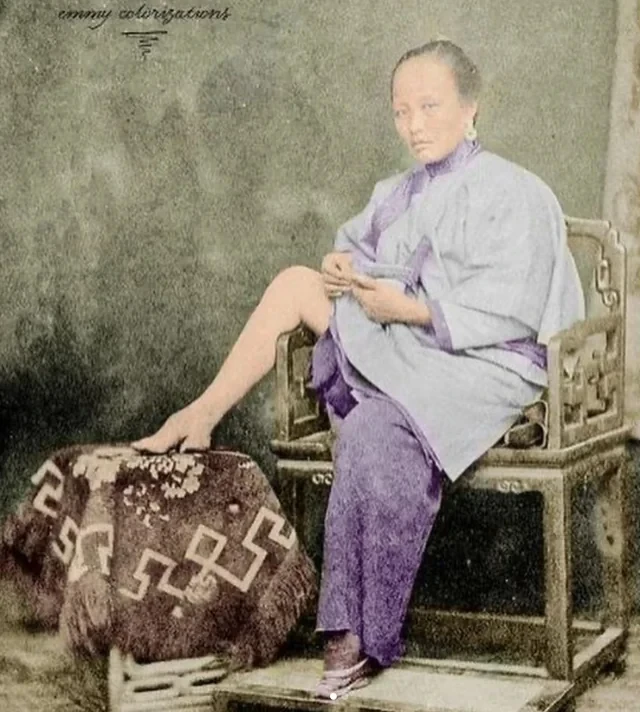
The practice of footbinding persisted in China for about a thousand years, right up until the 20th century.
One persistent myth is that Cixi secured government scholarships for those very same students, among whom were the future wives of Sun Yat-sen and Chiang Kai-shek. In reality, the Soong sisters – Qingling (Sun Yat-sen's wife) and Meiling (Chiang Kai-shek's wife) – studied in the United States at the expense of their wealthy father, businessman Charlie Soong, and not through Cixi's government program. These are different stories. Cixi's reforms in female education were real and significant in themselves – even without this addition.
A Hundred Days of Reform and the End of Illusions
Cixi's relationship with her second ward, Emperor Guangxu, degenerated into a true personal tragedy. As an adult, the young ruler attempted to escape his aunt's total tutelage. In 1898, he initiated the "Hundred Days of Reform"—a large-scale attempt to modernize the country along the lines of Japan's Meiji Revolution: reorganizing the army, reforming the examination system, and introducing machine production. 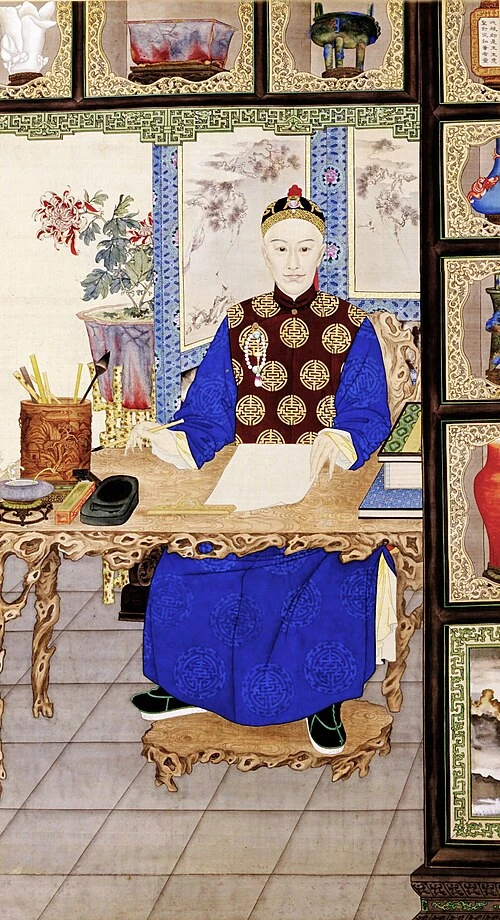
Emperor Guangxu. By an unknown court artist. Circa 1900
Cixi viewed this as a threat to her power. With the support of loyal military personnel, she staged another coup. The reforms were reversed. Guangxu was placed under lifelong house arrest on an isolated island in the middle of a lake within the Summer Palace. According to one version, Cixi ordered his favorite concubine, Zhen Fei, to be drowned in a well in 1900, suspecting her of contacts with foreign powers. Guangxu emerged only during obligatory ritual prayers. The rest of the time, he was obliged to prostrate himself before his aunt. 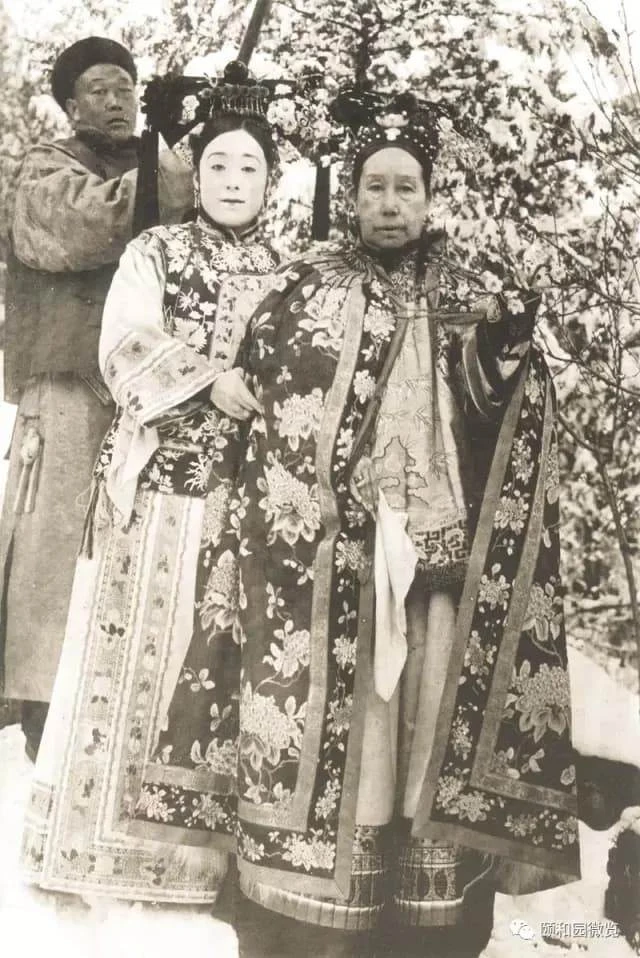
The Empress taking a walk. One of Cixi's last photographs. 1907
A detective-style ending
The denouement came in November 1908. On November 14, 37-year-old Guangxu died suddenly. The following day, 72-year-old Cixi died in the Summer Palace. For a long time, the deaths of both on the same day was considered a tragic coincidence. But in 2008, Chinese researchers published the results of an analysis of the emperor's remains: arsenic levels in his bones were thousands of times higher than normal. This was consistent with poisoning. Before her death, Cixi ordered her nephew's death—she could not allow a weak-willed ruler to wait until her death to try to change the country's course. 
The Summer Palace in Beijing—the empress's final residence
Cixi's successor was two-year-old Pu Yi, the grandson of one of her trusted military commanders, Ronglu. Three years later, in 1912, he would abdicate, and the three-hundred-year-old Qing Dynasty would come to an end. The very power Cixi had wielded for nearly half a century outlived her by only four years.
The Double Bottom of History
Today, Cixi appears before us in a wealth of visual images: in ceremonial oil portraits by the American Hubert Vos (1905), in archival photographs of the Forbidden City, and at the walls of the majestic Ding Dongling Tomb. In 1928, this tomb was plundered by General Sun Dianying's troops: Cixi's remains were thrown out of the coffin, and her jewelry was stolen. Puyi later ordered her reburial. 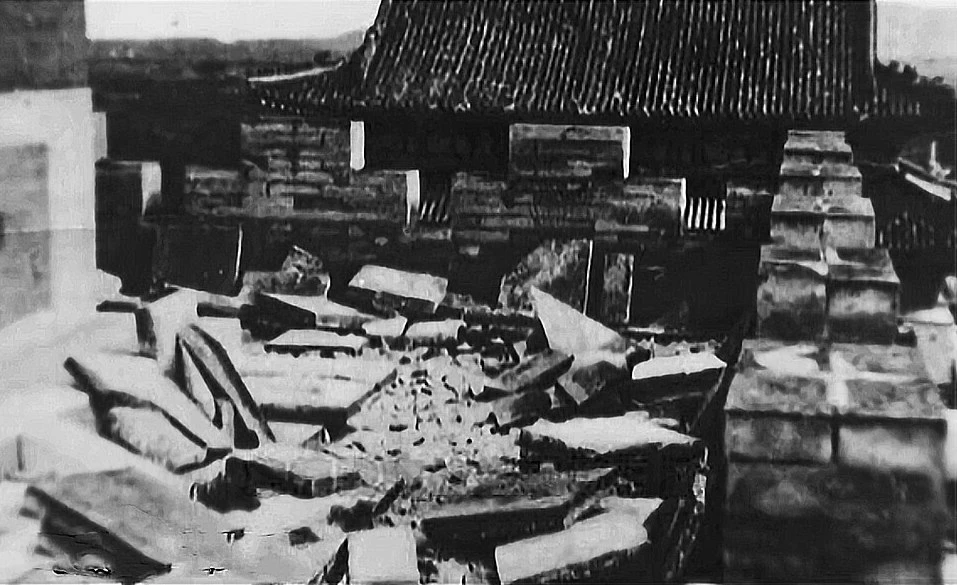
Cixi's tomb after the looting in 1928
Cixi's biography is a striking example of how patriarchal history treats strong women. Male rulers, for their similar sternness and pragmatism, are called "Great." Western authors have branded Cixi a treacherous witch, while historians of Communist China and Kuomintang Taiwan have labeled her a tyrant who destroyed a dynasty. Meanwhile, she ruled a fading empire during a time of global upheaval, kept the country from disintegrating, and, according to some Western diplomats of the time, was "the equal of Catherine the Great and Elizabeth I." 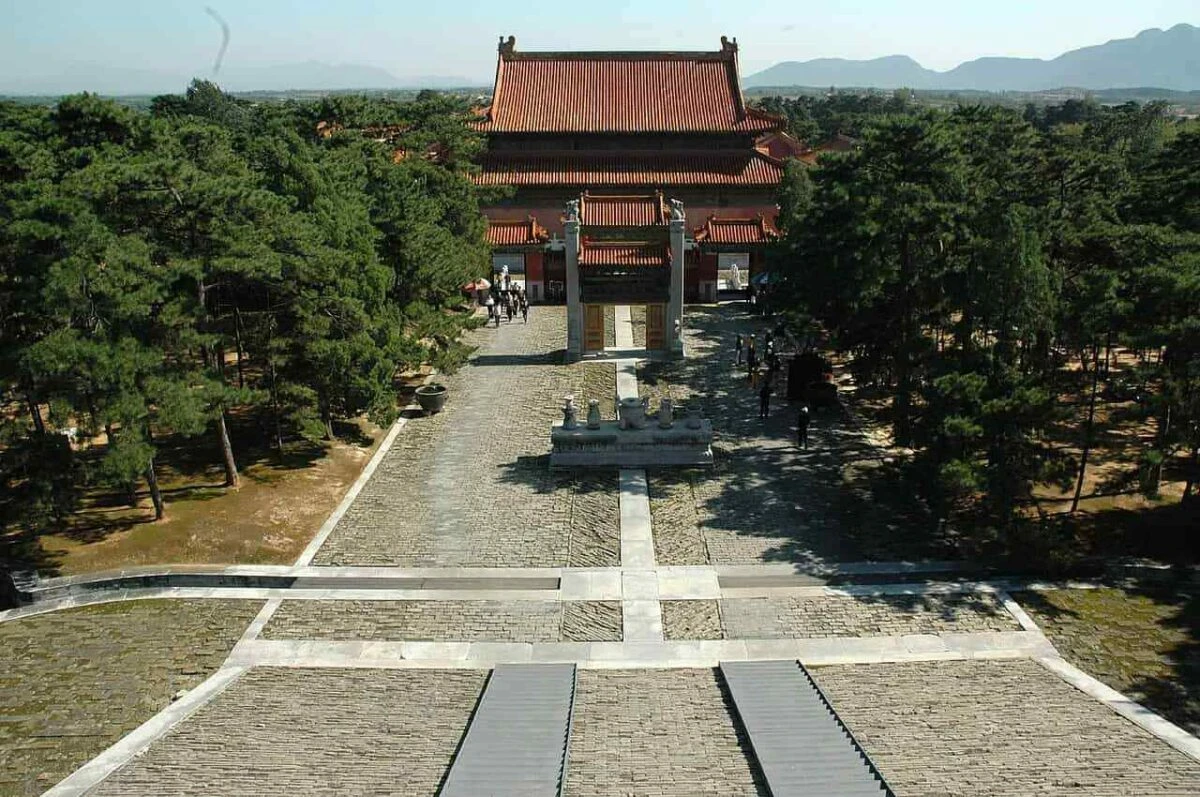
The Imperial Funeral Complex after restoration
The fate of Cixi prompts reflection on the nature of power and the price paid for it. Who was she really: a cruel tyrant who hastened the demise of a dynasty, or a brilliant politician who held back the collapse of a great empire for decades? Has history treated the image of the "Dragon Lady" fairly—and can harsh methods be justified by lofty goals? Share your thoughts in the comments.